
Summary
- The 15 January 2022 eruption and associated seabed disturbance damaged Tonga's international and domestic submarine cables. The natural event was not within the control of Tonga Cable Limited, the Government of Tonga or the country's telecom providers. Accountability starts instead with the continuity arrangements that institutions could influence before and after the physical break.
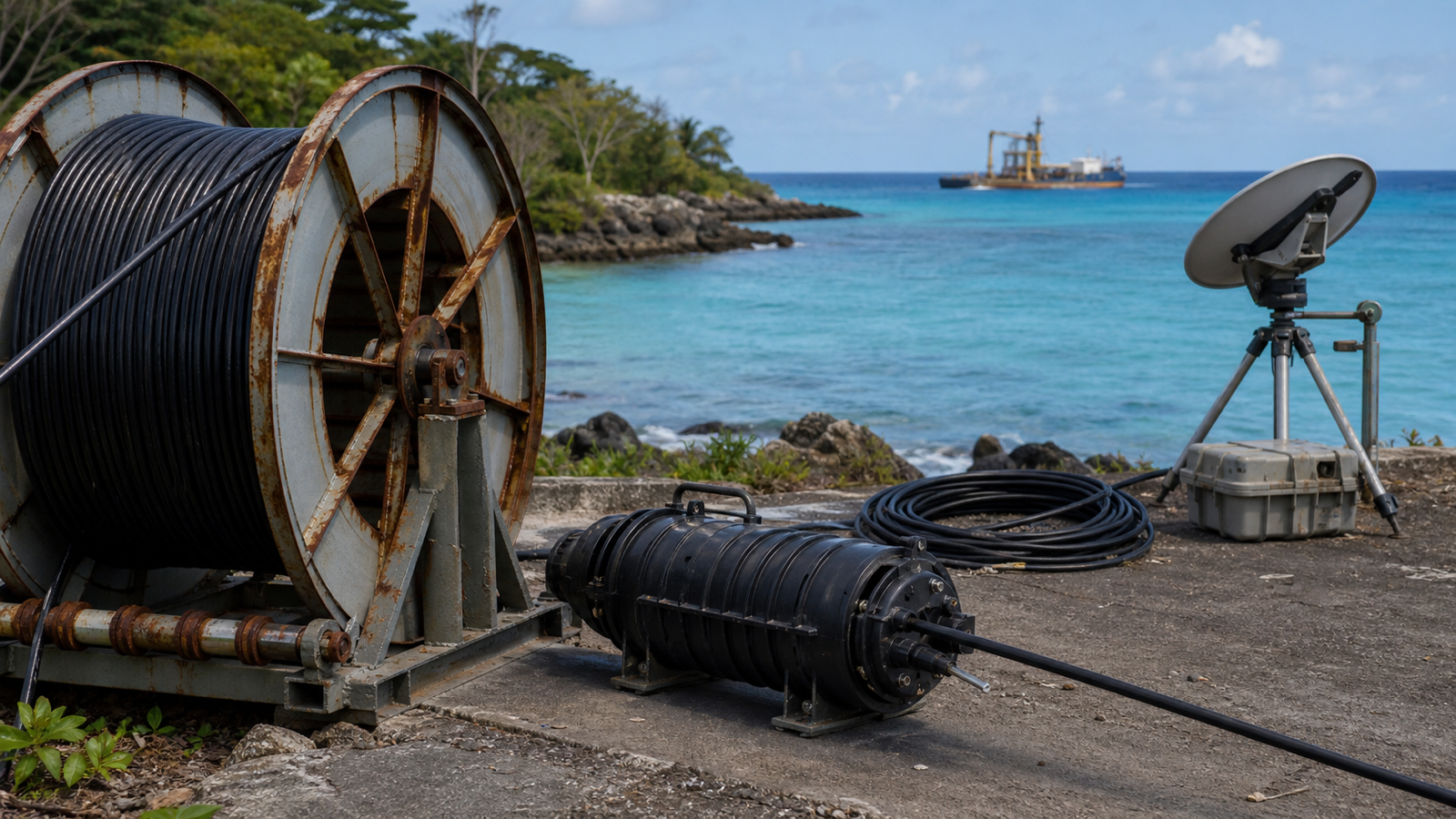
- Tonga had one international submarine fibre route, an 827-kilometre connection to Fiji. The cable had delivered major development gains since 2013, including much more international bandwidth and lower prices. Its success also meant that normal national connectivity depended heavily on one high-capacity path whose satellite substitutes could preserve selected communications but not ordinary public demand.
- The international route returned on 22 February 2022 after a measured 37-day disconnection. Tonga Cable and its partners had to mobilize CS Reliance, obtain equipment and spares through regional cooperation, wait for safe operating conditions and repair a section that public accounts described as roughly 90 kilometres damaged or buried. Those facts make vessel access, cable compatibility and spare-sharing part of the continuity design.
- The domestic cable exposed a much longer restoration tail. Tongatapu regained high-capacity international service first, while Ha'apai and Vava'u remained dependent on limited satellite and microwave links. Compatible domestic cable had to be manufactured in France, shipped to Samoa and collected by an available vessel. The marine repair took eight days once CS Lodbrog arrived, but service did not return until 12 July 2023.
- A post-event study examined cable and satellite redundancy, and a second international cable branching from the Hawaiki system to Vava'u was completed in May 2026. That outcome proves that geographic diversity was a practical control surface. It does not prove that the same project was affordable, approved or deliverable before January 2022, and it does not answer every question about fallback capacity, domestic resilience or repair readiness.
A development success became a national dependency
The most important fact about Tonga's communications failure is not the spectacle of the eruption. It is the topology that existed when the seabed moved. Tonga entered 2022 with one international submarine fibre route carrying its normal high-capacity connection to the global Internet. When that route failed, the International Telecommunication Union described the country as cut off from most Internet services because the only submarine cable on which it relied had been damaged. [1]-[3]
That concentration did not begin as an obvious policy failure. The Tonga-Fiji cable was a development achievement. Commissioned in August 2013, the 827-kilometre system connected Nuku'alofa to Fiji and onward through the Southern Cross network. The Asian Development Bank, the World Bank, Tonga Cable and the Government of Tonga financed and implemented a project intended to replace expensive, constrained satellite dependence with affordable broadband. The project later extended domestic fibre from Tongatapu to Ha'apai and Vava'u. [12]-[15]
The benefits were substantial. The World Bank reported that the regional connectivity programme had benefited more than 101,000 people by its 2018 close, including close to 20,000 people in Ha'apai and Vava'u. It said available international bandwidth had risen 118-fold to 4,400 Mbps, average retail broadband prices had fallen by 97 percent and a 1,217-kilometre submarine network connected the country internationally and domestically. Those figures are project results, not a measure of 2022 outage losses.
Their relevance is that Tonga's economy, public administration, education, health services, businesses and families had good reasons to reorganize around the capability the cable provided. [15]
Infrastructure success can therefore increase continuity obligations. A new road, power link or fibre route creates value partly because people stop using slower substitutes. As dependency grows, the question changes from whether the asset is useful to what happens when it is unavailable. The original project addressed several resilience dimensions at the landing station, including physical protection, flood-aware equipment placement and backup power. Public project records also document financing, implementation and regulatory development.
They do not establish that a second geographically independent international route or cable-equivalent standby capacity existed before 2022. [12]-[14]
That distinction prevents two opposite errors. The first would be to call the original cable a mistake because it later broke. Satellite links had severely constrained access, and fibre delivered broad public benefit. The second would be to treat those benefits as evidence that the continuity design was complete. A system can be successful in ordinary operation and still expose a country to a single-route failure. Redundancy is not a criticism of the primary route; it is a recognition that the route has become important enough to need an independent failure path.
The accountability case follows directly from that network fact. Remove the submarine-cable topology and the argument disappears. Tonga's harm was not merely that a disaster made online activity inconvenient. The country's normal international reachability depended on one physical route, substitutes did not provide equivalent public capacity, repair required scarce marine assets, and outer islands stayed constrained long after the international section returned. Route concentration, fallback capability and restoration logistics are the causal link between the network failure and the continuity test.
The eruption was uncontrollable, but the exposure was visible
No operator, ministry, donor or repair contractor caused the Hunga Tonga-Hunga Ha'apai eruption. The eruption and tsunami were extraordinary natural events, and the evidence does not assign institutional responsibility for them. The World Bank's rapid damage assessment estimated US$90.4 million in direct damage across the disaster and described severe communications disruption, but that total covers the wider event. It cannot be presented as a loss caused by the cable outage. [6], [7]
The physical trigger and the institutional exposure must be separated. The trigger was the eruption and associated seabed disturbance. The exposure was a national communications system with one international fibre route and limited substitute capacity. Duration was then shaped by another set of conditions: how quickly a repair ship could mobilize, whether safe marine access was possible, where compatible spare cable and repeaters were stored, what equipment had to be collected in transit, and whether domestic replacement cable had to be manufactured.
Early official accounts used broad language. They described eruption or tsunami damage and reported breaks on the international and domestic systems. That was reasonable during an emergency in which the seabed could not yet be inspected. Tonga Cable's chair told RNZ on 19 January that the exact damage would not be known until a repair vessel arrived and lifted the cable. Tests from both ends indicated cuts, but additional faults could emerge during recovery. The vessel needed preparation in Papua New Guinea, a stop in Samoa for equipment and government clearance because the work site lay in an area affected by the eruption. [24]
Later scientific evidence made the mechanism more specific without changing the uncertainty that existed during response. NIWA's post-eruption voyage mapped profound seabed change and examined the cable corridors. Peer-reviewed researchers compared pre-eruption and post-eruption surveys, sediment samples, imagery and numerical models. Their strongest published interpretation is that eruption-column collapse and remobilized seabed material generated powerful volcaniclastic density currents. Those currents followed and deepened seabed pathways, crossed topographic barriers and reached the cable routes. [16]-[19]
One Nature Communications study reported that almost 10 cubic kilometres of seafloor material was removed and that density currents damaged cables over more than 100 kilometres when international and domestic impacts were considered. Its modelling suggested that flows originating around the caldera could follow the areas of greatest observed seabed change and reach the international route. The result is strong evidence for the density-current mechanism, but it remains scientific reconstruction rather than an operator's complete cable test log. [17]
Reported cable lengths must be handled with equal care. Public accounts refer to at least 89 kilometres buried or damaged, around 90 kilometres severely damaged, and approximately 92 kilometres in some reporting stages. These are not a licence to pick false precision. "Roughly 90 kilometres" is a defensible description of the international damage when attributed to the relevant source. It must not be merged with the roughly 110-kilometre gap that Tonga Cable later described between recovered ends of the domestic system. Different sections, measurements and reporting stages produced different numbers.
The science matters to accountability because hazard-aware design depends on mechanism. A simple cut near a landing point, an anchor strike and a long-runout density current present different route-diversity problems. Two cables that are nominally separate can still share a seabed hazard corridor. A second route is useful only to the extent that its landing point, branch, marine path and upstream system do not reproduce the same failure domain. Later route surveys and hazard models can improve that assessment, but the public record does not disclose the exact pre-2022 risk models or route alternatives considered by Tonga's institutions.
Emergency links preserved functions, not normal capacity
Tonga was not left without every means of communication. Satellite phones, VSAT terminals, microwave links, high-frequency radio and provider networks preserved or restored selected channels. The distinction is essential. Saying that fallback was limited does not mean it failed completely. Saying that communications existed does not mean the fallback was equivalent to the cable.
The emergency record shows why. ITU worked with MEIDECC, the Emergency Telecommunications Cluster and satellite providers to repurpose equipment, secure bandwidth, deliver satellite phones and connect priority government functions. A Ku-band terminal at Fua'amotu International Airport was realigned to an Intelsat satellite. The meteorological service gained a link for receiving data, while teams worked to connect other government services and reach outer islands. [1], [2]
ETC minutes from 24 January recorded that CS Reliance had been dispatched and would stop in Samoa for supplies, including a repeater that could assist damage assessment. The rate of repair would depend on weather and seismic conditions. The same record described incoming VSAT and satellite equipment, quarantine constraints during Tonga's COVID-19 precautions and the use of satellite phones for outer-island damage assessments. It also recorded service boundaries between provider networks, including a period when Digicel limited calls to its own network while the National Emergency Management Office used the TCC network. [4]
By 23 February, the Government of Tonga had begun deploying 50 donated Starlink terminals across island groups. The government described those links as assistance during an Internet crisis and said development partners and UN agencies had also supplied satellite capacity. This was meaningful support for public authorities and communities. It should not be dismissed because it was not a perfect substitute. [5], [10]
Yet the records also show the capacity gap. After the international cable returned, ETC documented full voice, SMS and data service on Tongatapu while Ha'apai and Vava'u had more limited combinations of 3G, 4G, voice and data depending on provider. Emergency satellite equipment continued to be considered for the outer islands. When the domestic cable was finally restored in July 2023, Tonga's communications ministry said public demand had exceeded what satellite capacity could support. Traffic could then move back from satellite backhaul to the submarine cable. [5], [11]
This difference defines a fallback-capacity control. A satellite phone can carry an emergency call while being irrelevant to ordinary broadband demand. A VSAT can connect a ministry or response site while households and businesses remain offline or severely constrained. A microwave path can restore regional backhaul but offer less capacity, resilience or coverage than fibre. The correct continuity question is not whether any alternative existed. It is which services, users and locations the alternative could support, for how long, at what performance and under whose priority rules.
Public evidence does not disclose the exact satellite capacity under contract before 15 January 2022, the terminals available and tested, the traffic classes they could carry, the fuel and power assumptions behind ground equipment, or the financial limit on sustained operation. Those missing facts prevent a verdict that a particular institution failed to buy an available amount of backup. They also identify what a credible continuity record should contain.
For a country dependent on one international cable, fallback plans should distinguish at least three service levels. The first is emergency command: government, weather, disaster management, health and humanitarian coordination. The second is minimum public continuity: voice, messaging, banking, essential online services and family contact across island groups. The third is ordinary national demand. The 2022 response demonstrated valuable capability at the first level and portions of the second. It did not demonstrate cable-equivalent capacity at the third.
The 37-day international repair was a regional operation
The international cable returned to service on 22 February 2022. ITU's Disaster Connectivity Map measured a total disconnection of 37 days. ETC minutes recorded the handover of the repaired section to Tonga Cable Limited, rapid restoration of Internet, voice and SMS on Tongatapu, and a return of traffic toward normal levels. [3], [5], [8]
The five-week interval was not simply the time required to join two cable ends. The response began with incomplete knowledge of the damage. Engineers tested from landing points. A vessel had to be prepared and dispatched from Papua New Guinea, travel to Samoa, collect equipment and proceed to Tonga. The work site required clearance, and weather, volcanic and seismic conditions affected when marine operations could proceed. The vessel carried a spare repeater because test results could not eliminate every failure mode before recovery. [4], [24]
Spare cable was another dependency. Tonga Cable credited operators in New Caledonia and Vanuatu and the Southern Cross system with providing cable or repair kits for the international work. That cooperation was effective. It turned regional relationships and available inventory into a restoration control when Tonga's own needs exceeded what was immediately at hand.
The accountability question is not whether such cooperation should have been refused because it was improvised. It is whether the relationships, compatible inventory and release procedures were assured before the emergency or assembled after it. A friendly operator may have stock but no obligation to release it. A cable may be physically available but incompatible with the damaged system. Customs, loading, transport and ownership approvals can consume time. A maintenance agreement may reserve a vessel but still leave several systems competing after a regional event.
UNCTAD's Pacific digital-economy analysis placed Tonga's experience in that wider logistical context. It noted that repair times can be longer for remote Pacific systems because crews and ships travel long distances. It contrasted Tonga's shutdown with Fiji's continued high-speed connectivity through three other international cables. It also observed that traditional satellite performance was lower than the submarine cable and that cost had been part of public discussion about a backup cable. [20]
Those comparisons need restraint. Fiji and Tonga differ in market size, geography, traffic, capital access and network history. It would be simplistic to say Tonga should have copied Fiji on the same timetable. The comparison nevertheless identifies the function of route diversity. Fiji could lose one path without losing every international path. Tonga could not.
Repair readiness should therefore be measured as a chain, not as one contract. A credible record would identify the maintenance-zone provider; guaranteed response terms; vessel home port and transit assumptions; compatible cable, jointing kits and repeaters; authority to release shared stock; customs and quarantine arrangements; marine permits; weather and hazard thresholds; landing-station test capability; and escalation ownership across government and operator teams. If one link is only a hope, the restoration objective should disclose that uncertainty.
The 37-day result shows both capability and exposure. Tonga Cable, regional operators, governments, humanitarian partners and the vessel team succeeded in restoring the international route under difficult conditions. At the same time, the country had no equivalent path while that operation unfolded. Effective response does not erase the need to examine preparedness; it supplies evidence about which controls worked and which had to be found during the event.
The domestic cable revealed the long logistics tail
The international restoration did not end Tonga's connectivity crisis. It restored high-capacity international service to Tongatapu, but the domestic submarine cable connecting Tongatapu with Ha'apai and Vava'u remained damaged. ETC's 23 February service breakdown showed the resulting inequality: providers reported restored service on Tongatapu, while outer-island voice and data remained limited and depended on lower-capacity alternatives. [5]
Early estimates suggested six to nine months for the domestic repair because the section used a different fibre type that was not available and could take months to manufacture. The eventual restoration took longer. Service returned on 12 July 2023, around 18 months after the eruption. [5], [11]
The government and Tonga Cable explained the delay in concrete logistical terms. The damaged domestic system used a unique cable type. Replacement cable was manufactured in France over seven months after the order was confirmed, shipped to a warehouse in Samoa and then collected by CS Lodbrog when a suitable repair vessel was available. Once the vessel reached Tonga on 5 July 2023, the marine work was completed in eight days. [11]
That sequence corrects a common misunderstanding about infrastructure recovery. The visible repair operation can be short while the restoration programme is long. Jointing and relaying took days. Specification, procurement, manufacturing, shipping, storage, vessel scheduling and mobilization took months. A recovery plan that measures only the work at sea misses the dominant part of elapsed time.
The domestic damage was also different from the international break. Operator-attributed reporting described a roughly 110-kilometre gap between the ends that could be recovered, volcanic debris over parts of the route and a cable specification not held by neighbouring systems. The regional spare-sharing that supported the international repair could not simply be repeated with whatever cable remained nearby. Compatibility was a hard physical constraint, not an administrative preference.
This is why spare strategy belongs in governance. Stocking every possible length and cable type in a small market may be uneconomic. But "we cannot stock everything" is the beginning of a decision, not the end. Institutions can evaluate regional pooled inventory, standard specifications for future systems, framework manufacturing agreements, reserved production slots, pre-approved shipping routes, storage locations and the cost of carrying enough stock for the highest-consequence sections. The answer may still be that some risk must be retained.
The retained risk should then be explicit, priced and connected to stronger substitute capacity.
The outer-island interval also changes the meaning of national restoration. On 22 February, Tonga's international connection was back. That statement was true. It did not mean every island group had returned to the same service level. Ha'apai and Vava'u remained on constrained links until July 2023. National status reporting should therefore separate international reachability, Tongatapu retail service, each outer-island backhaul condition and the capacity of emergency alternatives.
The difference matters for public duties. A ministry may regain email, a provider may restore some mobile service and an island may still lack reliable high-speed access for schools, clinics, businesses and households. Aggregating those conditions into "service restored" can hide distributional harm. Continuity evidence should state not only whether a link is up, but what capacity and services are available to which communities.
The public record supports that unequal sequence. It does not support a claim that every outer-island resident had no communications for 18 months. Satellite, microwave and mobile links provided varying service. The defensible conclusion is narrower: the domestic fibre path remained unavailable, alternatives were capacity-constrained, and normal submarine-cable service to Ha'apai and Vava'u did not return until July 2023.
The second international route is outcome evidence, not a hindsight verdict
After the disaster, Australia and New Zealand offered to support a study of Tonga's telecommunications redundancy options. New Zealand's procurement record opened in May 2022 and asked for analysis of cable and satellite choices, social and economic effects of disruption, risks in existing infrastructure and preparedness planning. The tender was awarded in August. Its language is unusually direct: the 2022 damage demonstrated a pressing need for an effective strategy and executable backup plan. [21]
That study was followed by capital delivery. Australia, New Zealand and Tonga funded and built the Tonga Hawaiki Cable Branch System, a 405-kilometre branch from the Hawaiki system to the existing landing station at Vava'u. The Australian Infrastructure Financing Facility for the Pacific records an AUD35.6 million grant contribution and identifies the Government of Tonga, New Zealand and Tonga Cable as delivery partners. The cable landed in March 2026 and was officially completed in May. [22], [23]
The new path changes Tonga's continuity position. It gives the country a second international route and lands at Vava'u, complementing the Fiji-Tongatapu cable and the domestic system. Official partners explicitly describe it as critical network redundancy intended to reduce the risk of another national disruption.
That is strong evidence that geographic diversity was a real and actionable control. It does not establish that the same route could have been built before January 2022. Funding, branch availability, design, permits, marine survey, procurement and construction all have timelines. The public record does not show when each prerequisite became feasible or what earlier proposals existed. A later solution cannot by itself prove an earlier breach.
Nor does a second route close every continuity gap. The two systems still depend on landing stations, terrestrial backhaul, power, network operations and international upstream arrangements. A failure at one island group may affect how traffic reaches the other route. A wide regional hazard may challenge both systems differently. Domestic sections can still fail. Satellite and radio remain important for emergency independence, while spare and vessel readiness still determine how quickly damaged capacity returns.
The second cable should therefore be the beginning of a new evidence cycle. Operators and government should be able to demonstrate route separation, automatic or rehearsed failover, sufficient inter-island capacity, provider integration, power resilience, monitoring and regular exercises. A cable that exists but has not been tested under realistic loss of the other route is capital redundancy without complete operational proof.
The 2026 outcome also clarifies institutional ownership. National resilience required Tonga's government and cable operator, New Zealand, Australia, the Hawaiki system and delivery partners to act together. That same shared structure should be visible in operating duties. Who declares a failover? Who verifies available capacity? Which services receive priority? How are faults communicated? Who funds spares and maintenance? The asset answers the route-diversity question only if those operating controls answer the continuity question.
Sources
Access checked: 2026-07-25
- International Telecommunication Union, BDT Highlights, January 2022: https://www.itu.int/itu-d/sites/bdt-highlights/highlights-january-2022/
- International Telecommunication Union, "Restoring connectivity in Tonga through collaborative disaster response": https://www.itu.int/hub/2022/02/restoring-connectivity-tonga-internet/
- International Telecommunication Union, disaster connectivity report: https://www.itu.int/dms_pub/itu-d/opb/ind/d-ind-global.01-2022-pdf-e.pdf
- Emergency Telecommunications Cluster, Tonga Global Partners Teleconference #2 minutes, 24 January 2022: https://etcluster.org/sites/default/files/documents/ETC%20Tonga%20Global%20Partners%20Teleconference_2%20minutes_2022_01_24.pdf
- Emergency Telecommunications Cluster, Tonga Global Partners Teleconference #7 minutes, 23 February 2022: https://www.etcluster.org/sites/default/files/documents/ETC%20Tonga%20Global%20Partners%20Teleconference_7%20minutes_2022_02_23_0.pdf
- World Bank, Global Rapid Post Disaster Damage Estimation report: https://thedocs.worldbank.org/en/doc/b69af83e486aa652d4232276ad698c7b-0070062022/original/GRADE-Report-Tonga-Volcanic-Eruption.pdf
- World Bank, Tonga volcanic eruption and tsunami damage assessment release: https://www.worldbank.org/en/news/press-release/2022/02/14/tonga-volcanic-eruption-and-tsunami-world-bank-disaster-assessment-report-estimates-damages-at-us-90m
- Government of Tonga, Budget Statement 2022-2023: https://www.finance.gov.to/sites/default/files/2023-01/Budget%20Statement%202022%20-%202023.pdf
- Government of Tonga Ministry of Finance, disaster recovery financing release: https://www.finance.gov.to/sites/default/files/2022-02/MOF%20Press%20Release_Eng_Tong_10m%20ADPRF.pdf
- Government of Tonga communications release on satellite assistance: https://communications.gov.to/index.php/content-page/item/101-hon-prime-minister-thanks-elon-musk-for-satellite-assistance
- Government of Tonga communications release on domestic cable restoration: https://communications.gov.to/index.php/content-page/item/150-repair-of-the-domestic-submarine-cable-to-vavau-and-haapai-island-commenced
- Asian Development Bank, "High Speed Broadband Goes Live in Tonga": https://www.adb.org/news/high-speed-broadband-goes-live-tonga
- Asian Development Bank, Tonga-Fiji Submarine Cable Project evaluation: https://www.adb.org/documents/tonga-tonga-fiji-submarine-cable-project-0
- Asian Development Bank, Tonga-Fiji Submarine Cable Project completion report: https://www.adb.org/sites/default/files/project-documents/44172/44172-022-pcr-en.pdf
- World Bank, "Closing the digital divide in Tonga": https://www.worldbank.org/en/results/2019/09/16/closing-the-digital-divide-in-tonga
- NIWA, TAN2206 voyage report on the environmental impacts of the 2022 eruption: https://niwa.co.nz/sites/default/files/TAN2206-Voyage-Report.pdf
- Nature Communications, "Volcaniclastic density currents explain widespread and diverse seafloor impacts of the 2022 Hunga Volcano eruption": https://pmc.ncbi.nlm.nih.gov/articles/PMC10689732/
- PubMed-indexed review of Hunga eruption and subsea-cable risk evidence: https://pubmed.ncbi.nlm.nih.gov/40476038/
- Earth-Science Reviews, "The diversity, frequency and severity of natural hazard impacts on subsea telecommunications networks": https://doi.org/10.1016/j.earscirev.2024.104972
- UN Trade and Development, Digital Economy Report Pacific Edition 2022, Chapter II: https://unctad.org/system/files/official-document/dtlecdc2022d4_ch2_en.pdf
- New Zealand Government Electronic Tenders Service, Study of Telecommunications Redundancy Options for Tonga: https://www.gets.govt.nz/MFAT/ExternalTenderDetails.htm?id=25863169
- Australian Infrastructure Financing Facility for the Pacific, second international undersea cable project: https://www.aiffp.gov.au/investments/investment-list/expanding-digital-connectivity-tonga-second-international-undersea-cable
- Australian Minister for Foreign Affairs, completion of Tonga's second international undersea cable: https://www.foreignminister.gov.au/minister/penny-wong/media-release/strengthening-tongas-connectivity-second-international-undersea-cable-complete
- RNZ, "Repairing Tonga cable no simple process - cable company": https://www.rnz.co.nz/international/pacific-news/459834/repairing-tonga-cable-no-simple-process-cable-company
Member Briefing
Deeper Profile Context
Sign in with the right membership level to unlock the full briefing and source notes.
Only for Strategic Circle
Strategic Circle
Open to all readers. Unlock profile briefings after joining and signing in.
Join Strategic CircleOnly for Leadership Alliance
Leadership Alliance
For qualified IP-asset owners and management; sign in to unlock alliance briefings.
Join Leadership Alliance