
Summary
- NSF first connected researchers to five national supercomputer centers. RFC 1009 described a broader aim as well: reach scientific resources and serve a large research community.
- A later NIST report says email, remote login and file transfer soon dominated NSFNET traffic. By July 1988, seven regional university networks had joined a faster T1 backbone.
Five destinations gave the network its first shape
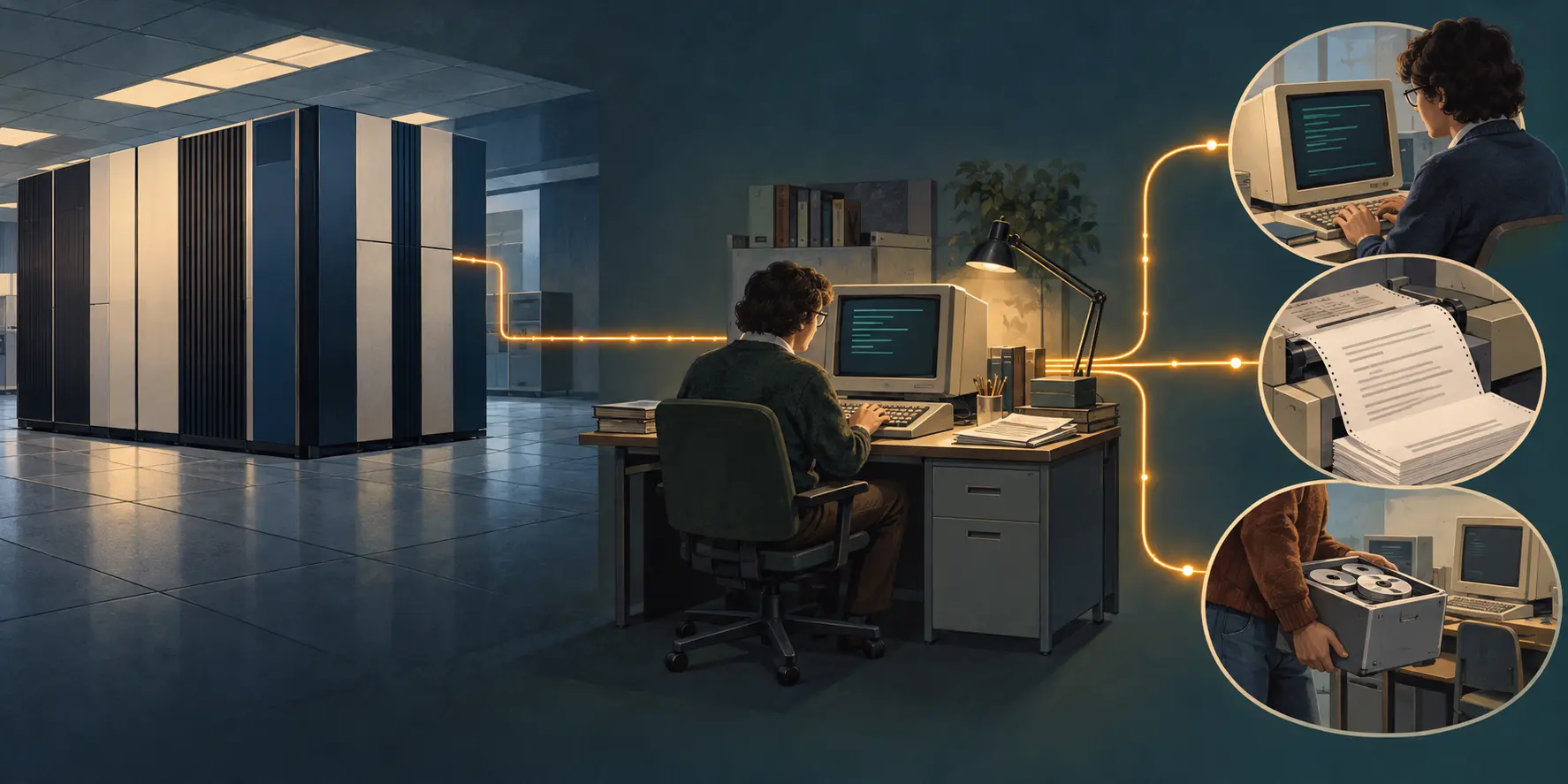
The first NSFNET story begins with a scarce resource. In 1985–86, NSF selected five national supercomputer centers: San Diego, Illinois, Cornell, Pittsburgh and Princeton’s John von Neumann Center. The 1986 annual report shows these sites in the program’s network plan. Connecting them meant researchers could reach costly machines without being on the campus that owned one.
The plan was already broader than a list of computers. In June 1987, RFC 1009 described an Internet extension for the centers and other scientific resources, alongside networking for a large research community. That contemporary purpose statement helps explain why the backbone could matter to people whose work did not involve a supercomputer session.
Ordinary services became part of the record
NISTIR 4734 later says that, although NSFNET had been promoted for supercomputer connectivity, traffic was soon dominated by electronic mail, remote login and file transfer. The report gives no measurement date or application-by-application packet breakdown, so the evidence supports the direction of the shift, not percentages or a precise start date.
These services made the backbone useful between research tasks as well as at the moment a scientist reached a remote machine. Email moved coordination; remote login opened systems elsewhere; file transfer carried working material between institutions. The sources name the services, though they do not count each service separately.
The network widened in scale and structure
NISTIR 4734 reports traffic reaching 200 million packets a month. It also records the initial backbone’s retirement in 1988 and the arrival, by July, of seven regional university research networks. The line rate rose from 56 kilobits per second to 1.544 megabits per second, the T1 rate.
RFC 1074, published in October 1988, describes permanent T1 links and an SPF-based interior gateway protocol for the later backbone. Those details mark an operational change: NSFNET had become a managed backbone joining regional research networks, not only a route among five named computing centers. The available records do not assign the upgrade to any one application; they show the traffic report and the capacity transition together.
For researchers, the meaningful change was reach. A national machine was valuable only to those who could get to it, while regional connections let more campuses approach the same backbone. The early network’s history is therefore visible in both its destinations and the paths that made those destinations part of a larger research system.
Sources: NSF, Annual Report 1986; Braden and Postel, RFC 1009, Requirements for Internet Gateways (1987); Rekhter, RFC 1074, NSFNET Backbone SPF based Interior Gateway Protocol (1988); NISTIR 4734, Foundations of a Security Policy for Use of the National Research and Educational Network (1992).
Member Briefing
Deeper Profile Context
Sign in with the right membership level to unlock the full briefing and source notes.
Only for Strategic Circle
Strategic Circle
Open to all readers. Unlock profile briefings after joining and signing in.
Join Strategic CircleOnly for Leadership Alliance
Leadership Alliance
For qualified IP-asset owners and management; sign in to unlock alliance briefings.
Join Leadership Alliance