Summary
- Netflix's September 1999 subscription allowed four titles a month for $15.95. In February 2000 it offered unlimited exchanges for $19.95 with four discs out at once; an October 2000 revision cut the concurrent limit to three.
- The queue chose what to send after a return. Netflix warned in 2002 that faster mail could produce more exchanges and higher delivery and revenue-sharing costs under the fixed monthly price.
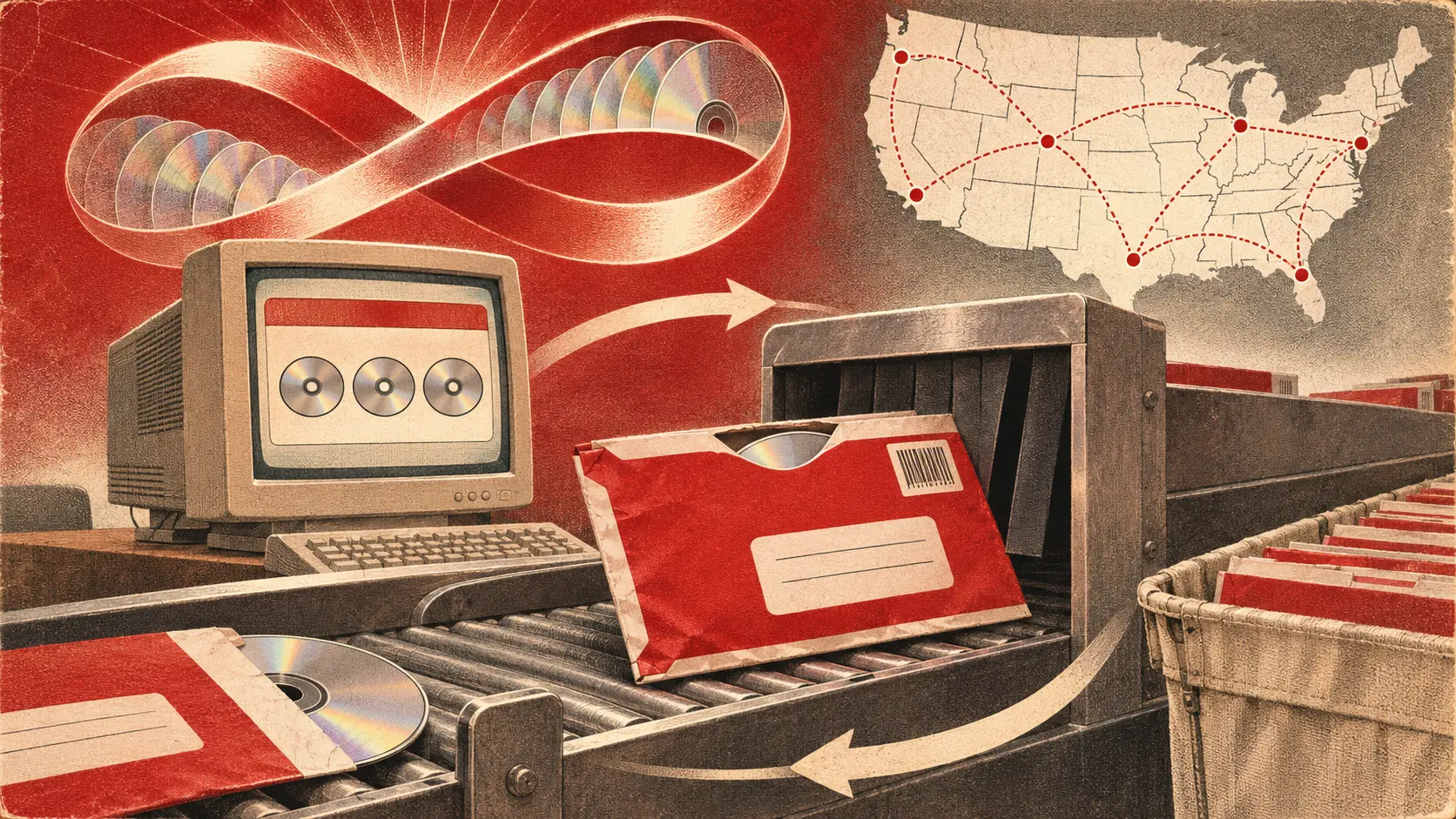
The subscriber had finished the movie. To get the next one, she put the disc in a prepaid mailer and sent it back. Netflix's website already knew her preferred next title; the postal system had to tell the warehouse that a slot was open. That return, rather than a click, started the next delivery. The company's FY2002 annual report, filed in 2003, said it mailed the next available title in a subscriber's queue after receiving a returned disc.
“Unlimited” arrived through a sequence of narrower rules. Netflix's 2002 amended registration statement described the September 1999 subscription as $15.95 a month for up to four titles per month, with no due dates or late fees; another title cost $3.98. That was a monthly quantity limit. In February 2000 the standard offer became $19.95 for unlimited titles over time, with a maximum of four out concurrently. In October the company changed the fixed-fee plan again: unlimited exchanges, three titles out at once. Four per month, four in hand and three in hand were three different promises, each written into the same young service within about a year.
The user interface made the offer feel expansive. A subscriber browsed the catalogue and arranged titles in a queue. Netflix sent available selections by first-class mail and included prepaid mailers for the return. No due date meant the viewer could keep a disc without a penalty. It also meant that a disc held on the shelf occupied one of the subscriber's three slots and postponed the next automatic shipment. The calendar stopped charging the customer for lateness; it did not stop counting the time a physical copy spent away from Netflix.
The company could change that clock from its side, too. Through December 2001 it had maintained a single distribution center in San Jose, California. Its 2002 registration statement said regional-center use began in January 2002 and that it was then shipping from eight regional centers. A shorter trip from a nearby center could get a disc to a subscriber sooner and bring a return back faster. The website's queue did not have to change its basic rule. The distance travelled by each envelope did.
Speed, however, cut both ways in Netflix's own account. In the same registration statement, the company anticipated that less time in transit would make subscribers exchange more titles. More exchanges meant more outbound and return shipping activity. Netflix warned that shipping and delivery costs and revenue-sharing expenses would rise and hurt operating results if subscriber retention or other factors did not offset them. This was management's 2002 forecast, not a reported measurement of what the regional rollout ultimately did to profit.
The fixed subscription fee made the tension plain: a faster service could be more attractive to customers while giving the company more trips to pay for within a month.
The annual report filed in 2003 shows the physical network becoming a larger part of the product. At filing time Netflix said it operated 18 shipping centers, including San Jose, and could reach more than half its subscribers with generally next-day delivery. That is its reported reach at that time, not a promise that every subscriber or every title arrived overnight. The report also said some studio revenue-sharing arrangements included charges tied to a DVD shipment, with expense recognized when the covered disc went out. Each returned envelope could unlock another title for the customer and another variable cost for the company.
Netflix did not invent a way to mail a disc without time or cost. It linked a web queue, a cap on concurrently held discs, first-class mail, prepaid returns and regional inventory into one repeatable service. The subscriber saw a list without a monthly count ceiling. The operator saw discs moving through a cycle whose pace depended on postal travel, customer behavior, available copies and the location of shipping centers. Calling the service unlimited described one part of that system accurately. The envelope described the part that actually had to move.
Original records
- Netflix, 2002 Form S-1/A: subscription-plan chronology, San Jose and regional-center rollout, and the forecast of faster exchanges and costs.
- Netflix, FY2002 Form 10-K filed in 2003: queue-and-return operation, 18-center network, next-day reach and shipment-linked revenue sharing.
Member Briefing
Deeper Profile Context
Sign in with the right membership level to unlock the full briefing and source notes.
Only for Strategic Circle
Strategic Circle
Open to all readers. Unlock profile briefings after joining and signing in.
Join Strategic CircleOnly for Leadership Alliance
Leadership Alliance
For qualified IP-asset owners and management; sign in to unlock alliance briefings.
Join Leadership Alliance