Summary
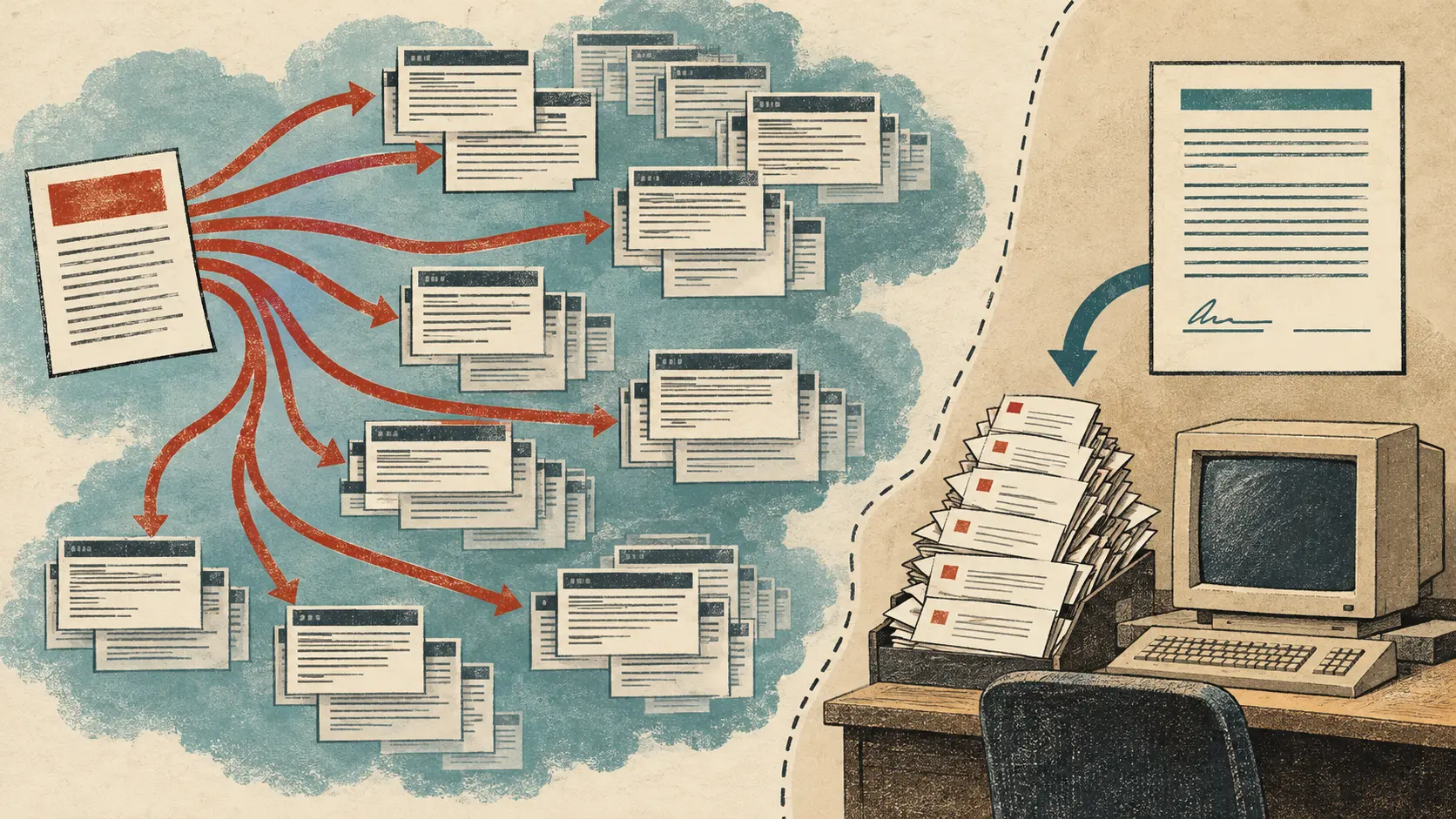
- Napster centralized discovery: clients sent searches to a server-side index of user-supplied filenames.
- The music file itself stayed on a user’s computer and moved directly to another user after a match.
A song could travel through Napster without passing through a Napster machine. That sentence sounds like a defense written by an engineer. It is also the reason the service’s server mattered so much.
Napster’s MusicShare client built a user library from MP3 files on the local computer. The client sent filenames to Napster’s servers, where they joined a changing directory associated with users who were online. A search did not inspect the audio. It matched words against that server-side index. Select a result and the server returned the host user’s Internet address; the two clients then connected, and the requesting user downloaded the file from the other user’s computer. The Ninth Circuit’s 2001 account lays out the sequence on pages 3–6.
So the network split a job in two. Napster helped people find a file; users supplied the storage and transfer. The server held names and routes, not the MP3 payload described by the court. In ordinary use, this could feel like a direct exchange between strangers. In operational terms, it depended on a central service that could answer “who says they have this?” and “where is that user?”
That distinction was not a technical footnote in the case. It was the control surface. The appellate court was reviewing a preliminary injunction, not deciding Napster’s ultimate copyright liability. It said the system’s mere existence was not enough for contributory liability without notice and a failure to remove infringing material. But the court also noted that Napster could search its index and bar users. The modified injunction required rights holders to identify specific copyrighted works and files; Napster then had to police within the capabilities of its system.
The court’s point was narrower—and more operational—than the slogan “the internet made copying easy.”
Napster could not simply listen to every MP3. The record said its system did not appear to give it access to the audio, and users could choose inaccurate filenames. A search result was a claim in a directory, not proof that the named recording sat behind it. Yet Napster could act on the directory and on participation in the service. It could remove an indexed entry or exclude a user, even though the file itself lived elsewhere. That was a powerful but imperfect form of control: strong over access to the meeting place, weak over the truth of each label and the content on each disk.
The public image of peer-to-peer sharing tends to put the endpoints in the foreground: one computer sends, another receives. Napster’s legal and technical story also has a middle. A central index made scattered files discoverable, and discoverability made the system useful. The same index gave the operator a place where notices, searches and exclusion could meet. The design did not collapse into a single server, but neither was it a network with no center.
The ending should be stated with the same care as the architecture. The service shut down in July 2001 after it failed to comply with a modified preliminary injunction, and the company filed for bankruptcy in June 2002. In 2007, the Ninth Circuit said Napster’s ultimate copyright liability had never been adjudicated. The shutdown is therefore not a final court verdict that centralized indexing alone made the service unlawful. It is a record of a service that could not keep operating under the modified order.
Napster’s index was central because search was central. The song was not. That separation explains both the service’s reach and the limits of its control—and why the courtroom argument kept returning to the machine that knew the filename and the machine that held the music.
Primary sources
- A&M Records, Inc. v. Napster, Inc., 239 F.3d 1004 (9th Cir. 2001), pp. 3–6, 45–46
- In re Napster, Inc., Nos. 06-15886 et al. (9th Cir. 2007), p. 3073
- In re Napster, Inc. Copyright Litigation, Document 935 (N.D. Cal. 2006), p. 4
The 2006 district-court order is included only for its account of a distinct 2005 direct-distribution-by-indexing theory in a separate proceeding; it does not decide the claims in the 2001 injunction appeal.
Member Briefing
Deeper Profile Context
Sign in with the right membership level to unlock the full briefing and source notes.
Only for Strategic Circle
Strategic Circle
Open to all readers. Unlock profile briefings after joining and signing in.
Join Strategic CircleOnly for Leadership Alliance
Leadership Alliance
For qualified IP-asset owners and management; sign in to unlock alliance briefings.
Join Leadership Alliance