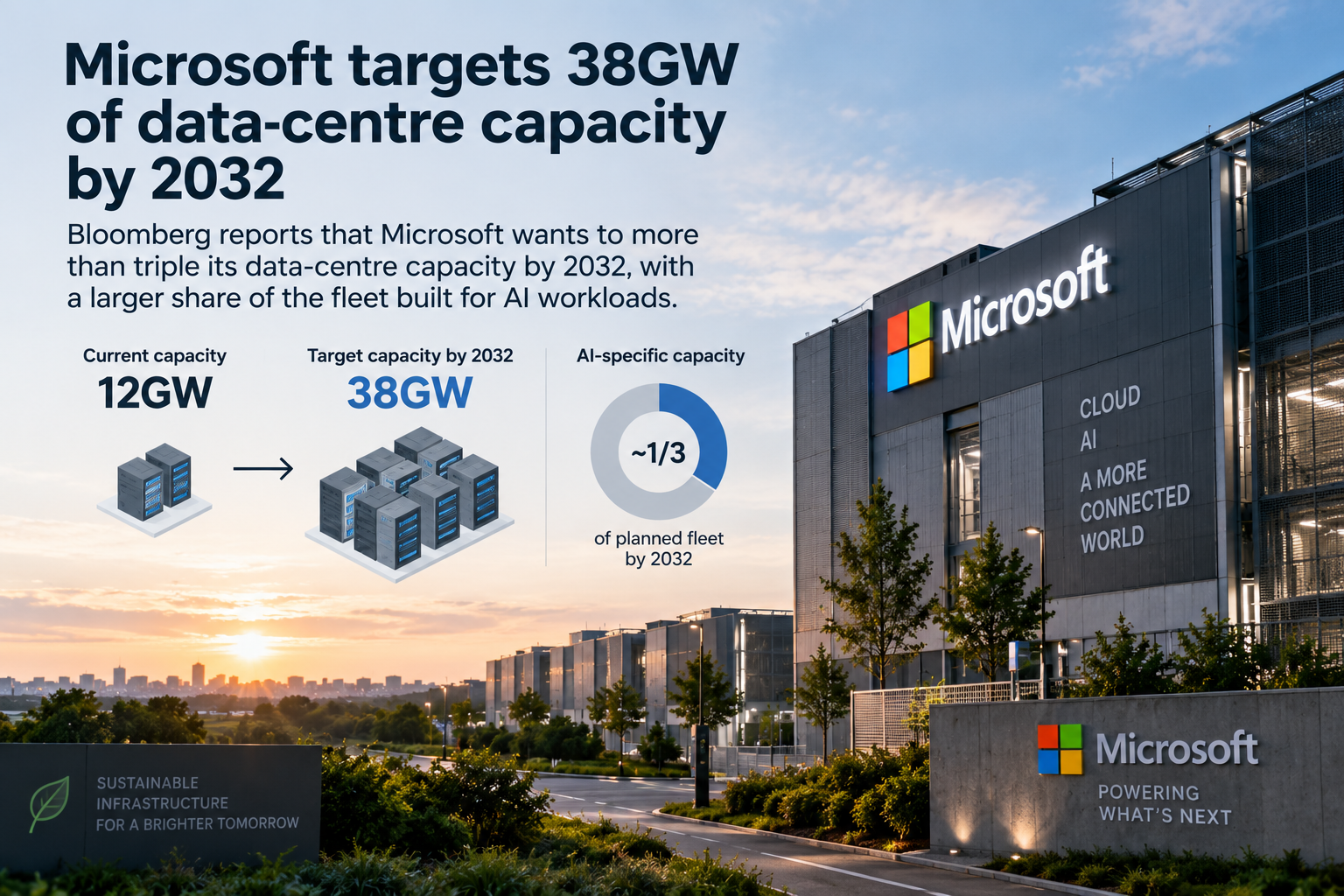
- Bloomberg reports that Microsoft is targeting about 38GW of data-centre capacity by 2032, up from roughly 12GW today
- Around one-third of the planned fleet could support AI-specific hardware, but Microsoft has not published a site-by-site delivery schedule
The fact
Microsoft is targeting about 38GW of data-centre capacity by 2032, more than three times the roughly 12GW it has today, Bloomberg reported on 10 September, citing people familiar with the plans. Reuters subsequently reported the figures. Microsoft did not immediately comment to Reuters.
Around 2GW of Microsoft's current capacity is centred on AI-specific chips, according to the report. By 2032, roughly one-third of the planned 38GW fleet is expected to be devoted to that type of hardware. No site-by-site construction or commissioning schedule was disclosed.
Microsoft is already spending heavily on infrastructure. It reported $41 billion of capital expenditure in its latest quarter, with roughly two-thirds going to shorter-lived assets, mainly CPUs and GPUs. Finance leases totalled $5.6 billion, largely for major data-centre sites. Those spending figures show the scale of the buildout, but they do not establish how much of the reported 38GW is already contracted, powered or available to customers.
The assessment
Microsoft’s 38GW target says more about the scale of its ambitions than what Azure customers can use today. New capacity only becomes useful once a site has power, cooling, network connections and computing hardware in place. Much of the planned expansion may therefore remain several steps away from becoming an available cloud service.
The reported shift towards more AI-specific infrastructure is more useful for understanding what Microsoft is building. Accelerator-heavy systems need dense power, cooling and networking, so the mix of future sites may matter as much as the overall number of gigawatts. Where those systems are installed will determine which regions gain additional AI capacity first.
For BTW readers, the strongest evidence will be commissioned capacity tied to actual Azure service availability. The 38GW target shows the scale Microsoft is planning for, but regional project dates and usable compute will show how quickly that ambition becomes infrastructure customers can actually access.
What to watch
Watch for Microsoft to confirm the 38GW figure and disclose where the additional capacity will be built. Regional power commitments, construction milestones, commissioned megawatts and new Azure AI-service availability will show how much of the reported target is moving from long-term planning into operating infrastructure.
Member Briefing
Deeper Profile Context
Sign in with the right membership level to unlock the full briefing and source notes.
Only for Strategic Circle
Strategic Circle
Open to all readers. Unlock profile briefings after joining and signing in.
Join Strategic CircleOnly for Leadership Alliance
Leadership Alliance
For qualified IP-asset owners and management; sign in to unlock alliance briefings.
Join Leadership Alliance