The short version
- DOCOMO and Mitsubishi Estate signed a 24 August agreement to build a next-generation communications cluster across Otemachi, Marunouchi and Yurakucho: mmWave at 26 and 28 GHz, sub-6 GHz across 3.5, 3.7 and 4.5 GHz, glass antennas, and the landlord's buildings, ducts and fiber treated as first-class network assets.
- What the release does not say is the interesting part — no site counts, no access rents, no build milestones, no indoor handoff data, no load results, no energy budget, no sharing terms, no named service.
Millimeter wave is sold as a spectrum story. In Tokyo's Marunouchi district it is a landlord story, and the landlord has just been handed a seat in the radio access network. A 28 GHz signal behaves less like a streetlamp than like a flashlight: brilliant where it points, useless one corner later. Concrete, coated glass, a parked delivery truck, a new awning, a crowd of commuters at 08:45 — each is an attenuator with a lease. So dense mmWave is not won by owning spectrum.
It is won by owning the right to put a small box in exactly the right place, then power it, fiber it, cool it, repair it and keep it pretty enough that nobody files a complaint.
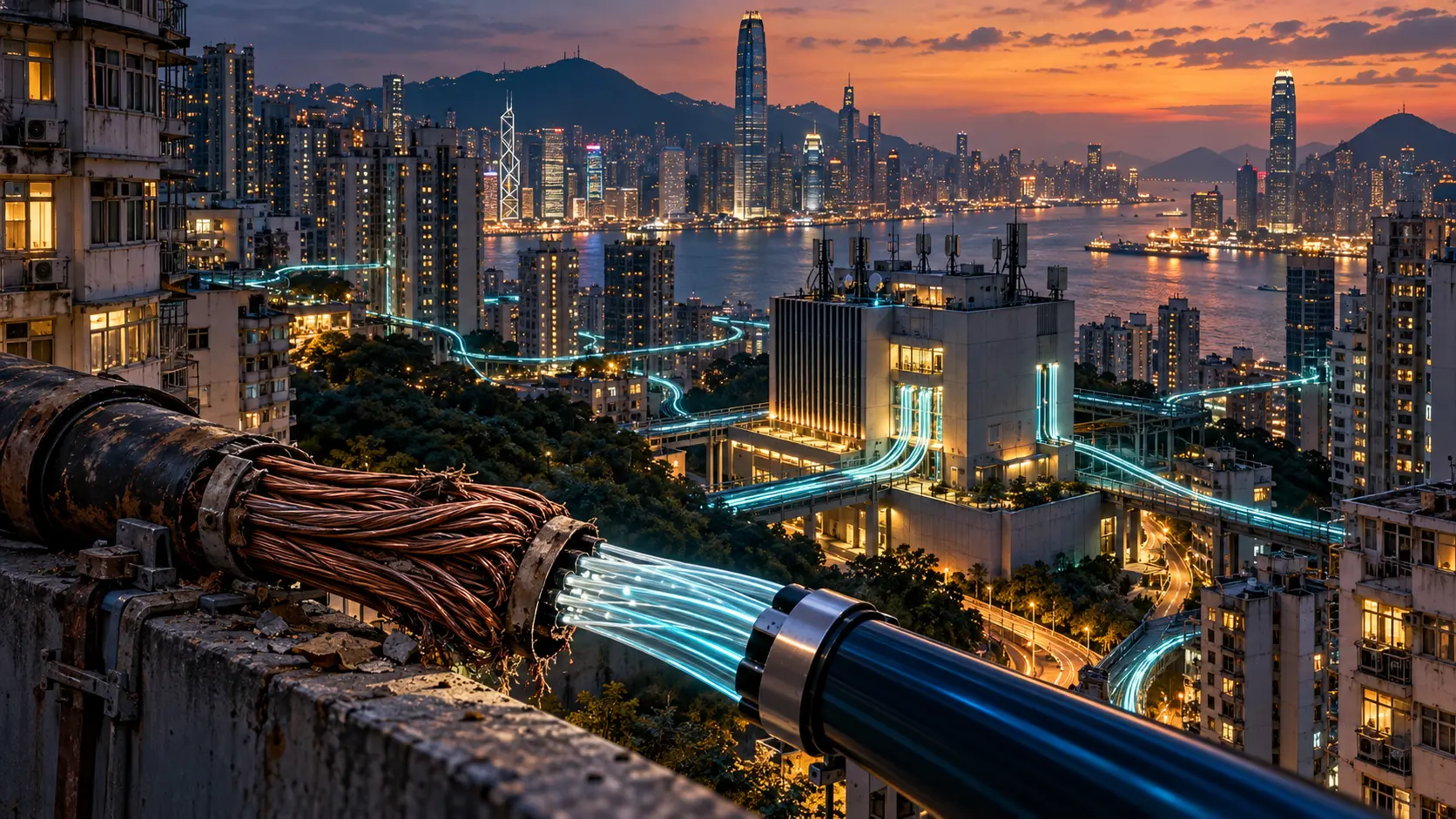
That is why the 24 August agreement between NTT DOCOMO and Mitsubishi Estate is worth more than the press release it arrived in. DOCOMO brings the radio: 26 and 28 GHz holdings described as 800 MHz in total, Tri-Band Massive MIMO across 3.5, 3.7 and 4.5 GHz, glass antennas, and the base-station kit it already runs. Mitsubishi Estate brings the harder half — buildings, decades of infrastructure-acquisition experience, and an area-management platform that already coordinates a district.
Its group fiber and data-centre assets may also shorten the path from antenna to core capacity, which in a dense cluster is the difference between a showcase and a science project.
Why mmWave in Tokyo is a real-estate problem first
High frequencies buy wide channels and pay for them in line-of-sight. Every additional gigabit per second of usable capacity has to be purchased with a physical location: a façade, a rooftop, a window, a lamp post, an equipment room. Each of those locations has an owner, a rent, a power feed, a fiber path, an aesthetic rule and a maintenance window. The engineering is largely solved. The procurement is not.
This is the part of 5G that never makes the keynote. Operators can model propagation to the decibel and still lose a year to a single landlord committee. A district with one dominant property owner can compress that year into months — and that, not the spectrum, is the actual product being announced here.
The architecture is sensible; the evidence is missing
The design is coherent. What the announcement does not provide is the ledger that would let anyone verify it. There is no count of permitted sites, let alone live ones. No construction sequence. No investment split between the two partners. No rent, no power price, no maintenance rule. No defined outdoor coverage, no indoor continuity, no handoff policy between the mmWave layer and the sub-6 GHz layer, no performance figures during commuter peaks, and no named digital service that would justify the cluster in the first place.
Without those denominators, "smart city" is an ambition wearing a hard hat. It is not yet an operating model.
Measure the deployment clock, not the speed test
The first honest metric is time. How long does it take, end to end, to identify a sightline, win landlord and streetscape approval, secure fiber and power, install a node and light it up? How many candidate locations fail, and for which reason — no duct, no fuse, no permission, no line of sight? A property partnership should shorten those intervals, and if it does, that process result will travel to the next district far better than any single throughput screenshot.
The second metric is continuity. Millimeter-wave islands have to be walked under pedestrian load, through vehicles, rain, temporary construction hoarding, summer foliage and the seasonal rearrangement of street furniture. Peak throughput under one antenna is a vanity number. What matters is the share of a movement path that preserves usable service, how cleanly the handoff drops to sub-6 GHz or to indoor systems, and what the tail experience looks like when the direct path disappears behind a bus.
Sharing is where the economics get decided
DOCOMO and KDDI have separately developed a compact repeater able to relay both operators' mmWave signals — a small but telling admission that duplicating this layer twice is wasteful. The Marunouchi release does not say whether property, fiber, power, antennas or repeaters will be open to other carriers.
Both paths have a price. Exclusive access accelerates one network and makes the city pay for the streetscape work twice. Shared neutral assets cut duplication but demand governance: who gets capacity, who fixes faults, who wins the upgrade queue, who eats the outage. A district that quietly becomes single-carrier infrastructure has not solved densification; it has privatised it.
When the landlord joins the NOC
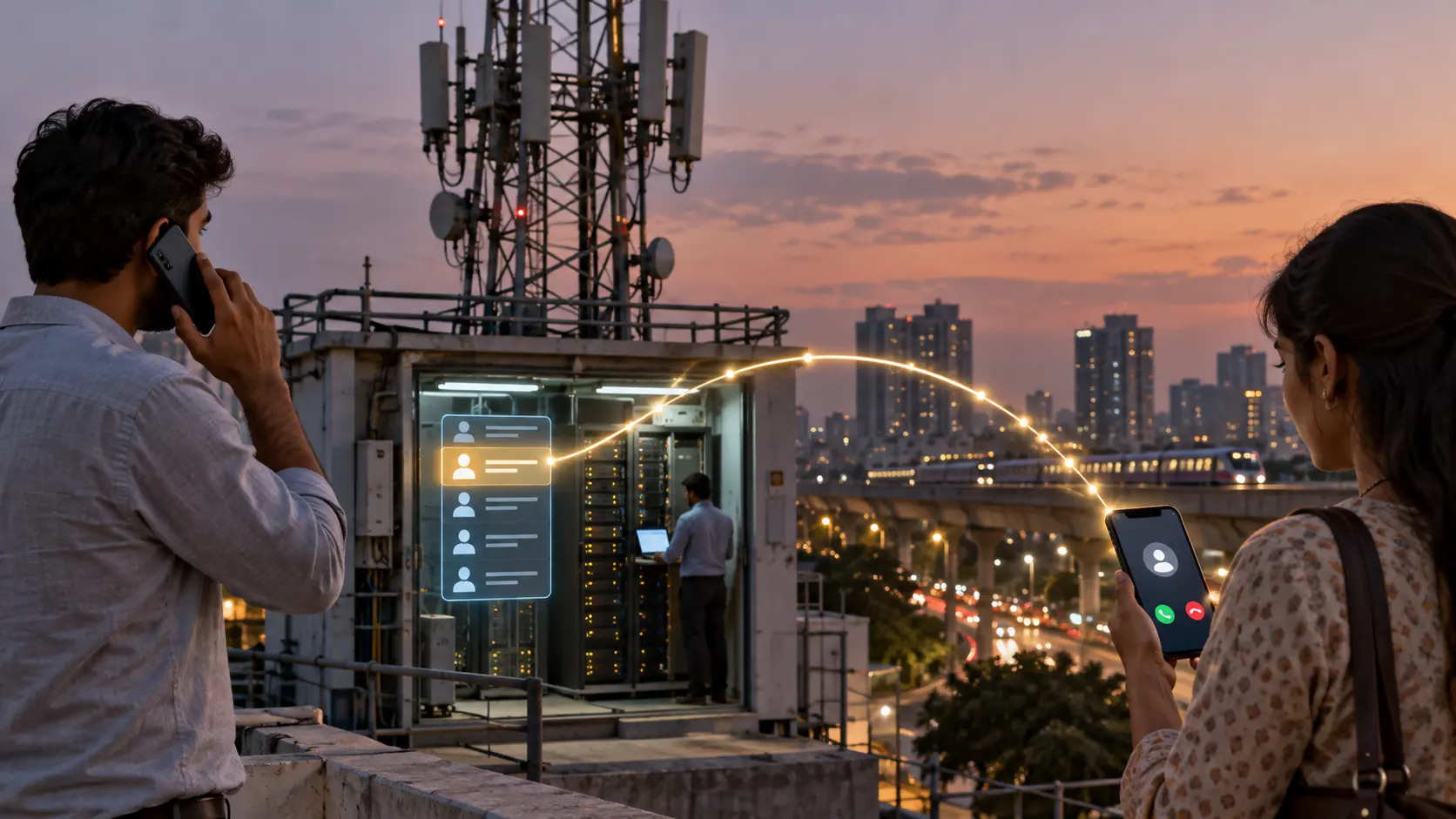
A façade node needs access after hours. A fiber cut crosses a building boundary and a street boundary and lands in a contract nobody wrote for that scenario. An aesthetic restriction can delay a repair by days. If service telemetry does not link radio failure to asset ownership and repair clocks, an operator's availability dashboard will look respectable while users experience plain, ordinary coverage failure. The bottleneck hides inside the average.
That is the real operational shift in this deal: the property owner stops being a supplier and becomes a participant in uptime. The contract has to say so.
Replication: method or showcase?
The partners want to extend the model to other major urban centres. Here is the trap. A district with concentrated ownership, existing fiber, group data centres and a single coordinating platform is the easy case. A fragmented shopping street, a station forecourt split across three owners, a suburb of small landlords — those are the real test. A reusable model must state which inputs are genuinely essential: ownership concentration, available ducts, power headroom, permitted antenna forms, traffic density, and the economics of the service that is supposed to pay for all of it.
So the agreement does locate the right control plane. Dense mmWave will never scale on radios alone; it needs coordinated urban assets and written rules about them. But a control plane is only as good as its instrumentation. Report this cluster as a matched ledger — deployment time, coverage continuity, load, cost, energy, repair intervals and sharing terms — and Marunouchi becomes a method other cities can copy. Report it as a press release, and it stays a very well-lit eight hundred metres.
Sources
Member Briefing
Read the full trend briefing
Members read the full briefing with the source notes behind every finding.
Strategic Circle
A daily briefing in your language, built from changes we have verified.
Join for USD 20/monthCancel anytime.
Members also get the full research library, a daily briefing on the networks they follow and the private forum.