
Europe and Middle East Trends
Europe and Middle East Trends
Europe and Middle East market trend intelligence tracks cloud service, regional ISP, national telecom, data centre, and institutional infrastructure signals across European and Middle Eastern internet infrastructure markets. BTW.

Latest Coverage
Latest from Europe and Middle East Trends
1,427 articles

Europe and Middle East Institutional Trends
Power International-Tyres: the corporate ASN behind a physical distribution promise
Power International-Tyres: the corporate ASN behind a physical distribution promise intelligence summary explains the development, the public evidence available to readers, the organisations involved, the regional context, market exposure, and the infrastructure consequences that…

Europe and Middle East National Telecom Trends
A mobile-site generator is not a local continuity plan until refuelling access, runtime and restoration priority are verified
A generator beside a mobile site is equipment, not proof of continuity. The local capability begins only when the site’s real load, safe access, fuel replenishment authority, delivery time and restoration priority can be exercised as one bounded operating chain.

Europe and Middle East Regional ISP Trends
Plusine Systems: three public names, separate responsibilities
Plusine Systems appears in public evidence under a legal name, the Axians commercial brand and the registered autonomous-system name PLUSINE-AS. Those identities can be joined, but the join does not answer every operational question. For a buyer, the useful work is to map which…

Europe and Middle East Institutional
Haffner launches biomass power-and-cooling offer for data centres
Haffner Energy has launched a modular biomass system that combines onsite power generation with cooling for data centres operating alongside the grid.

Europe and Middle East National Telecom Trends
An alternate coordination room is not a local continuity site until access, data, call routing and staffing are exercised
An address on a continuity plan does not prove that an alternate coordination room can take over. The capability begins only when authorised people can enter, receive the right calls and data, recover the current incident picture and accept command responsibility under controlled…

Europe and Middle East Datacenter Trends
Telehouse opens 5.4MW Building N in Frankfurt
Telehouse has opened Building N in Frankfurt, adding 5.4MW of live capacity at its established Kleyerstraße data-centre campus.

Europe and Middle East Regional ISP Trends
PLAZMATELEKOM's 20,000-subscriber claim still leaves the last mile to verify
PLAZMATELEKOM presents itself as a regional network with 20,000 active subscribers, 120 connected settlements and fibre across Ingushetia's larger population centres. The useful question is not whether those figures sound substantial, but what they mean at a specific address when…

Europe and Middle East Regional ISP Trends
Platon's 99.9% uptime promise leaves the failure boundary to verify
Platon Technologies presents a compact hosting proposition: its own infrastructure, a stated availability guarantee and two optical routes to the exchange SIX. The useful diligence question is not whether those claims sound reassuring, but where each promise begins and ends.
Europe and Middle East Regional ISP Trends
PKP Ferrit’s registry footprint makes operator identity a due-diligence question
PKP Ferrit’s public records connect a company name, an Internet-number allocation and an observed route origin. They do not collapse those layers into proof that one organisation currently controls every operational or contractual part of the service.

Europe and Middle East Institutional Trends
Piter-IX turns regional peering reach into a resilience question
Piter-IX presents a broad exchange footprint across Russian cities. That reach can shorten interconnection paths and widen choice, but a map is not yet a resilience proof: buyers still need to know which facilities, transport routes and operating processes can fail together.

Europe and Middle East National Telecom Trends
A satellite handset in storage is not a local outage fallback until airtime, deployment and call routing are exercised
A satellite handset can diversify emergency communications when terrestrial services fail. Its presence in a resilience cupboard does not prove that the duty team can power it, deploy it, obtain service or complete the call route the local plan depends on.

Europe and Middle East Regional ISP Trends
Pishgaman Ofogh Barkhat’s route boundary makes locality a due-diligence question
A local registration record is useful evidence, but it is not a map of every controller who can affect a customer’s data path. Pishgaman Ofogh Barkhat LLC illustrates why buyers should separate those questions before turning “local” into a resilience claim.

Europe and Middle East National Telecom Trends
A privileged-access SIM is not a local emergency communications plan until activation and use are verified
MTPAS can improve an eligible responder’s chance of accessing a congested mobile network. A special SIM in an inventory does not show that the right person can use it, that the activation route is understood, or that an alternative exists when mobile service is unavailable.

Europe and Middle East National Telecom Trends
Telefónica’s RedCap meter test goes beyond the radio link
A German trial connected a prototype gateway to the metering operator’s back office over 700 MHz. The next commercial question is whether the complete chain can be supported across years of field use.

Europe and Middle East Regional ISP Trends
OXG’s new funding partner cannot order a fibre customer
Societe Generale S.A. has agreed to buy half of Vodafone’s German fibre venture. The deal addresses the supply of capital; turning installed connections into paid usage is a separate task.

Europe and Middle East National Telecom Trends
Sparkle, Hellas Sat test quantum-safe satellite link
Sparkle and Hellas Sat have extended Sparkle's QSI service from a terrestrial data-centre link to a GEO satellite connection between Greece and Cyprus.
Europe and Middle East Datacenter Trends
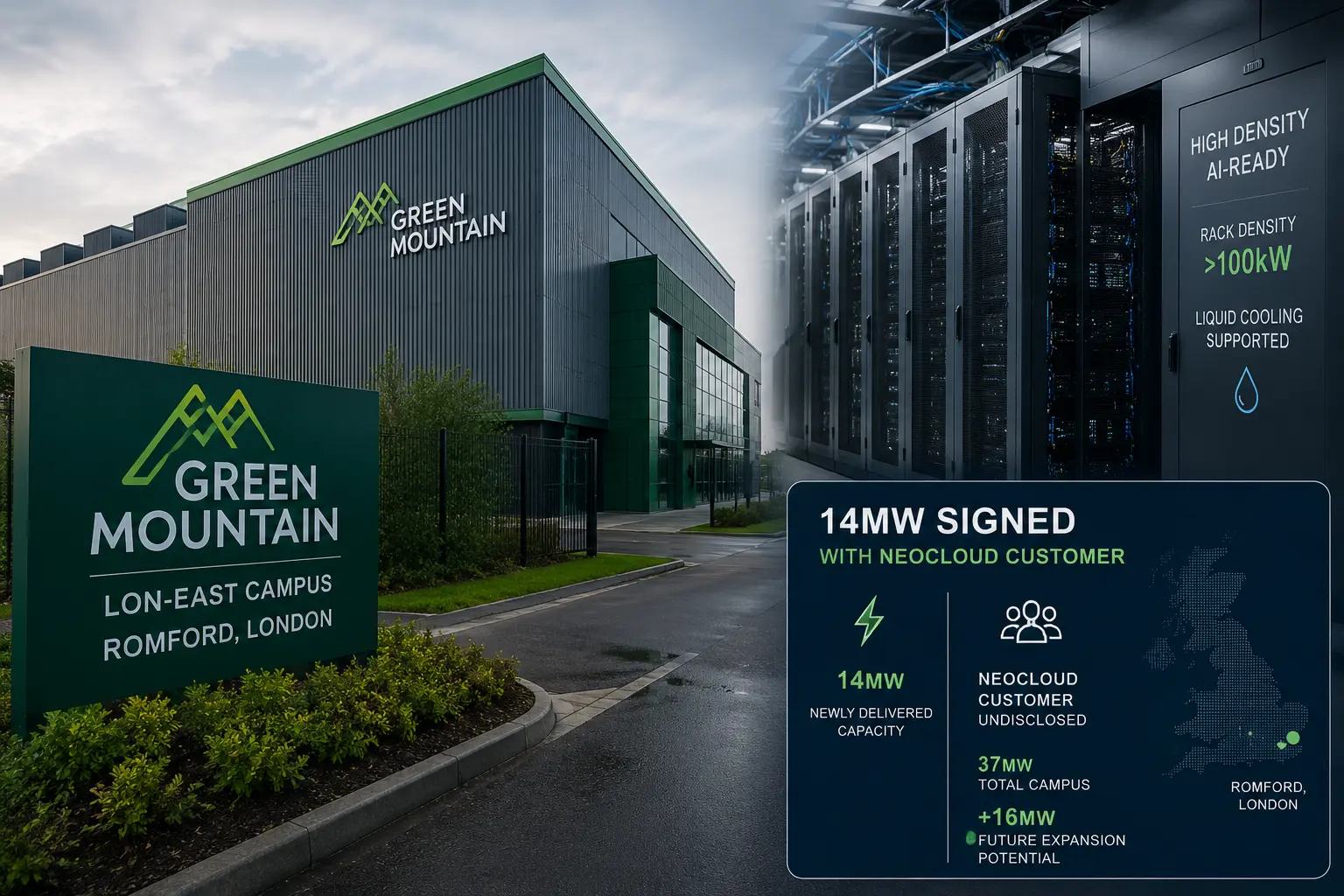
Green Mountain signs 14MW London neocloud customer
Green Mountain has signed an unnamed neocloud customer for the newly delivered 14MW expansion at its LON-East campus in Romford.

Europe and Middle East Institutional Trends
North Media buys BEAM grid-balancing platform for DKK 9m
North Media has acquired BEAM, a software platform designed to aggregate distributed energy assets for Denmark's grid-balancing market.

Europe and Middle East Cloud Services Trends
Aize’s Samp Deal Opens a Door to Older Plants
Area-based software subscriptions can bring more people into a digital twin. Keeping the plant’s representation current still needs an owner.

Europe and Middle East National Telecom Trends
Neo Space Group and Arabsat sign satellite services MoU
Neo Space Group and Arabsat will explore satellite communications, geospatial services and other space technologies across the Gulf and Middle East.