
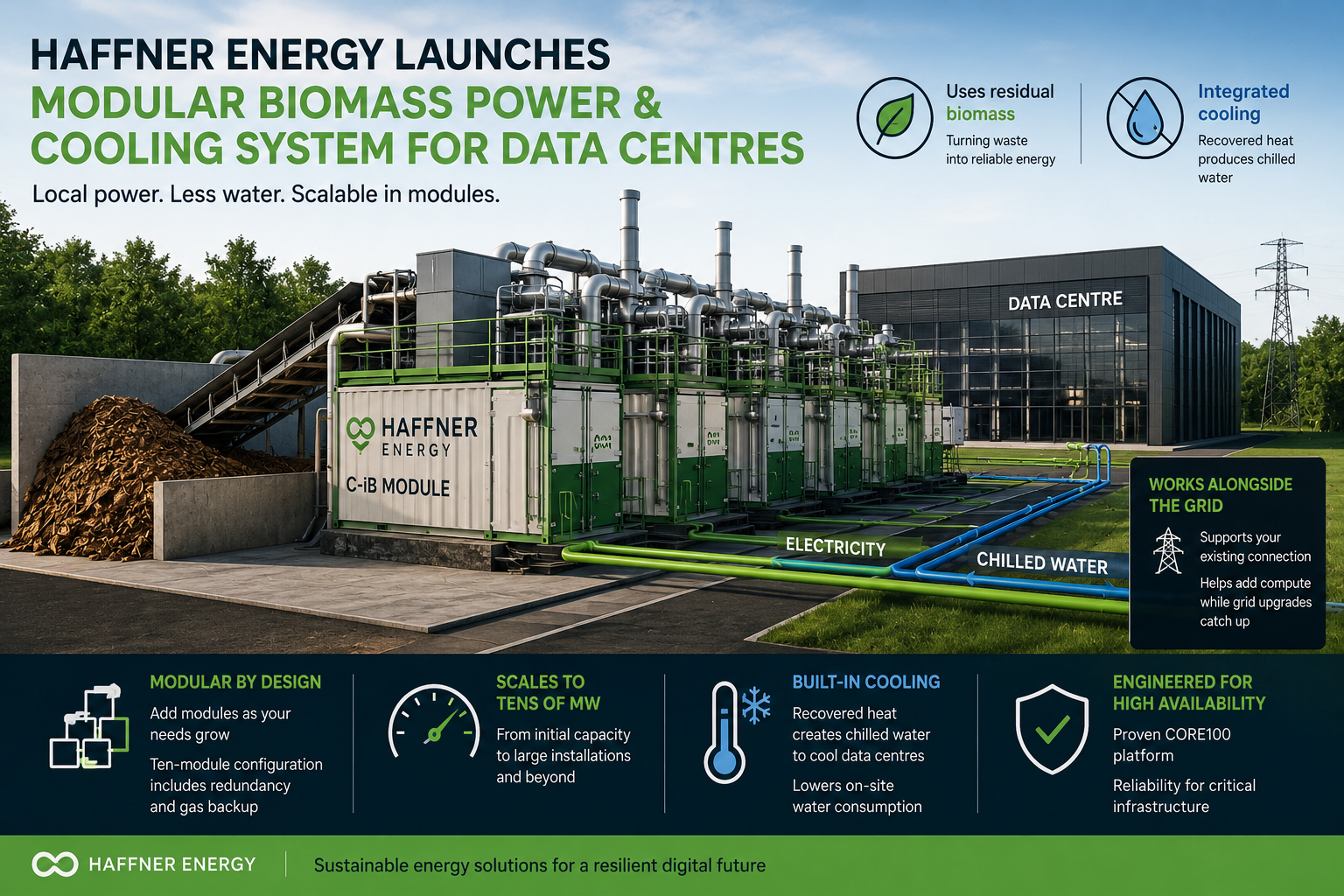
- Haffner Energy has launched a data-centre energy offering built around its CORE100 architecture and new C-iB modules
- The company says the modular system can supplement grid power and provide cooling, but it has not named a customer deployment
The fact
Haffner Energy announced on 28 August a biomass-based power-and-cooling offering for data centres. The system is built around its CORE100 architecture and a new C-iB module designed for larger multi-module installations. Haffner says installations can reach tens of megawatts and that additional modules can be added as computing capacity is built out.
The system is designed to operate alongside an existing grid connection rather than replace it. Haffner says residual biomass would fuel the modules. In a ten-module configuration, two modules are held in redundancy, with limited natural-gas backup available during exceptional periods when the biomass system cannot provide the required power.
Heat produced during electricity generation can also be recovered to produce chilled water for data-centre cooling. Haffner says initial commercial proposals are already being made, but it has not named a customer or announced an operating C-iB data-centre deployment.
The assessment
Using C-iB would change how a developer plans power for the site. Instead of waiting for the grid to cover the data centre's full future load, the developer could plan some generation on site as part of the build. That may be useful where a grid connection exists but cannot yet supply all of the capacity the developer wants to bring online.
The trade-off is that more responsibility moves onto the project itself. The developer would need to secure biomass, store it, maintain the generation equipment, arrange backup and make sure the power and cooling systems work together. Adding modules in stages could give the project more flexibility, but it only helps if each stage can be permitted, fuelled and operated reliably. Haffner has not yet shown that in a commercial C-iB deployment, so it is too early to say the system will shorten delivery times or reduce costs.
For BTW readers, the first customer project will show whether Haffner's model can actually help a data centre add usable capacity while grid supply remains limited. If the onsite generation introduces new problems around fuel supply, maintenance or availability, it may simply replace one constraint with another. Until a real deployment is operating, that balance remains unproven.
What to watch
Watch for Haffner to name a data-centre customer and disclose the number of C-iB modules, installed capacity, biomass arrangements and commissioning schedule. Once a system is operating, data on generation availability, grid draw and cooling output would provide evidence of how the package performs in a commercial data-centre environment.
Member Briefing
Deeper Profile Context
Sign in with the right membership level to unlock the full briefing and source notes.
Only for Strategic Circle
Strategic Circle
Open to all readers. Unlock profile briefings after joining and signing in.
Join Strategic CircleOnly for Leadership Alliance
Leadership Alliance
For qualified IP-asset owners and management; sign in to unlock alliance briefings.
Join Leadership Alliance