
Summary
- A satellite handset can diversify emergency communications when terrestrial services fail. Its presence in a resilience cupboard does not prove that the duty team can power it, deploy it, obtain service or complete the call route the local plan depends on.
- Maintain a narrow satellite-fallback readiness record and exercise the complete authorised chain from physical deployment to the intended call and return route. That evidence can show what the organisation controls, but it must not be presented as proof of universal coverage or guaranteed satellite service.
The failure begins after the cupboard opens
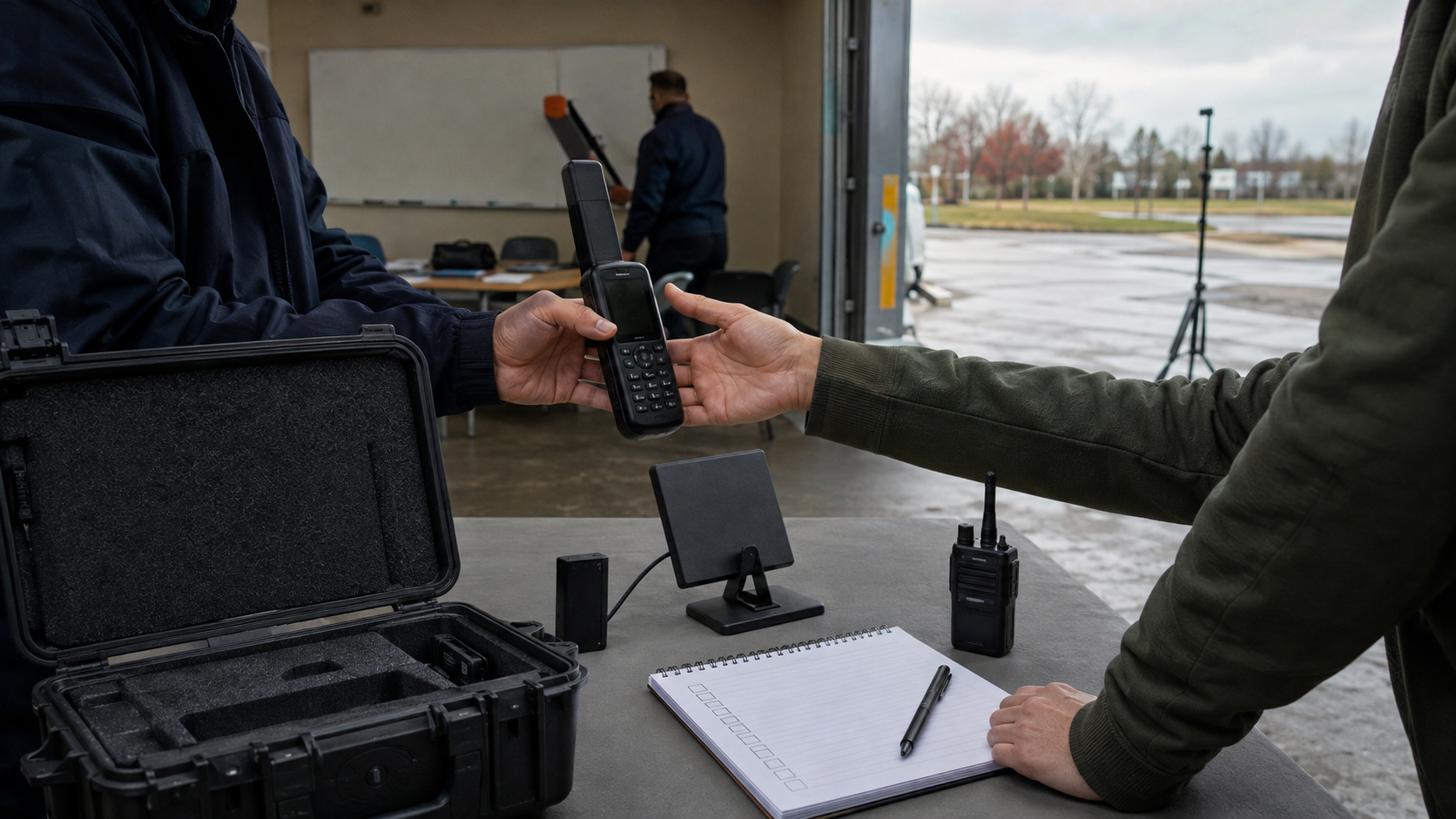
The scenario is easy to recognise. A storm exercise removes mobile and fixed connectivity from a coordination site. The satellite handset is where the plan says it should be, sealed in its case. The battery is present, but nobody can confirm whether the service remains current, where the antenna must be used, which numbers are permitted, or how an incoming callback reaches the right role.
That is not evidence that satellite communications are ineffective. It is evidence that possession and readiness are different facts.
UK Cabinet Office guidance describes resilient communications as arrangements able to absorb or mitigate disruption. Its account of the High Integrity Telecommunications System is deliberately architectural: resilience comes from combining a satellite pathway with landline connectivity independent of the commercial public switched telephone network. The relevant lesson for a local plan is diversity, not a promise that any single bearer will always work.
What public guidance can establish
The same Cabinet Office guidance says local telecommunications planning should go beyond a contact directory. It points to an assessment of responder requirements, a gap analysis, remedial actions, liaison with neighbouring areas and an exercise programme. The 2024 Exercising Best Practice Guidance likewise treats exercising as a practical method for testing preparedness against clear objectives and realistic scenarios.
Government is also exploring satellite and hybrid connectivity to augment emergency-services coverage in remote or difficult-to-serve locations. That first-party evidence supports a bounded proposition: satellite connectivity may add reach and resilience. It does not establish the state of a particular local subscription, battery, antenna, view of the sky, user competence or call route.
Those remain local facts.
A narrow readiness record
A useful readiness record does not need to reproduce a full asset-management system. For each role-critical satellite connection, it can identify the authorised custodian, service or airtime owner, handset and accessory set, charging responsibility, approved deployment point, intended outbound and callback routes, last controlled functional check and the exercise evidence that closed any finding.
Sensitive credentials, personal numbers and operational details should remain in the systems authorised to hold them. The shared record needs enough information to expose an unowned or untested step, not enough to create a new security problem.
The check should follow the real chain. Can the duty team locate and power the equipment? Can it be deployed in a place where its antenna can operate? Is service current? Does the authorised user know how to place the intended call? Can the receiving organisation recognise and return it? If the satellite path is unavailable, who owns the next approved route?
Each answer is evidence about a controllable step. None is proof of future network performance.
Exercise the route, not the label
A tabletop discussion can reveal ownership gaps, but it cannot show that equipment starts, service is available or a call reaches its intended destination. A controlled exercise should therefore include the physical deployment and an agreed test route, within legal, safety, supplier and operational constraints. Findings should have an owner and a retest condition rather than being closed by updating the inventory alone.
This approach also keeps the fallback in proportion. Satellite service may be valuable precisely because it is different from terrestrial mobile and fixed networks. It can still depend on power, subscription, suitable operating conditions, capacity and people who know the procedure. Diversity reduces common exposure; it does not remove every failure mode.
Perspective
Maintain a narrow satellite-fallback readiness record and exercise the complete authorised chain from physical deployment to the intended call and return route. That evidence can show what the organisation controls, but it must not be presented as proof of universal coverage or guaranteed satellite service.
Sources
Member Briefing
Deeper Profile Context
Sign in with the right membership level to unlock the full briefing and source notes.
Only for Strategic Circle
Strategic Circle
Open to all readers. Unlock profile briefings after joining and signing in.
Join Strategic CircleOnly for Leadership Alliance
Leadership Alliance
For qualified IP-asset owners and management; sign in to unlock alliance briefings.
Join Leadership Alliance