
Summary
- PLAZMATELEKOM's company page displays 20,000 active subscribers and 120 connected settlements, but it does not publish the counting method, observation date, premises-passed figure or technology available at each address.
- The provider says it built fibre in all large and medium settlements of Ingushetia and an owned regional backbone; its own sales process nevertheless requires a technical-availability check for each prospective address.
- RIPE records connect PLAZMATELEKOM LLC with ORG-PL557-RIPE, AS62440 and an IPv4 allocation, establishing a traceable network-resource footprint rather than proof of retail coverage, delivered speed or resilience.
Twenty thousand active subscribers is an intuitively legible claim. It suggests a network beyond the experimental stage, a recurring revenue base and an operating team accustomed to installations, faults and collections. PLAZMATELEKOM places that number beside a second counter: 120 connected settlements. Yet neither counter explains whether an active subscriber is a household, contract, account or live circuit, nor when the figure was measured. A scale claim becomes useful for diligence only after its denominator and operational boundary are visible.
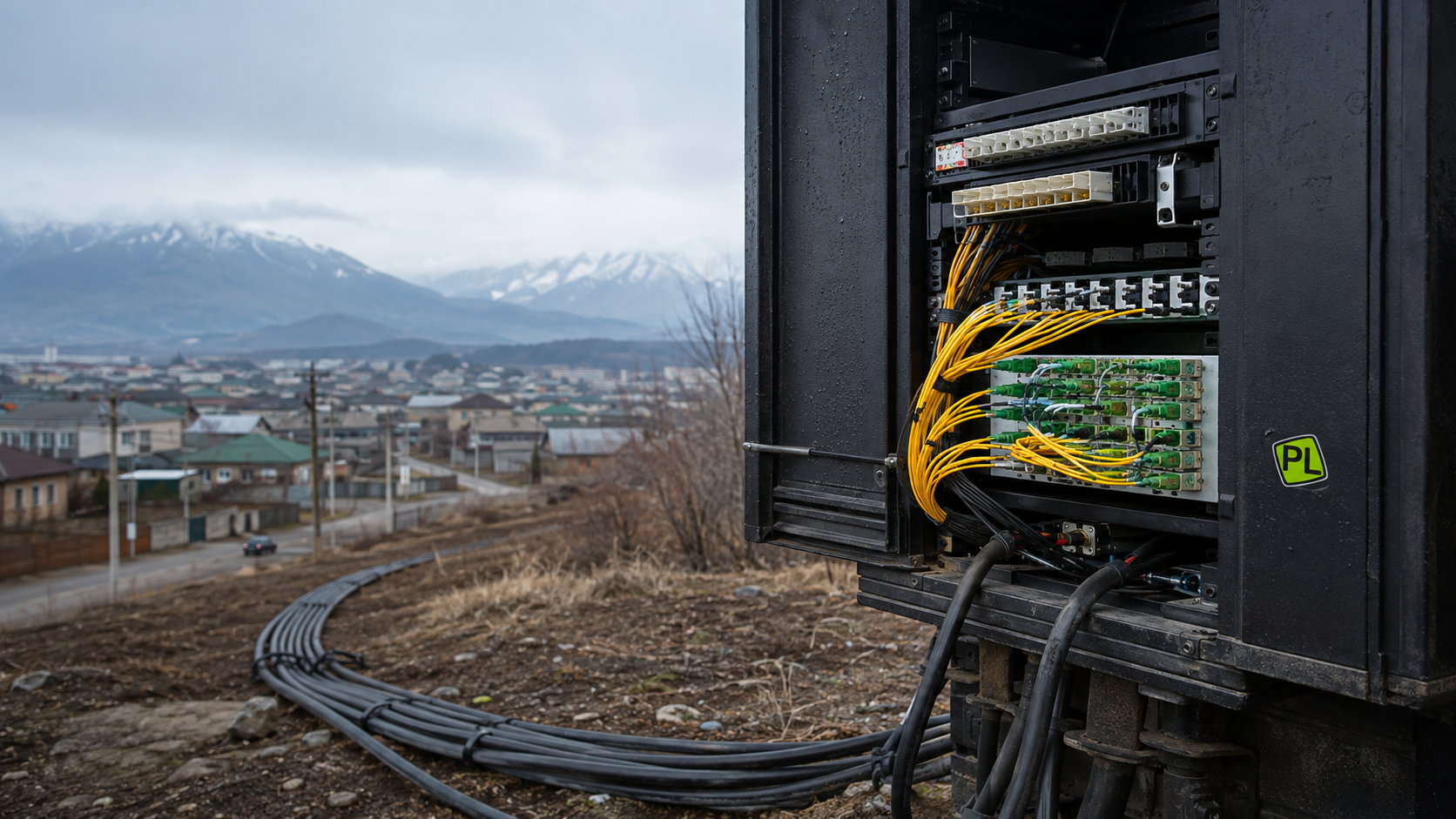
The company's profile page says PLAZMATELEKOM has operated in the Republic of Ingushetia since 2014. It says that, by the beginning of 2024, the company had built fibre-optic lines in all large and medium settlements of the republic and an owned backbone joining the main settlements and district centres. On the same page, the company displays the 20,000-active-subscriber and 120-connected-settlement counters. These are attributable statements from the operator; the reviewed material does not provide an independent coverage audit or the definitions behind the counters.
The company's own acquisition path shows why those definitions matter. Its homepage and internet page ask a prospective customer to provide an address so the operator can check whether the building is connected and whether service is technically available. That is a normal access-network process, but it also separates regional presence from serviceability. A fibre route through a settlement does not reveal how many streets, buildings or premises can receive service, which last-mile medium reaches them, or what installation work remains.
The retail page advertises unlimited plans at 100, 250 and 500 Mbit/s and elsewhere describes a wider range from 50 to 900 Mbit/s. Those are current offer observations, not measurements of delivered performance. The relevant operating questions include access technology, contention, backhaul capacity, customer-premises equipment, peak-hour throughput, latency, packet loss and fault restoration. None can be inferred from the highest number printed on a tariff card.
PLAZMATELEKOM also describes a network used for more than residential access. Its company page says it supplied communications channels to healthcare institutions under an Ingushetia modernisation project, supplied channels for an education-ministry video-surveillance system, and provided last-mile services to other communications operators, including Rostelecom. The same physical and operational estate may therefore support household, institutional and wholesale obligations.
The claims are relevant because a shared fault can affect customers with very different service expectations, but the reviewed page does not establish the present scope, contract terms or continuing status of those projects.
Public network-resource records provide a separate layer of evidence. The RIPE organisation object records ORG-PL557-RIPE under the name PLAZMATELEKOM LLC, country code RU, registration number 1140603000240 and organisation type LIR, with an address in Nazran. The aut-num object records AS62440, the name PLAZMATELEKOM-AS and status ASSIGNED. It also lists registered import policies involving AS12389, AS3216, AS31133, AS8359 and AS43182.
An inetnum record assigns 185.35.128.0–185.35.131.255 as ALLOCATED PA under the netname RU-ING-20130917 and associates the range with ORG-PL557-RIPE. At the evidence-capture time, RIPEstat network-info returned 185.35.128.0/22 with origin AS62440. The alignment makes the operator's resource footprint traceable. It does not show the physical last mile, validate the subscriber counter, prove that every registered routing relationship currently carries traffic, or measure the experience of a customer in any settlement.
The distinction has economic consequences. A regional operator can possess a genuine backbone and still face expensive marginal connections, uneven building access, congested aggregation, difficult field repair or dependencies outside its direct control. Conversely, an address-level qualification step can reflect disciplined engineering rather than weak reach. The evidence does not decide between those possibilities. It tells a buyer which boundaries to test.
That test should reconcile the public scale claims with operating records. Ask for the definition and dated basis of an active subscriber; settlement and premises-passed lists; technology and serviceability by address; install success and cancellation rates; peak-hour utilisation and measured speed distributions; fault volumes and restoration times; upstream and interconnection diagrams; physical diversity; and responsibility for shared residential, institutional and wholesale infrastructure. For critical sites, require the service level, escalation path and recovery evidence that apply to the actual circuit rather than to the regional brand.
PLAZMATELEKOM's public materials and RIPE records together support a narrower conclusion than either marketing scale or registry presence alone. They show a named regional provider, an address-qualified retail offer and a traceable network-resource footprint. They do not yet turn 20,000 subscribers or 120 settlements into a verified map of serviceable premises, delivered performance or recoverable failure boundaries.
Member Briefing
Deeper Profile Context
Sign in with the right membership level to unlock the full briefing and source notes.
Only for Strategic Circle
Strategic Circle
Open to all readers. Unlock profile briefings after joining and signing in.
Join Strategic CircleOnly for Leadership Alliance
Leadership Alliance
For qualified IP-asset owners and management; sign in to unlock alliance briefings.
Join Leadership Alliance