Summary
- A nominated fallback room is a location, not evidence that coordination can continue there.
- A defensible local control exercises access, staffing activation, voice and data routing, incident-record continuity and authority handover as one bounded chain.
The room opens but the response does not move
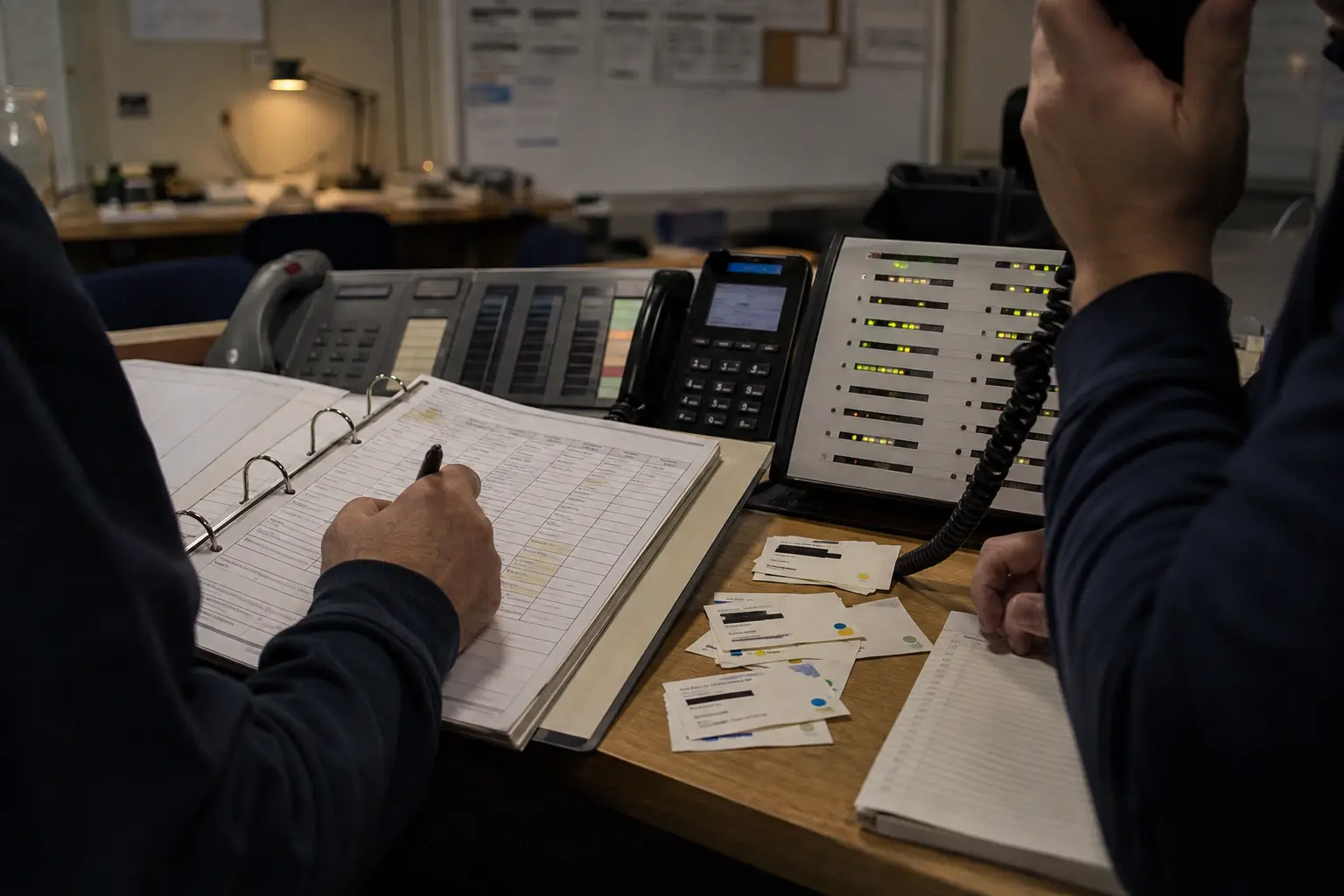
A building incident closes the primary coordination room. The duty team reaches the alternate site, but the first access card has expired. A second officer opens the room. The incoming coordination number still terminates at the unavailable building, one data account has not been tested from the alternate network, and the latest incident log remains on a screen nobody at the new site can see.
The alternate room exists. The coordinated response has not yet transferred.
This distinction is local and operational. It does not argue that every fallback facility needs identical equipment or that every incident requires relocation. It asks for evidence that the specific people, communications, information and authority needed for the planned function can move together.
What the public guidance establishes
UK emergency-response guidance places decisions at the lowest appropriate level while coordinating at the highest necessary level. It describes local agencies as building blocks of emergency response and calls for effective coordination within and between organisations and levels. Those principles make the handover of a local coordination function consequential, but they do not certify any particular alternate room.
Cabinet Office resilient-communications guidance gives the telecommunications part a practical shape. Local planning includes requirements, gaps and remedial action, liaison with neighbouring areas and providers, and an exercise programme. A room that cannot receive the intended voice or data routes therefore has an observable planning gap, even when its equipment inventory is complete.
The 2024 Exercising Best Practice Guidance adds an important boundary: plans and preparation cannot be treated as reliable until exercised and shown workable, and exercises need a mechanism for learning. That supports a controlled transfer test. It does not support a claim that one successful exercise guarantees performance in a future emergency.
A narrow activation record
The useful shared record can remain compact. It can identify the activation authority, authorised access role, minimum staffed functions, approved voice and data routes, incident-record handover method, last controlled activation, unresolved finding, corrective owner and retest condition.
Door codes, personal numbers, credentials, floor plans and sensitive operational detail remain in authorised systems. The shared record should reveal that an essential step is unowned or untested without becoming a second operational-security risk.
Each field answers a different question. Access evidence shows that the duty role can enter. Staffing evidence shows that the necessary functions can be assembled. Routing evidence shows that calls and data reach the new location. Record evidence shows that the team receives the current operating picture. Authority evidence shows who declares the transfer, who accepts command and how the primary site is prevented from issuing conflicting instructions.
Exercise the handover, not the address
A tabletop discussion can find unclear responsibilities, but it cannot show that a badge opens the door or that an incoming call reaches the alternate room. A bounded exercise should begin with loss of the primary site, require the authorised activation, bring the minimum roles into the alternate room, transfer an agreed voice and data path, recover a controlled incident record, acknowledge command handover and record failures for retest.
The test need not expose live credentials or interrupt public services. It can use approved test numbers, controlled datasets and a planned window. What matters is that each step produces evidence about the real chain rather than an assurance based on the room’s label.
Perspective
Maintain a narrow alternate-room activation record and exercise the complete authority, people, communications and information handover. A listed address is useful preparation, but only the tested chain shows which parts of local continuity are under control. Even then, the result is bounded evidence, not a guarantee that the site will be available in every emergency.
Sources
Member Briefing
Deeper Profile Context
Sign in with the right membership level to unlock the full briefing and source notes.
Only for Strategic Circle
Strategic Circle
Open to all readers. Unlock profile briefings after joining and signing in.
Join Strategic CircleOnly for Leadership Alliance
Leadership Alliance
For qualified IP-asset owners and management; sign in to unlock alliance briefings.
Join Leadership Alliance