
Intelligence
Latest Articles
Latest intelligence on infrastructure operators, policy decisions, market moves, and digital power shifts.

Global Institutional
Internet Security Research Group and the burden of running public trust
Internet Security Research Group is a small public-benefit organisation with an unusually large operational footprint. Through Let’s Encrypt, Prossimo and Divvi Up, it has turned web encryption, memory-safe infrastructure and privacy-preserving measurement into deployable public…

Asia-Pacific National Telecom
TPG's 2024 voice outage turned emergency-call notification into a change-control test
An Australian mobile-network change interrupted voice service for 80 minutes, but the more revealing failure came after engineers began the rollback: the organisation knew it had a significant outage at 1:22am and did not notify the national emergency-call operator until 9:07am.…
Creators
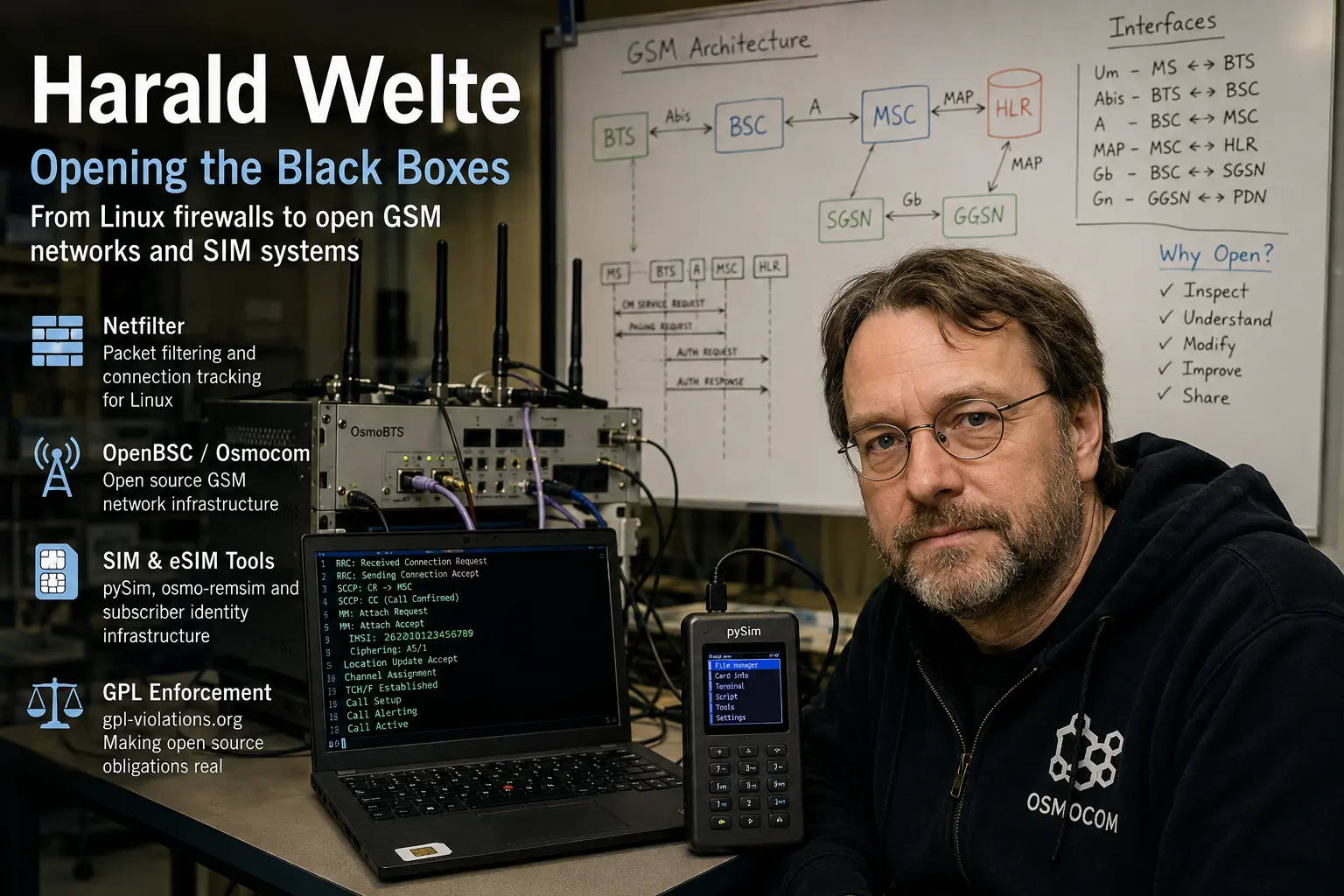
Harald Welte and the work of opening telecom’s closed interfaces
Harald Welte has spent more than two decades making communications infrastructure easier to inspect, test and maintain. From Linux packet filtering and GPL enforcement to open GSM networks and SIM tooling, his work shows that source code alone does not remove dependence: durable…

Europe and Middle East Institutional
GÉANT and the Federated Infrastructure Behind European Research
GÉANT does not replace Europe’s national research networks and does not operate a separate internet. The association provides a common continental layer – optical and IP connectivity, federated identities, cloud procurement, security coordination and global connections – enabling…

Europe and Middle East Institutional
GÉANT and the Federated Infrastructure Powering European Science
GÉANT does not replace national research and education networks in Europe, nor does it operate a separate internet from the public network. Instead, it provides those networks with a shared continental layer that includes optical and IP connectivity, identity federation, cloud…

Europe and Middle East Institutional
GÉANT and Europe’s federated research infrastructure
GÉANT gives Europe’s national research networks a shared continental layer for optical and IP connectivity, identity, cloud access, security and global collaboration without replacing national control. Its importance lies in federation: independently governed networks can operate…

Europe and Middle East Institutional
GÉANT and the Federated Infrastructure Sustaining European Science
GÉANT does not replace Europe’s national research networks nor operate a separate internet. It provides a common continental layer — optical and IP connectivity, federated identity, cloud procurement, security coordination, and global links — so that universities and scientific…
Global Cloud Services
Cloudflare's 2023 PDX outage made control-plane disaster recovery an accountability test
On November 2, 2023, Cloudflare's edge network continued to serve traffic while its control plane and analytics services were disrupted. The difference matters. A data plane is the part of a network that keeps packets and requests moving; a control plane is where operators and…
Europe and Middle East Institutional
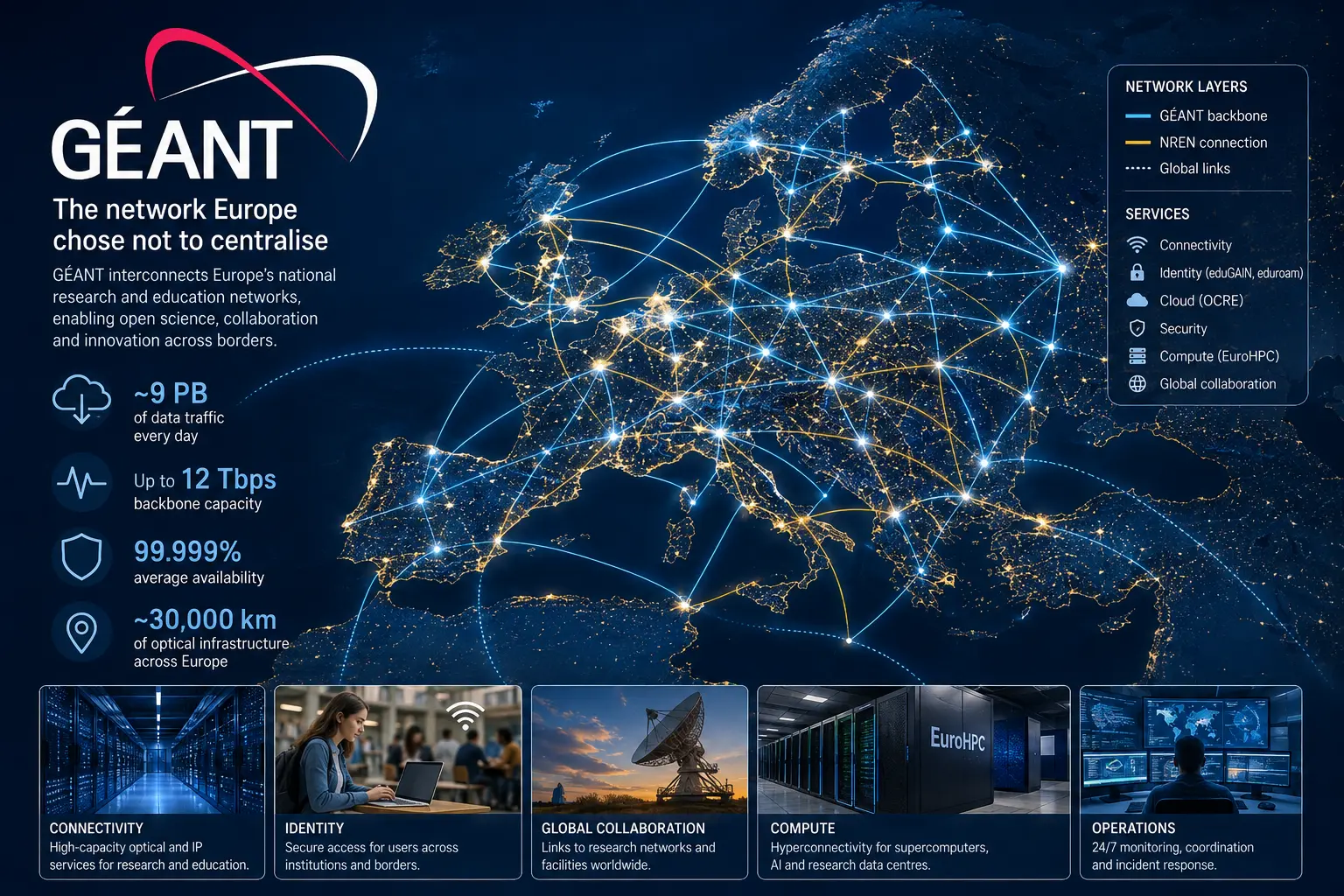
GÉANT and the network Europe chose not to centralise
GÉANT gives Europe’s national research networks a shared layer for optical capacity, routing, identity, cloud access, security and global collaboration. Its power comes from coordinating independently governed systems, but the same federation means that no single organisation…

North America Regional ISP
Inside The Internet, Inc and AS14473 show two announced IPv4 prefixes with uneven RPKI coverage
Inside The Internet, Inc and AS14473 show two announced IPv4 prefixes with uneven RPKI coverage intelligence summary explains the development, the public evidence available to readers, the organisations involved, the regional context, market exposure, and the infrastructure…

Latin America and Caribbean National Telecom
Hispamar's Brazil Control Centre Shows Why Satellite Links Still Need Local Operating Proof
Hispamar's Brazil Control Centre Shows Why Satellite Links Still Need Local Operating Proof intelligence summary explains the development, the public evidence available to readers, the organisations involved, the regional context, market exposure, and the infrastructure…

North America Institutional
ESnet: The Network That Connects Remote Research Facilities as One Scientific System
The Energy Sciences Network (ESnet) is a scientific network facility of the U.S. Department of Energy Office of Science, operated by Lawrence Berkeley National Laboratory. It is not a commercial telecommunications company or an independent corporation; rather, it is federally…

Leaders
Mohamed Nasr and the Route-Diversity Decisions Behind Egypt's Subsea Crossing Hub
The useful question about Egypt's place in international connectivity is not whether cables touch its shores. It is what an operator can actually choose after they arrive. A landing can be a geographic fact without becoming a flexible transit option. A collection of systems can…

North America Institutional
ESnet and the Network That Makes Distant Scientific Facilities Work as a Single Machine
The Energy Sciences Network connects US Department of Energy laboratories, instruments, supercomputers, and international collaborators through a dedicated scientific network. Its importance lies less in a speed figure than in the combination of fibre, routing, measurement…

North America Institutional
ESnet and the Network That Makes Remote Research Facilities Work Like a Distributed Machine
The Energy Sciences Network connects US Department of Energy labs, instruments, supercomputers and international partners over an infrastructure purpose-built for science. Its significance lies less in a speed record than in the combination of fibre, routing, measurement…

Asia-Pacific Datacenter Trends
Samsung Heavy signs floating data-centre engineering deal
Samsung Heavy and Mousterian have moved their US floating data-centre partnership into engineering, although no site, customer or construction order has been announced.

North America Institutional
ESnet and the science network that makes remote facilities work as one distributed machine
The Energy Sciences Network, known as ESnet, is not a commercial internet provider for individuals but a network facility of the U.S. Department of Energy's Office of Science. Operated by Lawrence Berkeley National Laboratory, it connects detectors, laboratories, supercomputers…

Asia-Pacific National Telecom Trends
Paul Abfalter to become FLAG CEO in October
FLAG’s strategy and revenue chief will succeed Carl Grivner, who will remain with the subsea network operator as chairman.

North America Institutional
ESnet and the network that turns distant scientific facilities into one machine
The Energy Sciences Network links US Department of Energy laboratories, instruments, supercomputers and international collaborators through a purpose-built scientific network. Its significance lies less in a headline speed than in the way fibre, routing, measurement…

Asia-Pacific National Telecom Trends
Telstra and Teneo warn AI is disrupting network forecasts
Telstra and Teneo executives say operators need new planning assumptions as AI changes where traffic originates, how it moves and when capacity is required.