
Summary
- BTW's public directory route for Hispamar Satelites S/A is live and identifies the existing company entry, distinguishing it from a generic satellite-company profile.
- Hispasat's public records support a narrow operating surface: Hispamar was tied to investment in a Brazil satellite control centre, a later Serviente teleport and control-centre operation, and a satellite-services portfolio presented at Futurecom 2016.
- The LACNIC membership and BTW directory record are useful identity records. LACNIC is the Regional Internet Registry for Latin America and the Caribbean, so the relationship supports a regional internet-number record, but it does not prove current route visibility, customer delivery, network capacity, legal licence scope or service resilience.
- A satellite control centre matters because satellite service is not only orbital capacity. Ground facilities, monitoring rooms, handoff sites, power, backhaul (the terrestrial transport between a satellite site and other networks), routing (the internet path-selection layer that tells traffic where to go), customer operations and escalation paths determine whether a service can be operated continuously.
- The available evidence does not show an outage, merger, new launch, coverage expansion or regulatory dispute. It shows an exact infrastructure identity and the public evidence boundary around that identity.
- "Brazil" is an operating context supported by directory and Hispasat records, not proof that every part of Hispamar's service is physically located, owned or resilient inside Brazil.
- For customers and counterparties, the important question is how orbital systems, ground stations, internet-number records and local support obligations connect when a service must keep working.
- The safe conclusion is that Hispamar's public record makes its Brazil ground-control surface visible enough to assess, while leaving customer geography, live capacity, route security, provider dependencies and continuity performance unproved.

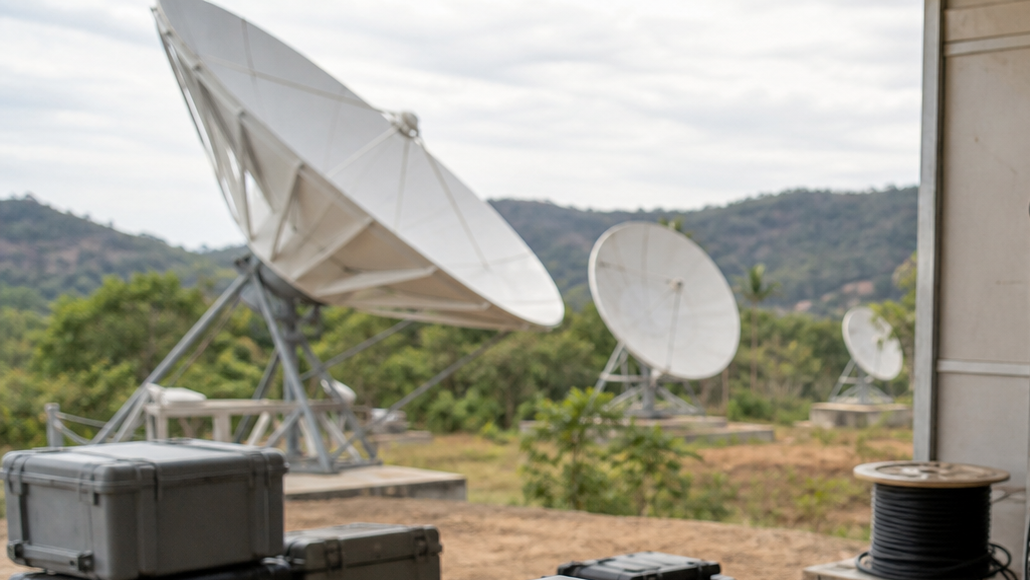
Illustrative satellite-ground antennas; the image does not depict a verified Hispamar facility, a real employee, a map, live network topology, coverage, bandwidth, redundancy or customer service condition.
What happened
Hispamar Satelites S/A has a stronger public infrastructure trail than many directory entries because the trail reaches beyond a static company name. BTW's directory route identifies the exact company object and associates it with Brazil internet-number records, including regional-registry membership plus ASN and IP-address identifiers.
Hispasat's public archive adds a separate operational layer: in 2016 it described investment in a satellite control centre in Brazil, in 2016 it also presented Hispamar's satellite launches and services portfolio at Futurecom, and in 2019 it described Hispamar operating from a new teleport and satellite control centre in Serviente, Rio de Janeiro.
Those records do not need to be inflated to be useful. The exact point is that Hispamar has a visible company boundary, a registry/member boundary and a ground-systems boundary. The company is not being described from a marketing slogan or a registry membership entry alone. The public records tie the subject to the practical side of satellite service: a place where signals, monitoring, control processes and operating responsibility meet the rest of the communications system.
That does not mean the public evidence reveals every operating fact. It does not show a current staffing roster, spacecraft-control procedures, service-level commitments, customer list, coverage map, bandwidth table, upstream internet paths, data-centre relationships or recovery design. It does not prove that every customer-facing service described by a parent or affiliate uses the same control facility. It also does not prove that a historic investment statement has the same exact operational meaning on 5 August 2026.
The useful reading is therefore layered. The directory layer tells the reader which Hispamar object is in scope. The LACNIC/member layer places the company near internet-number accountability without turning that record into a service-health certificate. The Hispasat operating-site layer shows that the satellite business had a documented Brazil ground-control and teleport surface. The missing customer-delivery layer remains missing.
For a non-specialist reader, the word "teleport" can sound abstract. In satellite communications it means a ground facility that sends and receives signals through antennas and related equipment. It is the terrestrial side of a service that may otherwise be described as space-based. A satellite control centre is similarly practical. It is the operational setting where monitoring and control work can occur. These ground systems are important because satellites do not remove the need for terrestrial accountability; they shift some of the most important dependencies into specialized facilities.
The public record around Hispamar is also a reminder that exact names matter. "Hispasat" and "Hispamar" are related names in the cited records, but they are not interchangeable labels for every claim. The exact subject is the Hispamar Satelites S/A company entry in the BTW directory and the public records that explicitly identify Hispamar. Claims about wider group ownership, consolidated financial condition, entire satellite fleets or every service sold under a related brand would require separate evidence.
The current public records support a narrower account of company identity, Brazilian ground operations and the need to keep registry and operating evidence separate.
Nothing in the evidence requires crisis language. The record does not say that a facility failed, that a satellite was at risk, that customer service changed or that a network route was withdrawn. It shows a continuity question that exists even in normal operations: when a communications provider depends on satellite capacity and terrestrial systems, what public evidence shows who is responsible for each layer?
That question is often more valuable than a single event announcement. Infrastructure decisions are made before failures become visible. A buyer, partner or regulator may want to know whether the party named in a directory also has a real operating surface, which ground facilities are relevant, which number-resource records identify the subject and which claims still need operator disclosure. Hispamar's record provides enough to ask those questions with precision, but not enough to close them all.
Why it matters
Satellite connectivity can be misunderstood because the satellite itself is the most visible part of the story. The public sees orbital coverage, launch news, service brochures and regional claims. The operating reality is more grounded. Antennas, control rooms, terrestrial backhaul links, internet-routing paths, power, physical access, monitoring systems and support teams determine whether the service becomes dependable communication rather than a high-level coverage statement.
That ground layer matters most when connectivity is used by people who do not manage satellites. A business may use a satellite circuit as primary access in a remote location, backup connectivity for a branch, transport for broadcast, government communications, maritime service, mining operations, rural education, health systems or emergency links. In each case, the customer buys an outcome: the link works, the provider can diagnose it, escalation reaches the right party and restoration follows a known responsibility chain.
An orbiting asset alone cannot prove that outcome. A satellite can be capable while a customer terminal, teleport, terrestrial backhaul, power supply, local regulatory condition or operations process creates the actual service boundary. A customer may experience an outage as a single loss of connectivity, but the cause can sit in any layer from an antenna alignment to an IP-routing handoff. The public evidence needs to identify the service layer being discussed before it can support a reliability claim.
Hispamar is useful because its public trail contains ground-system language, not only satellite-brand language. Hispasat's 2016 and 2019 records connect Hispamar to a Brazil control-centre and teleport context. Those records show that the company was not only represented through abstract service categories. The operations had a documented place and function in Brazil.
The evidence still has boundaries. A control centre is not a resilience certificate. A teleport is not proof of every route, backup path or customer service level. A portfolio presentation is not a current product catalogue. A directory record is not a licence. A membership record is not an uptime report. Treating any one of these as a complete proof would turn infrastructure reporting into guesswork.
For infrastructure readers, the value lies in resisting that shortcut. The public chain identifies Hispamar and shows a concrete ground-control surface. It allows a more precise set of questions: which services are controlled from which facilities, which ground stations hand off traffic to terrestrial networks, which third parties supply backhaul, how power and physical security are handled, how incidents are escalated, and what public network identifiers can be monitored.
Those questions are not hostile. They are normal due diligence for communications systems. A provider can have a strong operating system while disclosing only limited public detail. Public silence on topology or customer geography is common because operational data can be sensitive. The correct response is not to punish the provider for every missing field; it is to separate verified identity and operating surfaces from evidence that remains private or unproven.
That separation is also fair to customers. A customer deciding whether to use satellite service needs to know what the public record can support and which answers require direct contract disclosure. If public reporting says only that a company appears in a directory, the customer learns little about delivery. If public reporting says a company has a control centre and therefore must be resilient, the customer is misled. The more useful middle position is that a control-centre record gives a concrete operating point to examine, while resilience still needs proof.
For Hispamar, the practical infrastructure implication is narrower. The directory and LACNIC surface can identify the company and resource relationship, while the Hispasat facility records identify a ground-control context. Service resilience still depends on current facility operation, terrestrial handoffs, routing observations, support duties and contract terms, none of which is proved by labels alone.
For Hispamar, that approach creates a practical conclusion. The company has an exact directory identity and a documented satellite-ground operating surface in Brazil. That is enough for an infrastructure-accountability assessment rather than a generic corporate profile. It is not enough to certify current service quality, network security, customer reach or business continuity. Those remain the fields to verify before a buyer or public agency treats the service as critical.
The technical layer
The technical layer begins with the difference between a satellite system and a satellite service. A satellite system includes spacecraft and orbital resources, but a customer-facing service also needs ground equipment, network handoffs, operational monitoring and commercial support. The ground side is where the space segment becomes usable by ordinary networks and organizations.
A teleport sits at that boundary. It uses antennas and associated systems to communicate with satellites. It may support uplink, downlink, monitoring, traffic processing or other operational functions depending on design. The public record does not provide an exact equipment list, but the term still marks a terrestrial operating site rather than a vague corporate presence.
A satellite control centre is another boundary. It can support monitoring, command and operational control functions for satellite activity. Public references to a control centre therefore indicate that the company or group has described a place where satellite operations are managed. They do not reveal internal procedures, staffing levels, backup control arrangements or how responsibility is divided among entities.
Terrestrial networking remains part of the picture. Even when traffic crosses a satellite hop, it must eventually reach users, applications, data centres, operators or public networks on the ground. That can involve customer terminals, access circuits, private networks, gateways, internet exchange, transit, managed routers and application providers. A satellite service can fail or degrade because of any of those pieces, not only because of the satellite link.
RIR membership and ASN/IP network-resource references should be read in that context. An RIR, or Regional Internet Registry, records internet-number resources and associated organizations in a region. ASN means autonomous-system number, a public routing identity used by a network to exchange reachability information. IP network resources are the address and routing resources that let traffic be identified and carried across the internet. These records are essential for attribution, but they are still administrative records. They do not prove that a ground station is online, a route is visible, a service is secure or a customer is connected.
The BTW directory profile for Hispamar keeps the number-resource relationship narrow. It identifies the company as associated with LACNIC membership and ASN/IP network resources. That wording names the relationship without pretending the directory has inspected the operating network. The directory surface supports a resource and registry relationship; it does not prove operational control of all related infrastructure.
Hispasat's public releases add another evidence type. A company release is a first-party source, so it can identify stated investments, facilities, portfolio announcements and operating milestones. It is not independent performance measurement. It can support that Hispamar was described in relation to a Brazil control centre and later Serviente teleport/control-centre operations. It cannot, by itself, validate current capacity, customer experience, outage history or every technical feature.
Those limitations make the evidence more precise. Registry records answer who is associated with resources. Directory records answer which exact object is being discussed. Company releases answer what the operator publicly said about facilities or portfolio milestones. Live technical telemetry would answer whether routes are currently visible, whether ROAs are valid, what prefixes are originated and how paths change. Customer or contract evidence would answer service commitments. Each layer does one job.
Route security is an example of a missing layer. RPKI, or Resource Public Key Infrastructure, lets holders of internet-number resources publish route-origin authorizations that help networks validate which autonomous system may originate a prefix. The current public record does not include a route-origin validation result for Hispamar, so it does not support a claim about RPKI coverage, route security status or invalid-route risk. Route-security evidence would be relevant if the service or resource layer were evaluated in more detail.
Backhaul is another missing layer. Backhaul means the terrestrial transport that carries traffic between a site such as a teleport and other parts of a network. A teleport can be a strong operating point, but its continuity depends partly on power, terrestrial connectivity, equipment and support. The available records do not map those dependencies. They cannot show whether backhaul is diverse, which carriers are used, which facilities interconnect or whether alternate paths are tested.
The control-centre evidence also has to be dated. A 2016 investment reference and a 2019 operating reference are valuable historical and operating-site facts. They should not be silently treated as a current audit of the same facility. Public Hispasat records tied Hispamar to those facilities and activities, but they do not establish a specific current configuration without current supporting evidence.
Operating proof is therefore the central issue rather than a single new event. Hispamar's public record shows the kind of evidence that makes satellite infrastructure accountable: exact identity, ground-site language and a registry surface. It also shows what remains absent: current route observations, service topology, capacity, continuity plans, route-security metadata and customer impact.
The distinction helps avoid two opposite errors. The first error is to treat satellite service as if it floats above local infrastructure. It does not. The second error is to assume that one local facility proves the whole service chain. It does not. The useful technical reading is that satellite service depends on both orbital and ground systems, and public reporting must prove each layer separately.
Who is affected
The affected audience starts with customers or partners that depend on satellite links for continuity. A satellite service is often chosen because ordinary terrestrial networks are unavailable, expensive, fragile or insufficient for a particular site. That makes the service attractive, but it can also make the dependency more serious. If a mine, vessel, school, government office, broadcaster or remote enterprise uses a satellite link, the link may be the main path to applications, voice, monitoring, coordination or safety-related information.
Those users may not care about the phrase "RIR membership" during normal operation. They care when a problem has to be attributed. If the link degrades, they need to know which organization receives the ticket, which path is affected, which equipment should be checked, which provider has authority to escalate and whether the problem sits in the customer terminal, satellite segment, teleport, terrestrial backhaul or internet routing layer. Exact identity records help because they reduce confusion about the counterparty and the network-resource surface.
Network operators are affected in a different way. A satellite provider or satellite-linked network can participate in wider internet routing, private interconnection or managed enterprise connectivity. Operators need to know which autonomous system, resource holder or organization is involved when they troubleshoot routes, filter announcements, validate origin data or coordinate incidents. A directory entry and member record can give a starting point, but live routing evidence and contact reliability are still needed for operational work.
Regulators and public-sector buyers have another concern. Satellite links can support public services, disaster response, education, remote health, border operations, aviation, maritime, oil and gas, broadcasting or connectivity in underserved areas. A public agency does not need every engineering detail in public, but it does need a responsibility map. It should know which entity is contracted, which facilities and dependencies matter, how incidents are reported, how restoration is measured and what happens if a local ground path fails.
Investors and commercial partners should also separate identity from resilience. A company with documented control-centre and teleport language may have a more concrete operating story than one with only marketing copy. That does not automatically translate into lower risk, higher revenue, better margins or broader coverage. Commercial conclusions need contracts, customers, assets, financials and performance data. Public infrastructure evidence can improve the questions; it cannot replace the missing business records.
The broader internet community is affected because satellite systems increasingly interact with terrestrial networks. Satellite backhaul, direct-to-site links, enterprise circuits and remote connectivity can change how traffic enters and exits regional networks. If the public record does not distinguish number-resource identity from service delivery, routing discussions become less precise. A route can be visible without proving customer availability. A facility can exist without proving route diversity. A portfolio announcement can be real without proving current product terms.
For ordinary readers, the main lesson is simpler. Communications systems have hidden layers. A satellite link may be sold as coverage from above, but someone has to operate ground systems, maintain antennas, route traffic, power sites, monitor alarms and respond to customers. Public records are useful when they show which organization is tied to those layers. They are dangerous when they tempt readers to assume that everything behind the service is known.
Hispamar's case sits in that middle ground. The entity is exact. The ground-control surface is public. The number-resource relationship is visible. The customer and resilience picture is not complete. Those conditions support an evidence-bound assessment rather than a sweeping verdict.
The people most affected by the missing details are the ones who would depend on the link during stress. A business continuity manager needs to know whether a satellite service is independent from the same terrestrial path used by a primary circuit. A remote-site operator needs to know what spare equipment, weather response and support timing apply. A public agency needs to know whether a backup link has been tested under realistic conditions. A network engineer needs to know which prefixes, routes and contacts are current.
None of those answers can be inferred from the fact that a company appears in a directory or once announced a facility investment.
Missing evidence is therefore a decision boundary rather than a negative finding. The public record supports identity and operating-surface confidence. Decisions that depend on customer delivery need follow-up evidence closer to the service itself.
What to watch next
The first watch item is identity continuity. The existing BTW directory entry gives readers the company boundary for Hispamar Satelites S/A in Brazil. New evidence is most useful when it clearly names the same company, facility or operating responsibility. Similar names, parent-company references, regional business units and historic spellings can be useful context, but they should not silently absorb the Hispamar company boundary.
The second watch item is current ground-system evidence. The cited records include 2016 and 2019 Hispasat material. The strongest new evidence would be current first-party or authoritative material that confirms which control-centre and teleport functions remain active, whether names or locations have changed, and how responsibility is divided. Any current record should be dated and tied to the exact company and facility language.
The third watch item is live network-resource and routing evidence. The directory and LACNIC-member surface support an RIR and ASN/IP network-resource association, but not a claim about live route behavior without fresh routing captures. A current verification should check exact autonomous-system identifiers, announced prefixes, route-origin validation, routing neighbours and contact data. Each observation should preserve its time and method so a change over time is not confused with a different measurement view.
The fourth watch item is route security. Evaluation of Hispamar-linked number resources should check RPKI ROAs, origin validation status and any mismatch between resource holder, origin ASN and public service claims. RPKI does not prove overall cybersecurity, but it can answer a narrow and important question: whether a route origin has explicit authorization metadata. The current public record does not answer that question.
The fifth watch item is terrestrial dependency. A satellite service can depend on fibre paths, terrestrial transit, data-centre space, power, physical security, equipment maintenance and weather-sensitive field work. Public evidence rarely maps those details. A disclosure that identifies backhaul diversity, alternate teleport paths, restoration objectives or tested failover would materially improve the continuity picture. A broad statement about coverage would not be enough.
The sixth watch item is customer-facing service scope. Hispasat's Futurecom and facility records show that Hispamar was presented in relation to satellite launches, services and ground operations, but they do not provide a current product-level contract. A buyer would still need service availability, terminal requirements, installation rules, support hours, performance commitments, escalation channels, maintenance windows and outage-credit terms. Those fields are commercial and operational, not implied by registry membership.
The seventh watch item is the relationship between group-level statements and company-level responsibility. Hispasat sources mention Hispamar and provide useful first-party context, but each obligation still needs to be tied to the responsible company. Group announcements can describe shared infrastructure or subsidiaries, while customer contracts and regulatory obligations may sit with a particular legal or operating entity. The directory entry keeps those distinctions visible.
The eighth watch item is claim discipline around facilities and services. A control centre can be important without proving resilience. A teleport can be operational without proving capacity. A service portfolio can be meaningful without proving current availability. An RIR/member relationship can support identity without proving routing health. Readers should look for evidence that closes those specific gaps instead of treating one facility reference as the whole operating story.
The most efficient monitoring scope is narrow. It should include the current BTW directory page, current LACNIC/member visibility if accessible, the exact Hispasat pages cited here, and any authoritative current page that binds Hispamar to specific ground-system operations. Route claims require exact AS and prefix data rather than a generic "satellite provider" label.
That monitoring set would materially change the assessment only if it changed one of the proof layers: identity, ground operation, number resources, route behavior, route security, service scope or continuity. Anything else remains background context.
What this does not prove
The public record does not prove the current physical configuration of Hispamar's Brazil facilities. It supports public statements about investment, operation and facility language but does not provide a current engineering diagram. It does not identify the antennas, modems, monitoring systems, buildings, power feeds, providers or redundant paths in use on 5 August 2026.
It also does not prove customer coverage. A satellite operator may serve wide areas, but this specific public record does not provide a validated coverage map, customer list or current product catalogue. Coverage claims require first-party current product evidence or technical material that maps services to regions. Historic portfolio language is not enough.
It does not prove capacity. A teleport or control centre can support substantial operations, but the available public record does not state bandwidth, channel count, satellite capacity, spectrum usage, throughput, oversubscription, congestion or service quality. Any such claim would come from assumptions rather than the cited sources.
It does not prove uptime or resilience. Continuity depends on ground systems, space segment, power, routing, support, spares, contracts, access to sites and tested recovery practices. A facility may be central to continuity without proving that continuity. Public reporting should ask for evidence of redundancy and recovery rather than inferring it from the existence of an operating site.
It does not prove regulatory scope. LACNIC membership and number-resource association are internet-resource records. They are not telecom licences, satellite authorizations, spectrum assignments or public-service concessions. Regulatory claims belong to the relevant telecom, spectrum or corporate authorities and need their own sources.
It does not prove route security. RPKI and route-origin evidence would matter, but the current public record does not include a current RPKI result for Hispamar-linked routes. Therefore no route-security grade can be assigned from these records.
It does not prove ownership of every asset. Satellite operations often involve groups, affiliates, suppliers, leased facilities, managed services and partner networks. Hispasat records are strong first-party context for Hispamar, but they do not establish ownership or contractual responsibility for every component mentioned by implication. Asset ownership and service responsibility need direct evidence.
It does not prove a problem. The absence of a public capacity table or continuity map is common in infrastructure and is not evidence that Hispamar is unreliable. The record shows which facts are strong enough for accountability and which still require direct verification.
Keeping these non-claims explicit improves the assessment. Readers can rely on the exact identity and operating-surface facts without turning them into unsupported conclusions. Later evidence can be added layer by layer instead of forcing broad assumptions into the record.
Evidence map
The strongest identity evidence is the BTW directory route and company-directory binding. It gives the assessment a stable subject: Hispamar Satelites S/A, the Brazil company entry. The directory page states the company identity and the association with LACNIC membership and ASN/IP network resources. That is the foundation for avoiding same-name or group-level drift.
The strongest operating-surface evidence is the Hispasat archive material that mentions Hispamar and Brazil ground operations. The 2016 investment record supports the existence of a Brazil control-centre project. The 2019 record supports the later operating context for a Serviente teleport and satellite control centre. The Futurecom 2016 record supports the fact that Hispamar was presented in a satellite-launch and service-portfolio context at that time.
The LACNIC page is useful but limited. The directory-linked material records a LACNIC member-directory relationship, while one earlier capture of the public page was incomplete. That means the membership reference can support the directory's resource relationship, but the incomplete capture should not be treated as a complete current directory scrape. It is a supporting public-record signal, not a standalone operational proof.
The image is illustrative, not documentary proof. It uses satellite-ground antennas as a visual fit for the topic and contains no visible faces or text. It helps explain the ground-station theme but must not be captioned as a verified Hispamar facility or used as evidence for topology, geography, capacity or continuity.
The operating conclusion is narrow. RIR and number-resource records help establish Hispamar's resource identity, while telecom continuity depends on current systems, handoffs and support arrangements. The available public record supports a ground-control and registry-linked subject, not a complete map of every customer-facing satellite service.
This evidence map leads to a bounded but meaningful conclusion. Hispamar has enough public proof to be treated as an exact infrastructure subject with a Brazil ground-control surface. It does not have enough public proof to be treated as a fully mapped satellite service. The next useful step is targeted verification of current facility, routing, route-security, customer-scope and continuity fields.
How to read the directory record
The directory record is most useful when read as an identity anchor rather than a complete operating account. It gives the company a public identity in BTW's infrastructure directory, places the subject in Brazil and records a relationship with LACNIC membership and ASN/IP network resources. That prevents confusion with similar company names, parent-company references or broad satellite-industry language. It also gives later monitoring a stable object to revisit.
The record should not be asked to answer questions it was not built to answer. A directory profile can identify a company and point to a resource relationship. It does not inspect a control room, test a teleport, validate a spacecraft procedure, audit a licence, measure route security, verify an SLA or count customers. Those are different evidence classes. Treating the directory as universal proof would hide exactly where stronger evidence is needed.
The same restraint applies to the LACNIC surface. LACNIC is a Regional Internet Registry for Latin America and the Caribbean. Its records and membership surfaces are valuable because internet-number resources need accountable recordkeeping. If an organization is associated with number resources, operators and researchers can ask more precise questions about identity, contactability, allocation history and routing behavior. But a registry record is not a network operations centre.
It cannot show whether a circuit is up, whether a satellite gateway has alternate terrestrial paths or whether a customer ticket will be resolved within a promised time.
For Hispamar, the directory and registry layer become stronger because they are not alone. Hispasat's facility and portfolio records provide an operating context that a directory row cannot provide by itself. The sources therefore work together without collapsing into one another. The directory identifies the subject. The RIR/member surface identifies a resource-accountability context. The Hispasat records identify a ground-systems context. Their limits show what those layers prove and what they do not prove.
This is the difference between an evidence chain and a pile of references. In an evidence chain, each source has a job. If a source is used outside its job, the chain becomes weaker, even if the source is authoritative in its own domain. A first-party facility announcement can support that a facility was described by the operator, but it cannot measure uptime. A registry record can support attribution, but it cannot map physical routes. A directory profile can reduce entity ambiguity, but it cannot certify all operational claims.
That method also keeps later evidence easy to place. A current route table or route-origin authorization belongs with routing. A current facility page belongs with ground systems. A service catalogue belongs with customer scope. A licence or spectrum source belongs with the regulatory layer. Keeping those facts in their proper layers makes each conclusion narrower, more auditable and easier to correct if the source changes.
Readers benefit from that discipline because it keeps the conclusion usable. The public record is strong in some places and incomplete in others; it does not support either "Hispamar is fully transparent" or "Hispamar is opaque." Exact company identity is strong. Public ground-control and teleport language is strong enough to matter. Current service topology, live routing, route security, capacity, customer scope and continuity performance remain open. That is a better decision aid than either promotional confidence or unsupported suspicion.
The practical next step for any buyer, partner or public agency is therefore not a generic background check. It is a targeted evidence request. Ask for the current facility and service-responsibility map. Ask which entity signs the contract. Ask what route identifiers and internet-number resources are used for the service. Ask how teleport, backhaul, terminal, routing and support responsibilities are separated. Ask what redundancy is claimed and how it was tested. Ask how incidents move between Hispamar, any group-level operator, facilities, carriers and customer equipment.
For a non-specialist business reader, these questions separate identity from performance. A directory entry and number-resource relationship can show which organization is being discussed. A control-centre or teleport reference can show that the organization has been publicly associated with a real ground-system role. Neither fact alone shows whether a customer's link is available today, whether traffic has an alternate terrestrial path, whether a route is authorized, or which company must respond during an incident. Those answers require current operational, contractual and technical evidence.
Keeping those layers separate helps a buyer avoid two costly errors: trusting a brand name as proof of delivery, or dismissing a genuine operating surface because every dependency is not publicly mapped.
Those questions are grounded in the available public record. They do not assume wrongdoing, and they do not assume resilience. They translate an exact directory identity and a documented ground-control surface into a clear checklist for operational proof.
Sources
- https://btw.media/en/directory/hispamar-satelites-s-a-br
- https://www.hispasat.com/en/press-room/press-releases/archivo-2019/367/hispamar-starts-operating-from-its-new-teleport-and-satellite-control-centre-in-serviente-rio-de-janeiro
- https://www.hispasat.com/en/press-room/press-releases/archivo-2016/229/hispasat-invests-in-a-new-satellite-control-centre-in-brazil
- https://www.hispasat.com/en/press-room/press-releases/archivo-2016/243/hispamar-announces-new-satellite-launches-and-services-portfolio-at-futurecom-2016
- https://milacnic.lacnic.net/lacnic/asociados/publico?locale=EN
Member Briefing
Deeper Profile Context
Sign in with the right membership level to unlock the full briefing and source notes.
Only for Strategic Circle
Strategic Circle
Open to all readers. Unlock profile briefings after joining and signing in.
Join Strategic CircleOnly for Leadership Alliance
Leadership Alliance
For qualified IP-asset owners and management; sign in to unlock alliance briefings.
Join Leadership Alliance