
Summary
- GÉANT is a Dutch membership association, legally GÉANT Vereniging, which operates a pan-European research and education network and coordinates services together with national research and education networks (NRENs). Its value lies in making independently run national systems interoperable.
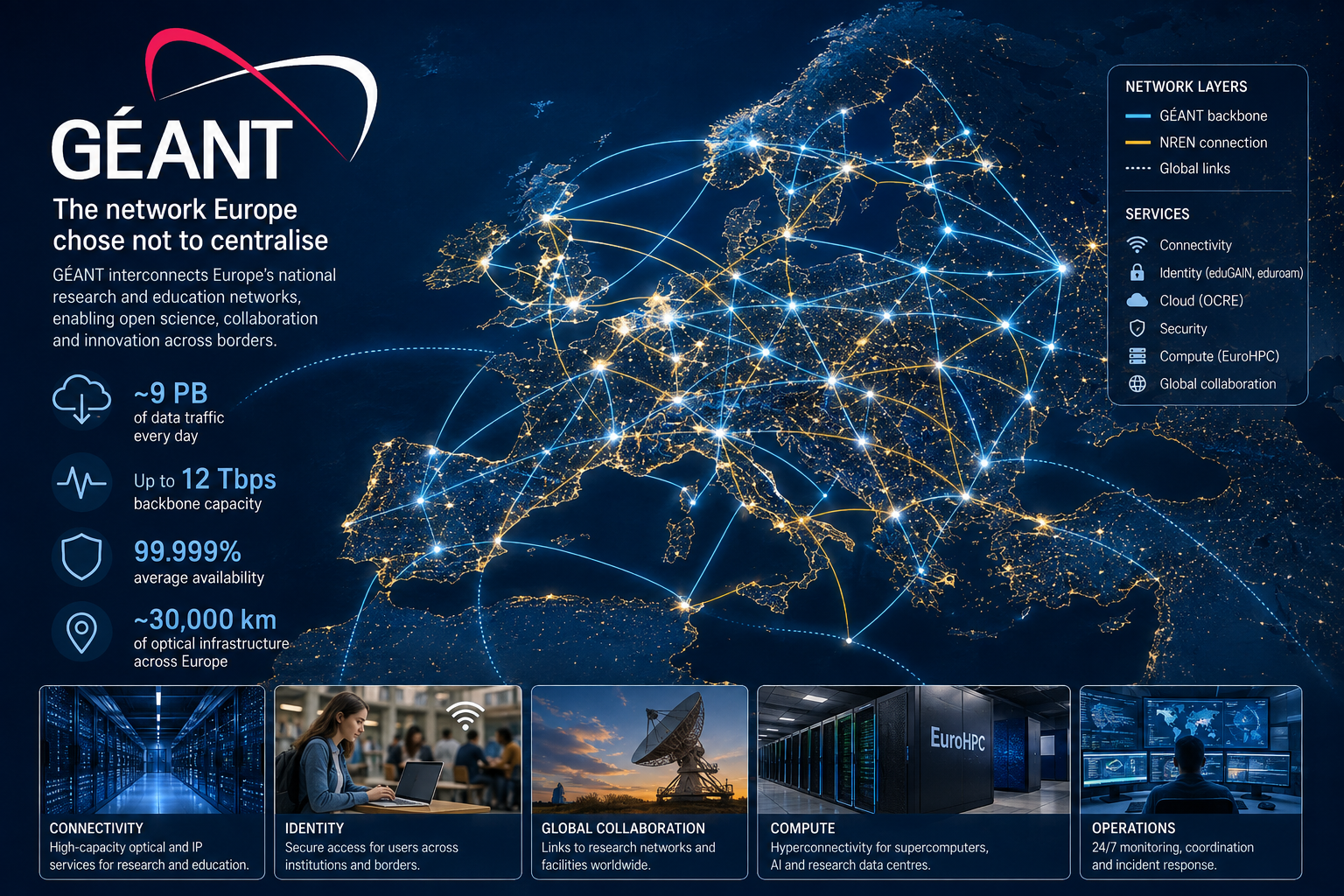
- The network carries approximately 9 petabytes of data per day, has backbone capacity of up to 12 terabits per second, and reports an average availability of 99.999 percent. These figures measure different levels of operation.
- The infrastructure combines an open optical system built under the GN4-3N programme with a Nokia IP/MPLS platform introduced between June 2024 and January 2026. The migration covered 32 sites and 1,240 services.
- Today GÉANT also coordinates eduroam and eduGAIN, cloud procurement via OCRE, security communities, global research links, and new services for EuroHPC and EUMETSAT. At the same time, its dependencies on public funding, NRENs, carriers, cloud providers and equipment vendors increase.
The Continental Layer Becomes Visible When a Path Crosses Borders
When someone opens a research portal or transfers a scientific dataset, they usually see the name of the university, the lab, or the national network. GÉANT stays in the background. The continental layer emerges when data must cross several countries, reach a supercomputing centre or a large research facility, or be handed off to another regional research network.
The path leads from the campus to the national research and education network (NREN) and from there to GÉANT. The responsibility of the national operator remains throughout.
Federation Is the Operating Model
Europe did not build a centrally managed academic network. National organisations remained responsible for their countries and cooperated through a shared continental layer. This reflects differences in funding, telecommunications markets, geography, higher education systems and technical development.
The federation creates reach without superseding local control. But it also means that end-to-end quality is assembled from multiple administrative domains. The campus, the NREN, GÉANT, the partner region and the destination facility may each control part of the path.
Association, Network and Project Are Not the Same
The name GÉANT designates three interconnected structures. GÉANT Vereniging is the Dutch legal entity that employs staff, holds contracts and is governed by its members. The GÉANT network comprises the optical, packet‑based and service‑related infrastructure. The GÉANT Project refers to successive programmes co‑funded by the European Commission and the NRENs.
A contributor to GN5 may be employed by an NREN, a member network remains legally independent, and a funding phase can end while the association and the production network continue.
A Specialised Network Remains Connected to the Public Internet
“Europe’s academic Internet” is useful only as a shorthand. GÉANT uses IP, BGP, Ethernet, MPLS and optical transmission like other networks. The specialisation comes from eligibility, policies, capacity and operating relationships, not from a separate protocol suite.
GÉANT IP provides private IP transit within the eligible research and education community. GÉANT World Service procures commercial Internet access for NRENs. In addition there is local peering, commercial transit and direct cloud interconnections.
Europe’s Fragmented Starting Point Prevented a Simple Central Design
Research networks emerged before commercial Internet services were widely and uniformly available. Universities used national academic networks, EARN, X.25 and early IP systems with diverse contracts and technical prerequisites.
A single continental replacement network would have required an organisation that takes over local access, staff, budgets and political responsibilities. Layering was more practical: national networks served their communities, while European entities organised common services and cross‑border capacity. That decision still shapes both the strengths and the limits of GÉANT.
RARE Created the Institutional Foundation for Collaboration
RARE was founded in 1986 as a European coordination body for research networks. The work included technical collaboration, policy, planning and knowledge exchange. In 1992 RARE also supported early activities of the RIPE NCC.
The critical habit was tackling requirements and operational problems together. For procurement, contracts and day‑to‑day network operations, however, the community needed a more specialised organisation.
DANTE Turned Coordination into Procurement and Operation
In 1993 RARE set up DANTE to procure and operate pan‑European network services. This separated community representation and technical collaboration from supplier contracts, project management and production operations.
DANTE became the executive layer that could conclude capacity contracts, manage providers and account for public funds. This operational function was later absorbed into today’s association.
EARN and RARE Merged into TERENA
EARN had operated as a European academic network since the 1980s. In 1994 RARE and EARN merged to form TERENA. The association combined member representation, technical communities, conferences and knowledge sharing, while DANTE continued to handle much of the production and procurement.
As identity, security, cloud access and network operations grew more intertwined, this institutional separation became increasingly awkward.
The First GÉANT Network Went Live in 2001
Historical sources date the programme start as 2000 and full operational service as 1 December 2001. The two dates describe different stages: the project launch and the completion of the production network.
The shared multi‑gigabit environment gave NRENs a reliable hub for cross‑border traffic, common operational processes and later specialised services. Research collaborations no longer had to procure their own continental connection from scratch for each project.
GÉANT2 Increased Control Over the Optical Layer
During the GÉANT2 phase of the 2000s the community gained greater access to fibre, wavelengths and long‑term optical resources. Fully managed carrier links are easy to consume but leave upgrade timing, routing and some fault diagnosis to the supplier.
More optical control enabled dedicated wavelengths, user‑controlled circuits, better predictability and support for data‑intensive research. At the same time the demands on optical engineering and operations increased.
Identity, Security and Community Work Broadened the Mission
Over the following decade GÉANT evolved from a backbone project into a multi‑layer infrastructure. eduroam made institutional access mobile, eduGAIN linked national identity federations, and certificate and security programmes built shared trust mechanisms.
Multi‑domain services connected projects across several operators. Cloud exploration, performance measurement and global partnerships were added. The organisation now had to integrate technical services, community work and programme logic at the same time.
The 2014 Merger Combined Operations and Member Governance
On 7 October 2014 DANTE and TERENA merged to form today’s GÉANT Association. The new structure combined DANTE’s procurement, project and operational expertise with TERENA’s member governance, technical communities and trust services.
The merger did not remove every internal boundary, but it made a single organisation responsible for network, identity, security, cloud, communications and EU projects.
A Dutch Legal Seat Does Not Make GÉANT the Owner of National Networks
GÉANT Vereniging is registered in the Netherlands under number 40535155, maintains the UK establishment BR019807 in Cambridge, and has had a small policy office in Brussels since October 2025.
These legal and institutional structures enable contracts, employment and representation. They transfer neither ownership of national backbones nor authority over campus networks to the association. The NRENs remain independent operators.
A Federation Can Be Counted in Several Correct Ways
The GÉANT homepage lists 43 European NRENs. The formal membership page counts 37 NREN members, NORDUnet representing five Nordic NRENs, and further associate members.
This is not necessarily a contradiction. The figures capture legal members, represented national networks and operational reach in different ways. GÉANT itself says it reaches more than 50 million users at around 10,000 institutions – mostly through the NRENs rather than through direct end‑user contracts.
The Members Govern an Organisation That Also Serves Them
The General Assembly is the supreme body and elects the Board. Gilles Massen was the Chair at the reference date, although he had wanted to step down earlier under a succession arrangement. Lise Fuhr has been CEO since November 2024.
For NRENs, GÉANT is a provider they themselves help steer. That keeps services close to community needs but demands compromises between countries with different resources.
GN5 also encompasses hundreds of staff at partner NRENs, not only the association’s own employees. At the end of 2024, 171 employees were reported. The net increase of eight people in 2025 does not provide a reliably attested new headcount.
The Physical Backbone Is Assembled, Not Fully Owned
GÉANT combines long‑term rights to dark fibre, spectrum and wavelengths with managed capacity, submarine cables, optical equipment, data centre space and partner links. The association does not own every duct, cable or building.
Its value comes from assembling these disparate rights, assets and supply chains into a coherent, operated system. The degree of control varies by route. Upgrade freedom, repair dependency and cost differ accordingly.
GN4-3N Rebuilt the Optical Foundation
Between 2019 and 2023 the GN4‑3N programme brought 69 routes into service, installed 405 Infinera nodes, decommissioned 50 legacy links and lit 26,047 kilometres of dark fibre or spectrum in 34 countries.
It formed today’s open optical foundation, reached peripheral sites and created more room for spectrum services, new coherent optics and experiments. The numbers are programme values and should not be read as a complete inventory of current routes.
An Open Line System Trades Simplicity for Long‑Term Flexibility
The Infinera FlexILS system separates fibre, amplification and the ROADM layer from transponders, pluggable optics and packet routers. This allows GÉANT to introduce new transmission technology or so‑called alien wavelengths without replacing the entire optical line.
Benefits include greater supplier choice, longer lifecycles and spectrum services. The drawbacks lie in multi‑vendor interoperability, more demanding performance planning and potentially unclear support boundaries.
Openness reduces dependence on single suppliers only when interfaces are tested, staff are trained and alternatives remain practically usable.
26,047 and About 30,000 Kilometres Refer to Different Scopes
The GN4‑3N final figure of 26,047 kilometres refers to lit fibre or spectrum within a defined programme. Later depictions of the wider infrastructure quote roughly 30,000 kilometres.
Extensions, different measurement boundaries and rounding can explain both figures. They should neither be added together nor interpreted as contradictory ownership statements.
Capacity and Traffic Are Not the Same Speed
The current network page states roughly 9 PB of traffic per day, up to 12 Tbps backbone capacity and average availability of 99.999 percent. The 2025 annual report records 3.6 exabytes, i.e. an average of nearly 9.9 PB per day.
Optical spectrum, 100G, 400G and 800GE interfaces, aggregated IP capacity, dedicated circuits and actual traffic are different measures. A backbone rated at 12 Tbps does not mean that every NREN, every path or every individual transfer receives that capacity.
The Nokia Migration Changed More Than the Router Vendor
In 2023 GÉANT selected a Nokia IP/MPLS platform under a framework led by Nomios to replace the Juniper layer. The live migration between June 2024 and January 2026 covered 32 sites and introduced an 800GE‑capable platform.
The teams did not copy existing configurations unchanged. They modelled services, identified undocumented behaviour and rebuilt the desired state based on the design.
Nevertheless, an 800GE interface does not guarantee equivalent end‑to‑end capacity. The optical layer, the remote infrastructure and the individual NREN access impose further limits.
1,240 Services Were Migrated on the Live Network
The transition moved 1,240 services across 29 existing and three new sites. New and old core systems were interconnected, routing and services were checked, paths were shifted gradually and legacy equipment was removed only afterwards.
GÉANT reported no service outage caused by the migration programme. This statement refers to the migration and does not mean that no other network incidents occurred during the same period.
GAP Moved Design and Intent Closer to the Source of Truth
The GÉANT Automation Platform (GAP) is built on the Open‑Source Workflow Orchestrator and related tools. A service request is translated into data and intent models, checked, converted into configuration and then validated using telemetry.
This makes the design – not the incidental state of individual devices – the primary reference. It requires clean inventories, clearly assigned responsibilities and models that actually capture hidden operational knowledge.
Automation Reduces Deviations and Enlarges the Potential Blast Radius
Repeatable workflows reduce typos, accelerate provisioning and improve consistency across many sites. A wrong model or a faulty template, however, can roll out the same wrong change to many places at once.
That is why the platform needs lab environments, pre‑flight checks, staged rollout, telemetry, abort criteria and rollback capabilities. Automation does not eliminate risk. It shifts it from individual commands to models, checks and approval processes.
GÉANT IP Offers Private Transit for Research and Education
GÉANT IP connects eligible NRENs and research organisations through a private routing environment for research and education. The service suits European and global research traffic that should be handled separately from the general Internet.
Private here means neither physically isolated nor immune to routing or supplier risks. The term describes the participating community, its policies and the operated transit service.
GÉANT World Service Adds Commercial Internet Access to the Research Network
NRENs also have to provide students and institutions with access to the general Internet, software‑as‑a‑service offerings and commercial cloud services. GÉANT World Service aggregates and procures the transit required for that purpose.
The separation allows research traffic, the public Internet, cloud access and private projects to be routed and billed differently. It also confirms that GÉANT is not an air‑gapped parallel Internet and remains dependent on commercial providers.
Dedicated Circuits, VPNs and GÉANT Open Serve Different Purposes
Point‑to‑point services provide fixed Layer‑1 or Layer‑2 capacity for projects with predictable or isolated paths. Layer‑3 VPNs create private routed networks, while GÉANT Open offers a controlled exchange environment for NRENs and approved organisations.
Spectrum and managed wavelengths serve even more specialised requirements. These offerings differ in isolation, flexibility, cost and lock‑in to endpoints. They are not interchangeable labels for the same link.
A Multi‑Domain Service Ends at Another Operator’s Responsibility Boundary
A cross‑border circuit can traverse GÉANT and several NRENs. Joint provisioning and monitoring can make it look like a single service, but each domain controls its own equipment, maintenance windows and escalation paths.
Fault resolution therefore needs clearly defined handover points, shared identifiers, synchronised timing and a central point of contact that does not obscure the real responsibility boundaries.
The Operations Centre Does Not See the Path Fully End‑to‑End
The GÉANT Operations Centre works around the clock, handling monitoring, incident management, maintenance, ticket management and partner coordination. Within its own core the view is detailed. Outside that it depends on campuses, NRENs, carriers and destination facilities.
perfSONAR and Data Transfer Node tests measure packet loss, latency and throughput. This helps distinguish backbone problems from misconfigured servers, firewalls or national access links. The measurement locates the bottleneck, but only the responsible organisation can fix it.
Five Nines Can Coexist with Numerous Incidents
For 2025 GÉANT reported 23 Priority‑1 service outages with an average resolution time of two hours and 1,581 Priority‑2 events. The five‑minute response target was met in 98 percent of cases.
A high annual average can conceal short, regional or redundancy‑only incidents. Operators should therefore look at duration, affected services, loss of backup paths and recurring patterns alongside a single availability figure.
Global Science Needs Links Beyond Europe
GÉANT works with regional and national partners such as Internet2, ESnet, CANARIE, RedCLARA, TEIN*CC, ASREN, WACREN and UbuntuNet Alliance. Programmes and investments cover transatlantic spectrum, Blue‑Raman, Medusa, EUMEDplus and AfricaConnect.
The association coordinates procurement and relationships but does not own a single global backbone. International links remain dependent on submarine cables, carriers, landing stations and the regional networks.
The Sparkle Agreements Linked Regional Systems Without Creating a Central Owner
On 31 July 2026 GÉANT announced three new capacity agreements with Sparkle: Slough–Allan to strengthen the ASREN connection to SESAME, Marseille–Cairo for ENSTINET, and a route between Lagos and Cape Town linking WACREN, UbuntuNet Alliance and South African networks.
The parties described Lagos–Cape Town as the first direct connection of African regional research and education networks on African soil. This wording remains an attributed claim within a particular definition of regional research networks.
Long‑Term Spectrum and Cable Commitments Trade Flexibility for Continuity
Transatlantic spectrum shares, Blue‑Raman, Medusa and other long‑term capacity reduce reliance on short‑term leased links and diversify routes to Africa, the Middle East and Asia.
At the same time they commit capital and operations for many years to cable systems, landing stations, permits, currencies and suppliers. Two routes shown separately on a map may use the same physical corridor. Real diversity requires verified pathing, repair plans and alternative handover points.
eduroam Made Institutional Identity Mobile
With eduroam the visited institution provides Wi‑Fi access while the home institution checks credentials via federated RADIUS chains. GÉANT coordinates the European and global components but does not centrally store all passwords.
At the end of 2025 eduroam was available at 45,000 locations in 112 territories and handled 9.2 billion authentications. The service quality remains dependent on national operators and home institutions.
eduGAIN Connects Identity Federations Without Replacing Them
eduGAIN exchanges trusted metadata between national identity federations so that a service can accept users from different countries. The home institution authenticates the person, while the service provider decides on authorisation.
At the end of 2025 there were 83 participating members, seven candidates and more than 10,100 entities – including around 6,200 identity providers and 3,900 service providers. Shared metadata does not eliminate differences in attributes, security levels or response speed.
MyAccessID and MyAcademicID Bring Federated Identity to Compute and Mobility
MyAccessID provides research infrastructures with a managed authentication and authorisation layer that includes protocol translation, identity linking, group management and entitlements. The service was selected for EOSC and the EuroHPC Federation Platform and had about 55,000 registered users in 2025.
MyAcademicID supports cross‑border university and student processes and had served nearly 700,000 users. Both services simplify access but remain dependent on the assertions of home institutions and the policies of resource providers.
Cloud Procurement Became Another Shared Continental Layer
Through OCRE GÉANT aggregates requirements and procurement processes for commercial cloud and software services. In 2025 more than 1,100 institutions in 29 countries actively used the framework contracts. The cumulative value was expected to exceed 500 million euros.
The current catalogue lists offers in 39 countries. Active usage and offer availability are different measures and should not be treated as identical reach figures.
OCRE Organises Access to Clouds but Does Not Run Their Platforms
GÉANT defines community requirements, runs tenders, selects providers and resellers, and supports NRENs and institutions in their use. Compute, storage, platform availability and many security controls remain with the cloud provider and the customer.
The framework can reduce contracting overhead. However it does not remove egress costs, data sovereignty questions, vendor lock‑in, outages or the local responsibility for architecture and access.
Security Is Both a Service Portfolio and a Community Practice
GÉANT combines DDoS detection and mitigation, upstream filtering, flow analysis, certificates, eduVPN, TF‑CSIRT and TRANSITS training. Some capabilities protect the continental network, others strengthen national and institutional teams.
At the end of 2025, 230 organisations used eduVPN as an enterprise VPN. Shared software avoids duplication but does not standardise local policies. Trust communities and training speed up cross‑border collaboration but do not replace local CSIRTs or adequate staffing.
ISO 27001 Applies Only to the Certified Management Scope
In 2025 GÉANT achieved ISO/IEC 27001 certification. It confirms an information security management system for a defined scope, not the flawlessness of every application, NREN, supplier or project partner.
The certification signals governance and process discipline. Its effectiveness, however, only becomes visible in asset inventories, risk treatment, testing, incident response and the consistent inclusion of external dependencies.
EuroHPC Makes Connectivity Part of Europe’s Compute Strategy
In September 2025 EuroHPC JU awarded GÉANT a contract worth up to 60 million euros over 48 months. GÉANT is to design, deploy and operate a hyper‑connectivity infrastructure for supercomputers, national HPC centres, AI factories, quantum facilities and research computing centres.
Terabit links, resilience, secure operational models and identity integration are to be delivered through GÉANT and the NRENs. Initial services were planned for 2026. The award does not, however, prove that all sites are already active with the planned capacity.
EUMETSAT Shows the Value of a Single Interface Across Multiple Networks
In May 2026 GÉANT concluded a five‑year framework contract with EUMETSAT. The association acts as a single point of contact and coordinates NRENs and regional networks for terrestrial weather data distribution, site connectivity, monitoring, reporting and contracts.
The simplification comes from a single contractual and operational interface. Technical performance still depends on each participating network and the EUMETSAT end systems.
Scientific Data Movement Exposes the Limits of Ordinary Enterprise Networks
Particle physics, radio astronomy, Earth observation, climate science, genomics, fusion, artificial intelligence and quantum research generate data volumes that demand specialised paths and well‑tuned transfer nodes.
End‑to‑end throughput depends just as much on servers, storage, firewalls and campus and NREN access. Data Transfer Node tests help separate network capacity from end‑system limitations.
The Helsinki Declaration of June 2026 commits six regional research and education networks to Earth observation collaboration. It is a strategic agreement, not a new physical link.
Optical Fibre Can Be Both a Communication Path and a Scientific Instrument
Controlled research fibre can be used for quantum experiments, precision timing and environmental sensing alongside data transport. That changes the value of a route: access to fibres, amplifiers and sites can enable research that would be harder to conduct on fully managed carrier services.
However, trials must not be presented as continent‑wide production services. Calibration, operation, data protection and sharing must be sorted out on a case‑by‑case basis.
Quantum Key Distribution Over 254 Kilometres Was a Milestone, Not a Service Launch
In 2025 GÉANT reported practical quantum key distribution work over 254 kilometres of ordinary telecom fibre. This enabled a test in a near‑production environment.
A permanent offering would require key management, loss budgets, a trusted‑node architecture, classical authentication, standards, monitoring and cost control. The demonstration proves development capability, not the existence of a Europe‑wide quantum security service.
Precision Timing Connects Networks with Metrology and Distributed Experiments
A White Rabbit pilot between Prague and Vienna explored precise time and frequency transfer for radio astronomy, metrology, particle physics, quantum systems and distributed sensing.
Such a service uses network paths differently from ordinary traffic. Asymmetries, temperature variations and calibration become critical factors. The pilot was not a ready‑made pan‑European timing network but a test of technical and operational feasibility.
Distributed Acoustic Sensing Turns Live Fibre into a Sensor
In a trial on the Amsterdam–Zandvoort route, distributed acoustic sensing analysed changes in backscattered light and generated 160 GB of measurement data within one hour.
Vibrations can indicate traffic, trains, aircraft, earthquakes, sea conditions or cable disturbances. Using production fibre raises questions about equipment access, data volume, privacy, scientific calibration and coexistence with communications services.
The Digital Research Environment Aims to Unite the Entire Stack
The planned Digital Research Environment is intended to link community and commercial clouds, network, identity, security, resource allocation, usage control and a common wallet. It responds to research workflows that today have to span multiple portals, accounts and contracts.
In 2025 it was funded as an innovation and proof‑of‑concept programme. At the reference date it must not be presented as a mature, universal European service. The difficult questions concern governance, portability, cost allocation and accountability.
European Sovereignty Means Steered Choice, Not Technological Independence
GÉANT strengthens European‑led connectivity through long‑term fibre and spectrum rights, shared identity, procurement leverage and support for EuroHPC.
Yet the infrastructure uses global cloud providers, commercial submarine cables and technology from Nokia, Infinera and others. In this context, sovereignty means being able to influence terms, preserve alternatives and make dependencies visible. It does not mean complete technological autarky.
The Funding Model Combines Membership with Public Programmes
For 2025 GÉANT reported income of 58.159 million euros and a profit after tax of 1.509 million euros. Of that, 39.760 million euros came from the GÉANT project, 9.975 million euros from international projects and 5.225 million euros from membership fees. European Commission grants accounted for 63 percent of income.
Membership fees create institutional continuity but do not replace the programmes that fund much of the development and international work. As an association GÉANT has no shareholders. The general reserve of 19.802 million euros serves the mission.
High Cash and Short‑Term Liabilities Reflect the Project Cycle
At the end of 2025 the balance sheet showed total assets of 130.545 million euros, cash of 61.075 million euros, receivables of 54.555 million euros and current liabilities of 108.935 million euros.
Large EU projects are often pre‑financed before eligible costs are incurred. The cash is therefore not freely available corporate treasure. Likewise, the short‑term obligations are not automatically a crisis signal. Both must be read in the context of project lifetimes and billing cycles.
The 2026–2030 Strategy Demands More Than Transporting Data
“Powering Knowledge for Europe” sets three goals: strengthen physical and human networks, create scalable digital services with new technologies, and develop a sustainable funding model for core operations and growth.
Guiding principles include member focus, innovation, scalability, financial logic, proactivity and impact. The real test is not the number of pilots but which services transition to permanent operations, secure funding and receive clear accountability.
The one‑person office in Brussels is meant to improve policy and funding dialogue but is not an operations centre.
Risks Accumulate at the Boundaries Between Members, Suppliers and Services
GÉANT depends on NRENs, the European Commission, carriers, fibre and colocation providers, equipment vendors, cloud platforms, identity federations and research institutions.
Major risks include changes to funding, supplier concentration, automation errors, submarine cable faults, cyberattacks, cloud dependency, uneven identity security and slow national adoption.
Nokia and Nomios bring uniformity but concentrate roadmap and support. OCRE can aggregate usage with large cloud providers. eduGAIN distributes trust but also vulnerabilities.
The sources show no credible major fraud or manipulation scandal. The burden is structural: observability, alternatives and tested transitions determine whether ordinary dependencies become systemic failures.
GÉANT’s Importance Lies in Shared Layers That Preserve Local Control
GÉANT does not centralise all of Europe’s research networks, nor all accounts, cloud contracts or projects. The association creates shared optical and IP capacity, identity trust, security practices, procurement frameworks, operational coordination and global links.
That is why the organisation is easy to overlook and hard to replace. Its successes often appear under the name of a university or an NREN. Its limits, too, remain federated.
The lasting contribution of GÉANT is to enable coordinated scale without turning Europe’s research infrastructure into a centrally owned and controlled network.
Member Briefing
Deeper Profile Context
Sign in with the right membership level to unlock the full briefing and source notes.
Only for Strategic Circle
Strategic Circle
Open to all readers. Unlock profile briefings after joining and signing in.
Join Strategic CircleOnly for Leadership Alliance
Leadership Alliance
For qualified IP-asset owners and management; sign in to unlock alliance briefings.
Join Leadership Alliance