
Summary
- GÉANT is a Dutch member association, formally GÉANT Vereniging, that operates a pan-European research and education network and coordinates shared services with national research and education networks. It is not a commercial carrier, a centrally owned European campus network or a separate internet
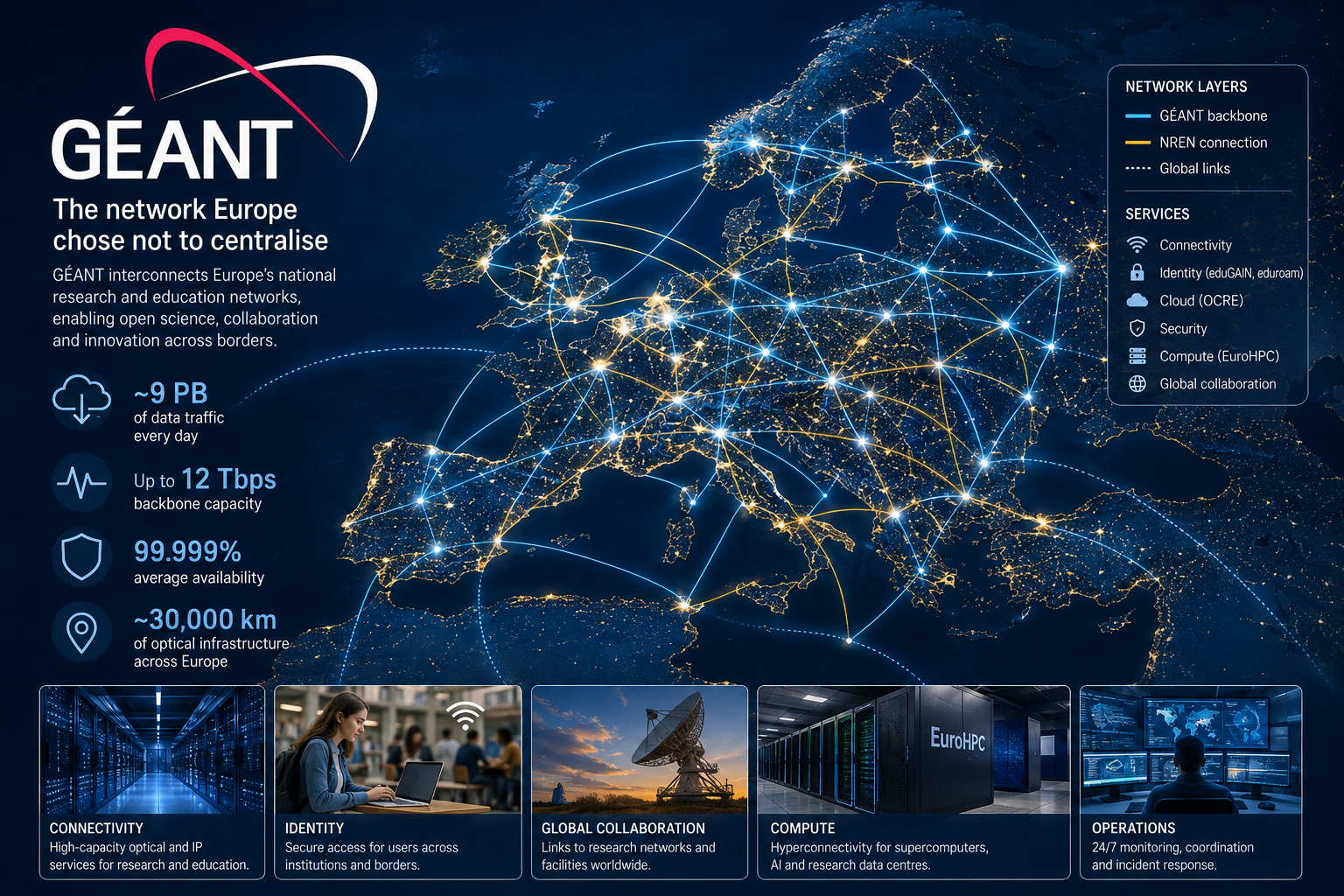
- The network reports about 9 petabytes of traffic a day, backbone capacity of up to 12 terabits per second and average availability of 99.999%. These figures describe different layers and averages; they do not mean that every path runs at 12 Tbps, every user receives that speed or no outage occurs
- GÉANT’s current infrastructure combines an open optical system built through GN4-3N with a Nokia IP/MPLS platform migrated between June 2024 and January 2026. The packet transition covered 32 sites and 1,240 services and used the GÉANT Automation Platform to rebuild services from intent models rather than reproduce legacy configurations line by line
- GÉANT’s role now extends beyond connectivity into eduroam, eduGAIN, cloud procurement, security coordination, global research links, EuroHPC hyperconnectivity and EUMETSAT data distribution. That breadth creates strategic value while increasing dependence on public funding, national networks, commercial carriers, cloud providers, equipment vendors and the quality of federated operations
The continental layer appears when a scientific path crosses borders
A researcher normally encounters a university, laboratory, supercomputer or national research network rather than GÉANT itself. The continental layer becomes visible when a path crosses a national boundary, reaches a European scientific facility, enters a specialist exchange or continues towards another regional research network. GÉANT sits behind many of these interactions, providing common infrastructure and operating relationships rather than a retail connection to the individual at the keyboard.
The path remains layered. A campus connects to a national research and education network, usually known as an NREN. The NREN connects to GÉANT for continental and global services while retaining its domestic infrastructure, policies, member relationships and local support responsibilities. GÉANT therefore creates European reach without taking over the national networks that researchers use directly.
This arrangement matters because scientific performance is assembled across several administrative domains. GÉANT can operate its backbone to a high standard, but a workflow may still depend on a campus firewall, an NREN access circuit, a commercial cloud, a subsea cable and a remote scientific facility. Federation does not remove those boundaries. It gives the organisations involved a shared framework for crossing them.
Federation is the operating model
Europe did not create one centrally administered academic network. It developed a federation in which national organisations remain responsible for their countries and cooperate through a continental layer. The structure reflects differences in public funding, geography, telecommunications markets, university systems and technical history. A design that ignored those differences would have required political and operational authority that no single organisation possessed.
Federation offers scale while preserving local control. It also means that responsibility cannot be assigned simply by looking at the organisation whose name appears on a service. The user may experience one path, while operators see several contracts, control planes, incident procedures and funding arrangements. GÉANT’s role is to make those relationships work together without pretending that it owns or commands every component.
The model is stronger when common layers solve genuinely shared problems. Continental optical capacity, international routing, identity metadata, cloud procurement and cross-border incident coordination become more efficient when organised once for the community. The same model becomes weaker when a shared service assumes that every NREN has identical resources, assurance practices or local operating capacity.
The association, network and project are related but distinct
The name GÉANT refers to three connected structures. GÉANT Vereniging is the Dutch legal association that employs staff, holds contracts and is governed by its members. The GÉANT network is the optical, packet and service infrastructure. The GÉANT Project is the sequence of European Commission and NREN co-funded programmes through which the association and partner organisations develop infrastructure and services.
These distinctions determine who controls people, budgets and operational decisions. A contributor to a GÉANT project may be employed by an NREN rather than by GÉANT Vereniging. A national network can be a member and an operating partner without surrendering legal independence. A grant phase can end while the association and production network continue.
The legal entity gives the federation the ability to employ specialists, sign procurement frameworks, hold assets and accept programme funding. It does not make the association the owner of Europe’s national research networks. The legal centre enables joint action; it does not dissolve the national institutions around it.
A specialised network remains part of the wider internet
GÉANT uses familiar technologies including IP, BGP, Ethernet, MPLS and optical transport. Its routes are specialised through eligibility, policy, capacity and operating relationships rather than through a separate protocol system. Research traffic can use private research and education paths, but the same institutions still require commercial internet, cloud connectivity and local peering.
GÉANT IP provides private routed transit for eligible research and education organisations. GÉANT World Service procures commodity internet access for participating NRENs. Universities may also use local internet exchanges, commercial transit or direct cloud connections. The result is an interconnected system in which the research network complements rather than replaces the public internet.
This distinction prevents two common errors. GÉANT is not a European consumer ISP, and it is not an isolated alternative internet. It is a policy-controlled, high-capacity layer designed for research and education, connected to the broader network ecosystem where scientific workflows require it.
Europe’s fragmented starting point shaped the present structure
European research networking began before commercial internet services were mature or uniform. Universities and research institutions used national academic networks, EARN, X.25 services and early IP systems under different contracts and technical standards. Cross-border cooperation therefore had to work across existing national investments rather than replace them with a clean continental design.
RARE was established in 1986 as a coordination body for European research networking. It created a forum for technical collaboration, planning and policy at a time when no common production backbone existed. Its importance lay in developing habits of cooperation before the community possessed one shared operational service.
RARE established DANTE in 1993 to procure and operate pan-European network services. EARN and RARE merged in 1994 to form TERENA, which continued community representation, technical collaboration and professional development while DANTE handled much of the production and procurement work. This division of labour anticipated the later GÉANT structure: one side represented the community, while another signed capacity agreements, managed suppliers and operated infrastructure.
The first GÉANT programme began in 2000, and the network became fully operational in December 2001. The two dates describe project inception and production completion rather than competing founding moments. The network gave Europe’s NRENs a predictable common layer for cross-border traffic and made later dedicated circuits, identity services, security coordination and global partnerships easier to build.
The 2014 union joined member governance with network operations
DANTE and TERENA joined in October 2014 to create the present GÉANT Association. The change combined production operations, project delivery, member relations, technical communities, identity work and governance under one organisation. It was a consolidation of established institutions and contracts rather than a conventional startup formation.
The current association is registered in the Netherlands and also maintains a UK branch. A Brussels policy office opened in 2025 to strengthen engagement with European institutions. That office is a representation function rather than an operations centre, but its creation reflects the extent to which research budgets, cybersecurity rules, cloud policy and sovereignty programmes now shape infrastructure design.
The association’s current homepage describes 43 NRENs as making up the wider GÉANT community. Formal legal membership counts can differ because NORDUnet represents several Nordic networks and associates are treated separately. These numbers are not contradictory when their units are preserved: operational participation, legal membership and project consortium participation measure different relationships.
Member governance makes GÉANT both supplier and shared institution
The General Assembly is the association’s highest governing body, and the members elect the Board of Directors. The executive team manages network services, shared services, finance, operations, communications and programme delivery. For an NREN, GÉANT is therefore not simply an external vendor. It supplies infrastructure that its members collectively govern.
This structure can align the continental layer with national requirements, but it does not guarantee identical priorities or capabilities. Large NRENs may possess deeper engineering teams and greater procurement leverage than smaller members. A shared service may be strategically attractive while imposing different migration, support or compliance costs in each country.
The workforce also extends beyond the association’s payroll. GÉANT projects include contributors employed by NRENs across Europe, which gives the programme access to national expertise and makes outputs easier to adopt locally. It complicates attribution and headcount because the people producing project work are not all employees of GÉANT Vereniging.
The association reported 171 employees at the end of 2024 and net staff growth of eight during 2025, but the 2025 report did not publish one explicit closing headcount. Adding the net increase to the previous total would be a plausible inference only if counting methods remained unchanged. The exact current figure should therefore not be presented as verified.
The physical backbone is assembled rather than wholly owned
GÉANT’s network combines dark-fibre rights, spectrum, managed capacity, subsea systems, commercial colocation and equipment controlled by several parties. The association does not own every trench, cable, landing station or building on its maps. Its infrastructure role is to assemble long-term rights and service relationships into a coherent network with enough control to plan capacity and recovery.
Control over a wavelength or spectrum band can offer substantial operating autonomy without legal ownership of the underlying cable. Conversely, a route shown as part of the GÉANT topology may still depend on a carrier, colocation provider or fibre owner whose failure lies outside GÉANT’s direct authority. Asset descriptions therefore need to distinguish operational control from legal title.
The current network is often described as approximately 30,000 kilometres. The completed GN4-3N programme reported 26,047 kilometres of dark fibre or spectrum lit. The difference is best understood as a change in date, scope and rounding rather than a contradiction. Project metrics count what a defined programme delivered, while a later network description may include additions and a wider operating footprint.
GN4-3N rebuilt the optical foundation
GN4-3N ran from 2019 to 2023 and delivered the largest restructuring of the GÉANT backbone in roughly a decade. The programme placed 69 routes into production, deployed 405 Infinera nodes, retired 50 legacy links and connected 34 countries while lighting 26,047 kilometres of dark fibre or spectrum. It extended long-term optical control and created a foundation for higher-rate coherent transmission and specialised spectrum services.
The network adopted an open line system based on Infinera FlexILS. The architecture separates the fibre, amplification and reconfigurable optical layer from transponders, coherent pluggables and packet routers. That separation allows GÉANT to introduce new transmission technologies without replacing the entire line system or remaining tied to one generation of transponder.
Openness is not the same as independence from suppliers. Multivendor optics require careful performance engineering, spectrum planning, qualification and clear support boundaries. When a route degrades, responsibility may extend across fibre owners, the line-system supplier, coherent-device vendors and the packet platform. The architecture reduces one form of lock-in while increasing the value of integration expertise.
Managed wavelengths and spectrum services serve different users. A managed wavelength gives a project dedicated capacity on GÉANT-operated equipment. A spectrum service can allow an NREN or scientific project to deploy its own compatible coherent technology over part of the open line system. The latter offers more control but also transfers responsibility for optical compatibility, power levels, fault isolation and lifecycle management.
Capacity figures describe different layers
GÉANT’s network pages report about 9 petabytes of data carried per day, backbone capacity of up to 12 terabits per second and average availability of 99.999%. The 2025 Annual Report recorded 3.6 exabytes moved during the year, equivalent to roughly 9.9 petabytes a day when averaged. These measures describe traffic, aggregate engineering capacity and service availability rather than one universal user connection.
A route may include optical spectrum, 100G or 400G wavelengths, an 800GE-capable router port and a smaller NREN access link. Dedicated circuits and ordinary IP traffic also use different service layers. The maximum packet-interface capability cannot be treated as an end-to-end service unless the optical path, remote interface and national handoff support the same rate.
GÉANT reported a 400G ZR+ field test over more than 3,400 kilometres in 2025. The result supplied engineering evidence that coherent pluggable optics could operate over a long multi-span route under defined conditions. It did not mean that every route had been converted or that the same optical margin existed across the network.
The Nokia migration changed the operating model
GÉANT selected a Nokia IP/MPLS platform through a Nomios-led framework in 2023 to replace its Juniper routed layer. The live migration ran from June 2024 to January 2026, introduced three new sites, transitioned 29 existing sites and established support for 800GE interfaces. The programme moved 1,240 services across 32 sites while the production network remained operational.
The project was more significant than a router refresh. Engineers did not attempt to copy every legacy configuration line. They described intended services through models, identified undocumented behaviour and rebuilt the network around a software-like source of truth. The hardware changed, but so did the method by which network services are defined, validated and operated.
The GÉANT Automation Platform, known as GAP, is built on the open-source Workflow Orchestrator and related tools. Service requests are represented through data and intent models, translated into configuration, checked before change and compared with streaming telemetry afterwards. Inventory and operational state are updated as part of the workflow.
This approach reduces dependence on device-specific commands and knowledge held only in individual engineers’ memories. It also creates a larger potential blast radius. A mistaken model or policy can be propagated more consistently and more quickly than a manual change. Production-like testing, approval gates, state reconciliation, access control and the ability to stop a workflow when observed reality diverges from intent are therefore part of the operating architecture.
GÉANT reported no service disruption attributable to the migration. That claim should remain scoped to the migration programme; the wider network still experienced unrelated incidents during the period. The defensible conclusion is that a carefully staged continental transition was completed without a planned shutdown and without a reported migration-caused service outage.
The network service portfolio reflects different scientific needs
GÉANT IP interconnects eligible NRENs and research partners through a private routed environment. GÉANT World Service procures commercial internet access for participating networks. Dedicated circuits, managed wavelengths, spectrum, Layer 3 VPNs and multi-domain private services support workflows that need more predictable endpoints, isolation or capacity than ordinary shared IP routing provides.
GÉANT Open offers a controlled interconnection environment in which eligible networks and organisations can establish direct relationships through shared facilities. It resembles an internet exchange in physical and operational form, but participation is defined by the research and education mission rather than unrestricted commercial membership. It complements rather than replaces the routed backbone and commodity internet access.
Each service changes the responsibility map. A dedicated wavelength offers predictable capacity but requires optical engineering. A VPN provides policy isolation while depending on shared platforms and several routing domains. A multi-domain circuit may cross a campus, an NREN, GÉANT and another regional network before reaching a scientific facility.
The user may see one service, while operators see several organisations with different authorities. Common definitions, escalation paths and monitoring reduce coordination costs, but GÉANT cannot directly configure every domain. End-to-end responsibility must be assembled because it is not naturally centralised.
Operations depend on evidence and trusted relationships
The GÉANT Operations Centre runs continuously and handles monitoring, maintenance, incident intake, escalation, ticketing and partner coordination. Its visibility is strongest inside GÉANT-controlled infrastructure and becomes weaker when a service crosses partner networks, commercial carriers or institutional systems.
A campus application failure can begin outside the continental backbone even when the user perceives the issue as a GÉANT problem. Operations therefore depend on telemetry and on trusted contacts who can exchange evidence quickly. Shared incident language and established procedures are as important as the technical dashboards.
The research and education community uses perfSONAR and data-transfer-node testing to measure throughput, loss, latency and host performance across domains. These tools help distinguish a congested backbone from a slow server, an undersized firewall or an access circuit that cannot sustain the intended rate. Measurement does not repair the path automatically, but it turns a general argument about “the network” into evidence about specific systems and segments.
GÉANT’s 99.999% average availability can coexist with a significant incident workload. The 2025 report recorded 23 Priority 1 service-loss incidents and 1,581 Priority 2 resilience-loss incidents, with an average P1 resolution time of two hours. A redundant service may remain available after one path fails, while a short local outage has little effect on a continental average. Incident counts therefore reveal operational work that one headline percentage can hide.
Global science depends on federations beyond Europe
European researchers collaborate with facilities and networks in North America, Africa, the Middle East, Latin America and Asia-Pacific. GÉANT’s international relationships include Internet2, ESnet, CANARIE, RedCLARA, TEIN*CC, ASREN, WACREN and the UbuntuNet Alliance, alongside commercial carriers and subsea systems.
GÉANT does not operate one global backbone. It coordinates capacity, procurement and service relationships with regional networks that retain their own governance, funding and operational responsibilities. The result is a fabric of federations in which Europe provides one strong regional layer but depends on partners for end-to-end delivery.
AfricaConnect programmes support regional and national networking in sub-Saharan Africa, while EUMEDplus works with ASREN and countries around the Arab Mediterranean. The partnership model matters because European funding and procurement should not be confused with ownership of another region’s research infrastructure. Long-term success still depends on national investment, local engineering capacity, regional governance and sustainable funding after each programme phase.
In July 2026, GÉANT announced three capacity agreements with Sparkle linking regional research systems. The routes strengthened connections involving ASREN, SESAME, Egypt’s ENSTINET, WACREN and the UbuntuNet Alliance. The significance lies in shortening dependency chains and connecting regional organisations through commercial capacity, not in creating one central owner.
Subsea commitments trade flexibility for continuity
GÉANT’s international portfolio includes transatlantic spectrum, Blue-Raman participation, preparations for Medusa and other long-duration capacity arrangements. These commitments can reduce dependence on short-term managed circuits and give the research community more influence over upgrades and route diversity.
Long commitments also expose the association to subsea faults, landing-station concentration, geopolitical restrictions, carrier distress and changing traffic patterns. A technically sound route may become difficult to use because licences, sanctions, currency, commercial terms or repair access change. Research networking cannot remove those conditions, but it can diversify corridors and preserve alternatives.
Diversity cannot be judged from a topology map alone. Two apparently independent routes may share a landing station, terrestrial duct or supplier and fail together. The relevant operating question is whether the paths are independent under the failure scenarios that matter to scientific users. That requires contractual and physical-route knowledge that public diagrams do not fully disclose.
eduroam made institutional identity portable
eduroam allows a student or researcher to use credentials from a home institution at a participating site. The visited organisation provides network access, while authentication travels through national and institutional RADIUS infrastructure to the home domain. GÉANT coordinates important European and global components without maintaining one universal password database.
At the end of 2025, eduroam was available at about 45,000 locations in 112 territories and recorded 9.2 billion authentications during the year. These figures demonstrate scale, but security still depends on certificate validation, device configuration and the identity practices of the home institution. Federation extends trust without making every participant equally strong.
The service illustrates GÉANT’s wider role. The network provides the physical path, but the user experiences the system through identity, policy and institutional support. A failure in credentials or metadata can interrupt access even when every link is healthy.
eduGAIN links federations without replacing them
eduGAIN connects national identity federations by distributing trusted metadata about identity providers and service providers. A research service can accept users from many countries because it knows where assertions originate, which certificates sign them and how to reach responsible organisations. Authentication normally remains with the user’s home institution.
By the end of 2025, eduGAIN had 83 participating members, seven candidate countries and more than 10,100 entities, including roughly 6,200 identity providers and 3,900 service providers. The architecture scales through common rules and metadata rather than one central user directory. Differences in attributes, assurance and incident response remain practical constraints.
MyAccessID and MyAcademicID extend the same model into compute, research infrastructure and academic mobility. MyAccessID provides a managed authentication and authorisation layer for communities including EOSC and the EuroHPC Federation Platform, while MyAcademicID supports cross-border education services. Identity becomes an infrastructure dependency when access to a supercomputer, dataset or mobility programme relies on credentials that can travel across institutions while retaining an accountable home source.
The trust substrate requires routine maintenance. Expired certificates, stale metadata or compromised signing keys can disrupt many services while the backbone remains operational. Identity availability therefore has its own incident, renewal and assurance cycles.
Cloud procurement became another common layer
European universities and research institutions buy cloud services under different national procurement laws, data-protection requirements and budget processes. GÉANT’s OCRE frameworks aggregate common requirements and establish supplier and reseller arrangements that NRENs and institutions can use.
By the end of 2025, more than 1,100 institutions in 29 countries were actively consuming services through the frameworks, while the catalogue listed offers across 39 countries. Cumulative framework value was expected to exceed €500 million. These figures describe active use, geographic availability and programme expectations rather than one measure of market share.
OCRE organises access to providers; it does not operate their platforms. Availability, product retirement, egress pricing, jurisdiction, internal security and service design remain controlled by commercial providers and customer institutions. Collective procurement can improve terms and reduce duplicated work while also accelerating concentration on a small number of hyperscale platforms.
The framework’s success should therefore be judged partly by practical portability. Common contracts provide leverage only if institutions can understand data-egress exposure, identity dependencies, switching costs and the technical work required to leave a provider. Procurement efficiency can otherwise become a route into long-lived lock-in.
Security combines central services with local responsibility
GÉANT’s security work includes DDoS detection and mitigation, traffic-flow analysis, certificate services, eduVPN, incident-response communities, TF-CSIRT and TRANSITS training. Some functions protect the continental network directly. Others improve the ability of NRENs and institutions to operate their own security programmes.
Security cannot be completely centralised. GÉANT can filter traffic, coordinate trusted contacts and maintain shared tools, but a compromised campus account, weak national identity process or unpatched local system belongs to another operator. The shared layer reduces gaps without removing local accountability.
The association achieved ISO/IEC 27001 certification in 2025. The certification shows that a defined information-security management system was assessed against the standard. It does not prove that every network component, member NREN, project partner or downstream service is free from vulnerabilities.
The practical value lies in documented risk management, controls and auditability within the certified scope. End-to-end security still depends on the administrative domain with the weakest applicable controls, which is why community practice and incident coordination remain as important as certification.
EuroHPC makes connectivity part of Europe’s compute strategy
In September 2025, the EuroHPC Joint Undertaking awarded GÉANT a contract worth up to €60 million over 48 months to design, implement and operate hyperconnectivity for European supercomputers, national HPC centres, AI factories, quantum facilities and research data centres. Initial deployment began after the award, with the first services expected during 2026.
The contract gives GÉANT a defined operating role in Europe’s strategic computing infrastructure. It does not mean that every facility was connected at the award date or that a terabit path alone makes compute resources usable. Site readiness, NREN access, security policy, local interfaces, identity and allocation systems still determine whether a service can support real workflows.
The EuroHPC Federation Platform reinforces this integration. A researcher needs authorised access, an allocation and a network path capable of moving data to and from the resource. GÉANT is increasingly coordinating these layers together, which can simplify use while increasing the consequences of failure across identity, connectivity and resource management.
EUMETSAT shows the institutional value of one coordinating interface
GÉANT signed a five-year agreement with EUMETSAT in May 2026 to coordinate connectivity services with several NRENs and regional networks. The arrangement includes a single point of contact for planning, operations, maintenance, monitoring, reporting and contracts, as well as the renewal and upgrade of terrestrial meteorological-data distribution.
The service illustrates what federation can provide beyond bandwidth. A scientific organisation can work through one coordinating body rather than negotiate every national segment separately. GÉANT does not acquire direct control of all the participating networks; it assumes responsibility for assembling their work into a coherent operating and escalation model.
This coordinating role is likely to become more important as scientific services cross more institutions. The commercial value lies partly in reducing institutional complexity, but the underlying technical responsibility remains distributed. A single contact is useful only when the coordinator has evidence, trusted relationships and clear authority at each handoff.
Scientific data movement exposes the limits of enterprise networking
Particle physics, radio astronomy, Earth observation, climate modelling, genomics and artificial-intelligence research can generate datasets that exceed the assumptions of ordinary campus networking. Useful performance requires capacity at the instrument, campus, national, continental and destination layers, together with tuned data-transfer nodes and storage.
GÉANT can remove a major cross-border bottleneck, but end-to-end throughput remains a systems property. A 400G continental link does not deliver 400G if a server, disk, firewall, NREN access circuit or remote facility is slower. The network’s role is to supply capacity and make the remaining constraints measurable.
Data-transfer-node testing recognises that high-speed science transfers need hosts designed for sustained movement rather than ordinary application servers. Network interfaces, CPU placement, storage, congestion control and transfer software must be engineered together. Testing before a production campaign reduces the risk that expensive backbone capacity is blamed for an endpoint limitation.
The Helsinki Declaration signed in June 2026 extended cooperation among regional research networks supporting Earth observation. It is a commitment to collaborate rather than a new circuit or guaranteed capacity. Its significance lies in the workload: satellite and environmental data are global, time-sensitive and distributed among agencies, clouds and researchers.
The fibre can become a scientific instrument
Control of optical infrastructure allows experiments that conventional managed circuits may not support. GÉANT has used production-style fibre for quantum-key distribution, precision time and frequency, coherent-optics trials and distributed acoustic sensing. These projects treat the network as a laboratory whose physical properties can be measured and manipulated.
A successful field test demonstrates feasibility under defined conditions. It does not establish that the function is ready, affordable or widely available. The operating model must still address equipment, calibration, support, standards, security, service levels and cost.
GÉANT reported quantum-key-distribution work over 254 kilometres of ordinary telecommunications fibre in 2025. A production service would require key management, optical-loss engineering, classical authentication, monitoring, trusted-node decisions and an economic model. The demonstration is important because the organisation controls suitable routes and partner relationships, not because Europe already has a continent-wide quantum network service.
A Prague–Vienna pilot used White Rabbit technology to explore precise time and frequency distribution. Radio astronomy, particle physics, metrology and quantum systems may need traceable clocks closely synchronised across distant sites. Timing is affected by path asymmetry, optical equipment and calibration, making it a specialised service rather than ordinary packet delivery.
In December 2025, GÉANT used a production backbone fibre between Amsterdam and Zandvoort for a distributed acoustic sensing test. The system analysed changes in reflected light to detect vibration, and one hour of testing generated 160 GB of sensing data. The result points towards cable monitoring and geophysical uses while raising questions about data volume, calibration, privacy and coexistence with communications.
The Digital Research Environment aims to assemble the stack
GÉANT’s developing Digital Research Environment seeks to combine community and commercial cloud, network connectivity, identity, security, resource allocation and usage management. The concept responds to a practical problem: researchers experience these elements as one workflow even when institutions procure and operate them separately.
The programme remained in proof-of-concept and innovation work at the research cutoff. Its value will depend on whether institutions can join without surrendering policy control, whether accounting works across providers and whether services remain portable. It should not be presented as a mature universal platform.
A proposed resource wallet could allow projects to manage entitlements and usage across community and commercial resources. That could simplify fragmented grants and allocations, but it also becomes a policy mechanism. Someone must determine which resources can be combined, how costs are reconciled and what happens when a provider changes its terms.
European sovereignty means governed choice
GÉANT gives Europe a member-governed network, long-term optical rights, common procurement and shared identity systems. These assets can reduce dependence on any one commercial carrier and give public research institutions more influence over service design.
The same system uses Nokia routers, Infinera optical equipment, Nomios integration, commercial clouds, subsea operators and global partners. Sovereignty is therefore a matter of control, alternatives and the ability to change suppliers rather than technological self-sufficiency.
A common platform can increase leverage and reduce operational variation. It can also concentrate roadmaps, support processes and security response around a principal vendor stack. The packet layer needs credible future migration options, just as the open optical layer needs the expertise to integrate alternatives.
The strongest sovereignty claim is not that Europe controls every component. It is that European institutions can govern important layers, understand their dependencies, negotiate collectively and preserve workable exit paths.
Public funding enables common infrastructure and creates programme dependence
GÉANT reported €58.159 million in income and €56.627 million in expenditure before tax for 2025, producing a €1.509 million result after tax. The GÉANT Project was the largest income line at €39.760 million, while European Commission grants represented 63% of total income. Membership fees contributed €5.225 million.
The funding mix supports investments whose benefits cross national borders and are difficult for one NREN to capture. It also ties a large share of development capacity to European programme cycles, eligibility rules and budget priorities. Financial sustainability is therefore an infrastructure question, not merely an accounting matter.
The association has no public shareholders, market valuation or distributable dividend. Its general reserve, reported at €19.802 million, supports organisational continuity rather than investor return. The nonprofit form changes how value is distributed; it does not make equipment, specialist staff or international capacity costless.
At the end of 2025, GÉANT reported €130.545 million in total assets, including €61.075 million in cash and €54.555 million in debtors, against €108.935 million in short-term liabilities. The cash balance should not be interpreted as an unrestricted commercial war chest. European projects often provide pre-financing before eligible expenditure occurs, creating cash and matching obligations at the reporting date.
Membership fees are much smaller than project income. They express member commitment and support the association, while EU and international programmes fund much of the development and cross-border activity. The central planning challenge is deciding which project-built capabilities should become permanent operations and who pays for them after the development phase ends.
The 2026–2030 strategy widens the common layer
GÉANT launched its 2026–2030 strategy, “Powering Knowledge for Europe”, in June 2026. It sets three broad goals: strengthening physical and human networks, creating scalable digital services that integrate emerging technology, and building a sustainable financial and governance model for core operations and expansion.
The strategy reflects the organisation’s widened role. Connectivity remains foundational, but identity, cloud, security, computing access and global partnerships now shape what members expect. The test is whether GÉANT can add these layers without overextending a grant-dependent organisation or weakening the national autonomy that made federation workable.
Its decision principles include member focus, innovation, scalability, financial logic, proactive behaviour and impact. These principles can conflict. A service may be innovative but expensive for smaller NRENs to adopt, or strategically attractive without a clear long-term operating model.
Governance therefore has to decide which functions belong in the common layer and which should remain optional programmes. Federation is strongest when shared investment addresses a cross-border need that members cannot solve efficiently alone.
Risk accumulates at the boundaries
GÉANT depends on NRENs, European institutions, carriers, fibre owners, colocation providers, optical and router vendors, hyperscalers, identity federations and scientific facilities. None of these dependencies is unusual on its own. Their combination creates a large coordination surface where failure can cross contractual and administrative boundaries.
The principal risks include funding concentration, supplier dependence, cyberattack, automation error, subsea faults, cloud lock-in, inconsistent identity assurance and uneven national adoption. Resilience comes from route diversity, clear responsibilities, independent evidence and tested fallback rather than from assuming that a member-governed organisation is insulated from commercial or geopolitical conditions.
The available record does not establish a project-wide security compromise, deliberate traffic manipulation or major governance scandal. The material risks are more ordinary and persistent. Infrastructure can be fragile without a villain, and the relevant question is whether the organisation can observe, contain and recover from failures across several domains.
GÉANT’s significance lies in common layers that preserve local control
GÉANT does not centralise every European research network, user account, cloud contract or scientific project. It creates continental layers that let those systems interoperate: optical and packet capacity, identity trust, security practice, procurement frameworks, operating coordination and global links.
That is why the organisation can be easy to overlook and difficult to replace. Its success is often experienced through another institution’s name. Its limits are equally federated: the continental layer cannot repair every campus, dictate every national policy or remove every supplier dependency.
The durable achievement is coordinated scale without a centrally owned European research network. The next phase will be judged by whether GÉANT can deepen integration while keeping services observable, portable and governable across countries. Federation creates resilience when cooperation produces leverage without turning the coordinating layer into an unavoidable point of failure.
Member Briefing
Deeper Profile Context
Sign in with the right membership level to unlock the full briefing and source notes.
Only for Strategic Circle
Strategic Circle
Open to all readers. Unlock profile briefings after joining and signing in.
Join Strategic CircleOnly for Leadership Alliance
Leadership Alliance
For qualified IP-asset owners and management; sign in to unlock alliance briefings.
Join Leadership Alliance