
Intelligence
Latest Articles
Latest intelligence on infrastructure operators, policy decisions, market moves, and digital power shifts.

Global National Telecom
Granite Telecommunications and AS16504: Where Managed Network Control Ends and Business Continuity Begins
Granite’s public network identity and managed-service descriptions reveal a useful business truth: one provider can centralize monitoring, tickets, devices and carrier coordination, but continuity still depends on records, underlying circuits, power, site access and decisions…

Global Datacenter
Equinix Fabric and the limits of programmable interconnection
Equinix has spent more than a decade turning private connections among data centres, clouds and network services into software-addressable products. Its 2026 push into agent-assisted operations and geographic path controls makes the platform more useful, while making the ports…

Europe and Middle East Cloud Services
Traefik Labs: The gateway layer for cloud-native applications
Traefik Labs evolved from an open-source proxy designed to track constantly changing container infrastructure into a company that aims to govern application traffic, APIs, artificial intelligence and the Model Context Protocol through a single gateway layer. The position that…

Global Institutional
RouteViews and the infrastructure that makes the internet’s routing system observable
RouteViews began in 1995 as a practical way for network operators to inspect how their routes appeared from outside their own organisations. Three decades later, the University of Oregon-hosted project operates a globally distributed BGP collection, archive and access platform…

North America Institutional
Fastly and the programmable edge that reshaped content delivery
Fastly was founded on the proposition that content delivery should not be a remote utility configured outside the software-development process. It built a CDN around programmable cache behaviour, rapid invalidation, real-time telemetry and an intentionally concentrated network of…

Asia-Pacific National Telecom
Telstra's 2020 local-number porting shutdown showed that keeping a number depends on an executable handover
When people change telephone providers, they often want to keep the local number already known by family, customers, suppliers and public services. That familiar result hides a coordinated infrastructure change. The old provider, the new provider and the carriers between them…

Latin America and Caribbean Cloud Services
Amazon Data Services Uruguay Is in the LACNIC Ledger, but AWS Outposts Is Not a Uruguay Cloud Region
Amazon Data Services Uruguay Is in the LACNIC Ledger, but AWS Outposts Is Not a Uruguay Cloud Region intelligence summary explains the development, the public evidence available to readers, the organisations involved, the regional context, market exposure, and the infrastructure…
Global Institutional
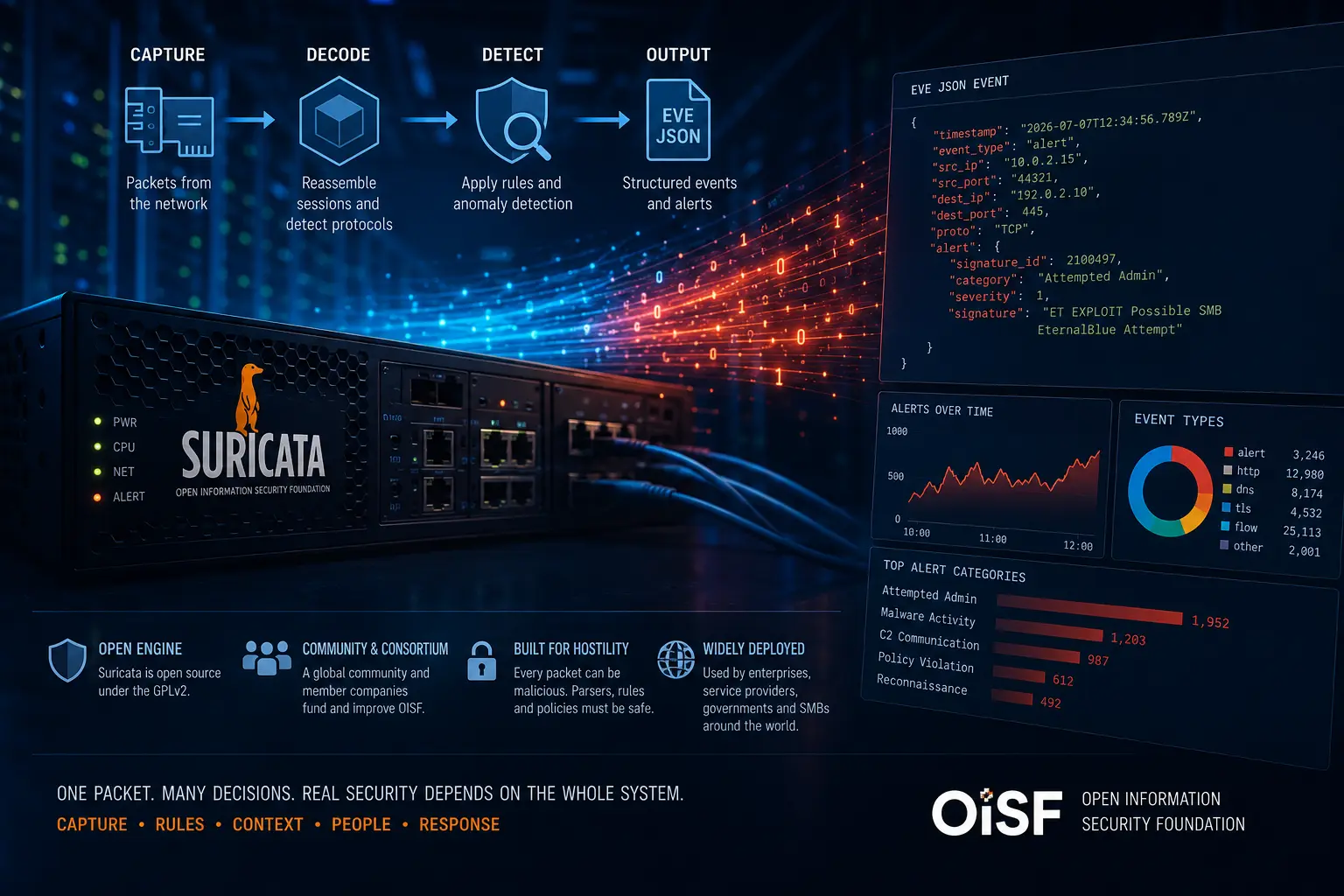
Suricata and the small nonprofit guarding a hostile packet surface
Suricata tracks flows, rebuilds streams, parses protocols, applies rules and emits telemetry inside sensors and commercial products. OISF maintains that public engine on a budget small beside its downstream reach, while every packet, parser and rule can become a failure point.

Global Institutional
Nmap and the limits of what a network scan can know
Nmap turned hosts, ports, filters, services and operating-system fingerprints into a shared operational vocabulary. Nearly three decades later, its value still depends on a restraint many automated systems lose: each result describes one probe, from one vantage point, at one…

Asia-Pacific National Telecom
Telstra's March 2024 Triple Zero disruption showed that a backup must preserve the call, destination and location
Australia's communications regulator found 473 breaches after a technical disruption at Telstra's Triple Zero call centre. The event was not simply a server outage. It exposed three different continuity duties that are easy to collapse into one: keeping the caller connected while…
Global Institutional
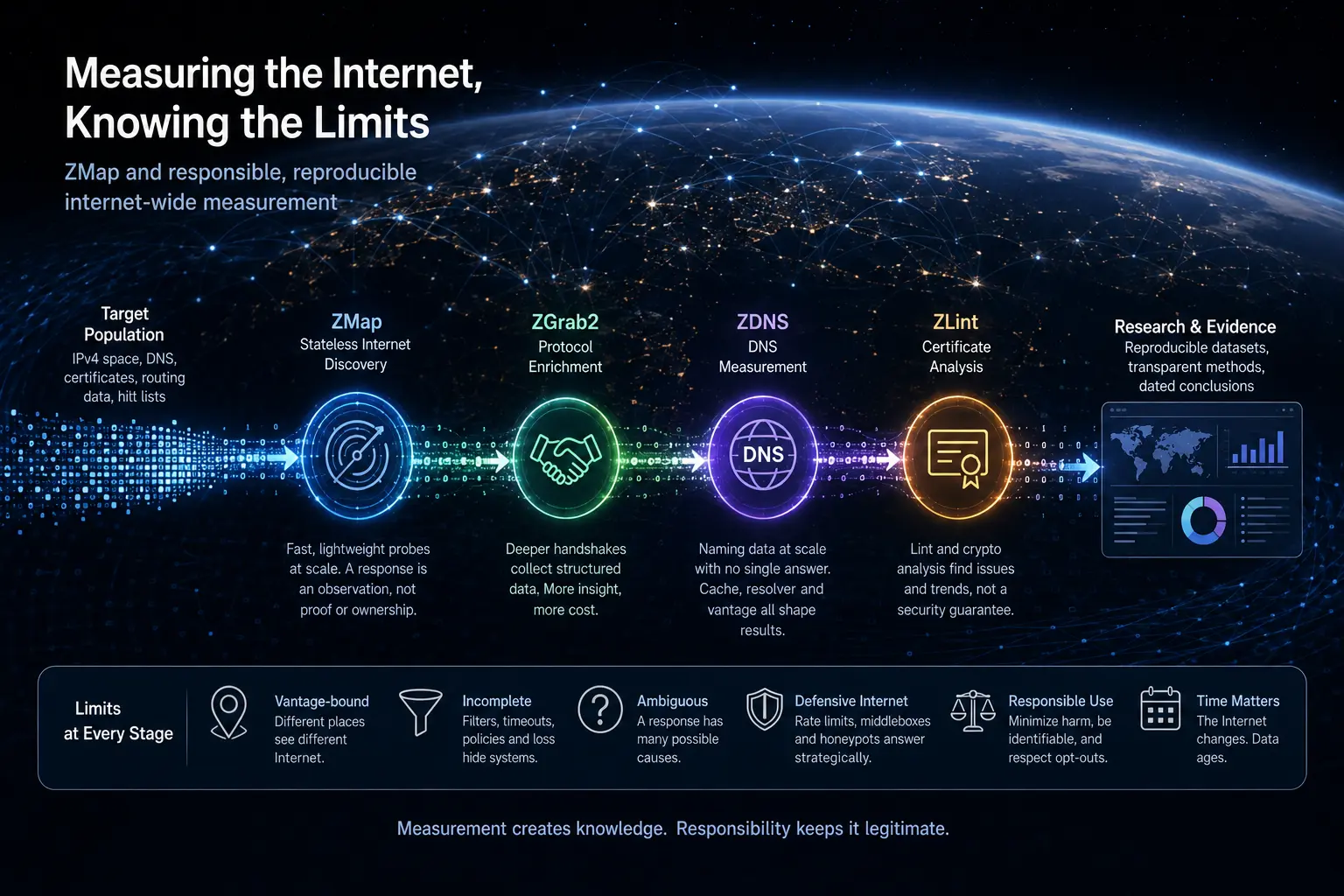
ZMap and the limits of an internet-wide census
ZMap made public IPv4 surveys repeatable by separating a fast stateless probe from deeper protocol analysis. The same design makes every result depend on target selection, vantage point and responsible operation: a response is an observation, not proof of ownership or…

Leaders
Rob Shakir and the Work of Describing Networks Across Vendor Boundaries
A large network rarely fails because its engineers lack a name for a router. It fails in harder places: when two devices use different names for the same kind of state, when an automation system reads one vendor correctly and another incorrectly, when a route moves between tables…

North America Regional ISP
Cox Communications and AS22773: What Registry, Routing and Restoration Records Reveal About Network Continuity
Public registry records, live routing observations and Cox's own operating disclosures show why a broadband connection depends on a chain of controls rather than one reassuring number.
Global Institutional
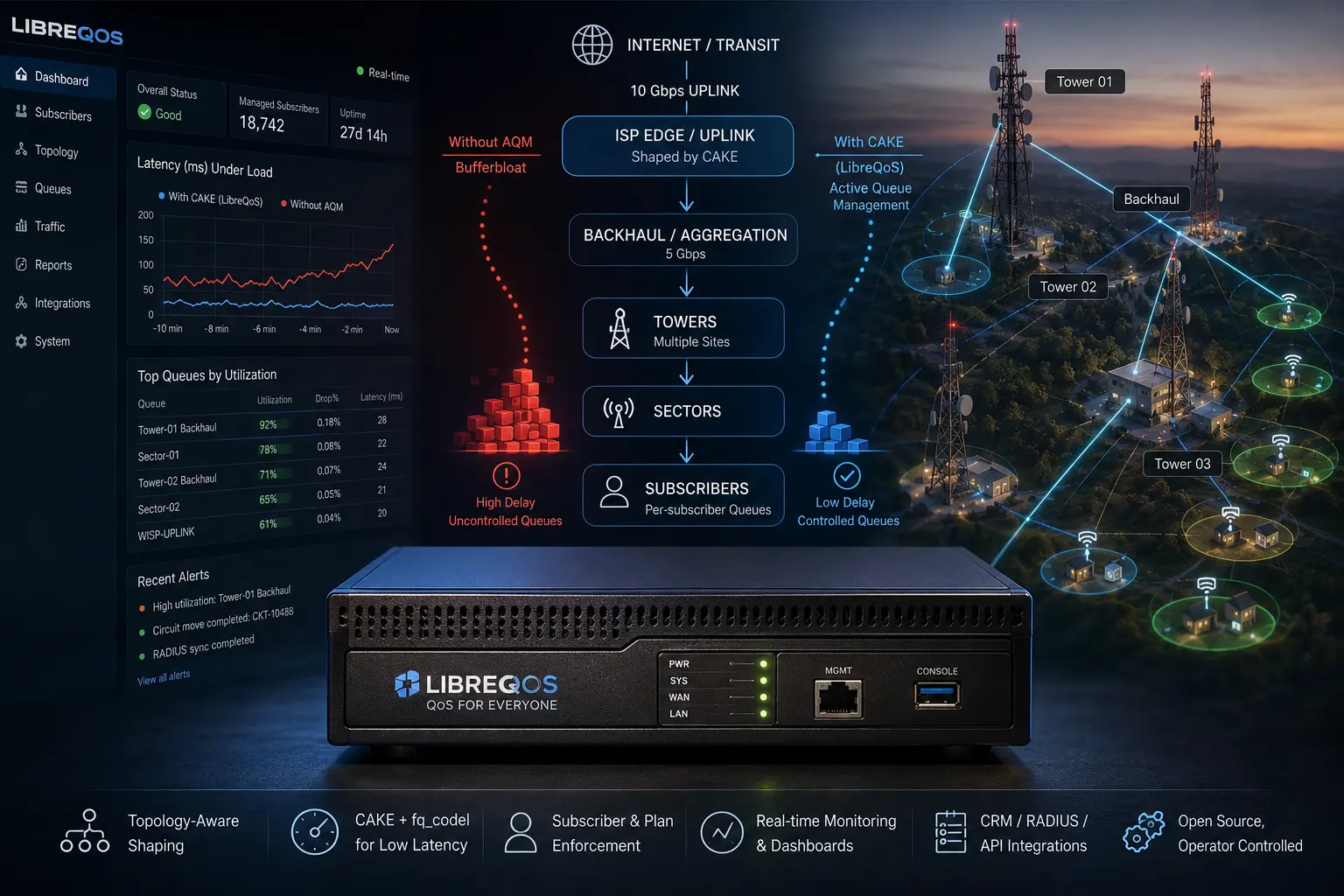
LibreQoS and the topology that decides where broadband slows
LibreQoS puts a Linux shaper inside the traffic path, using CAKE and an operator’s model of subscribers, towers and backhauls to keep queues short under load. Its advantage depends on a hard condition: the network model and capacity values must be more accurate than the…

Asia-Pacific National Telecom
Optus's Coles Mobile porting breach showed that a phone number is a control record, not just an account field
Australia's communications regulator found that Optus, acting as the gaining provider for the Coles Mobile brand, proceeded with 44 unauthorised mobile-number ports without completing the required additional identity verification. The incident is easiest to understand when a…
Global Institutional
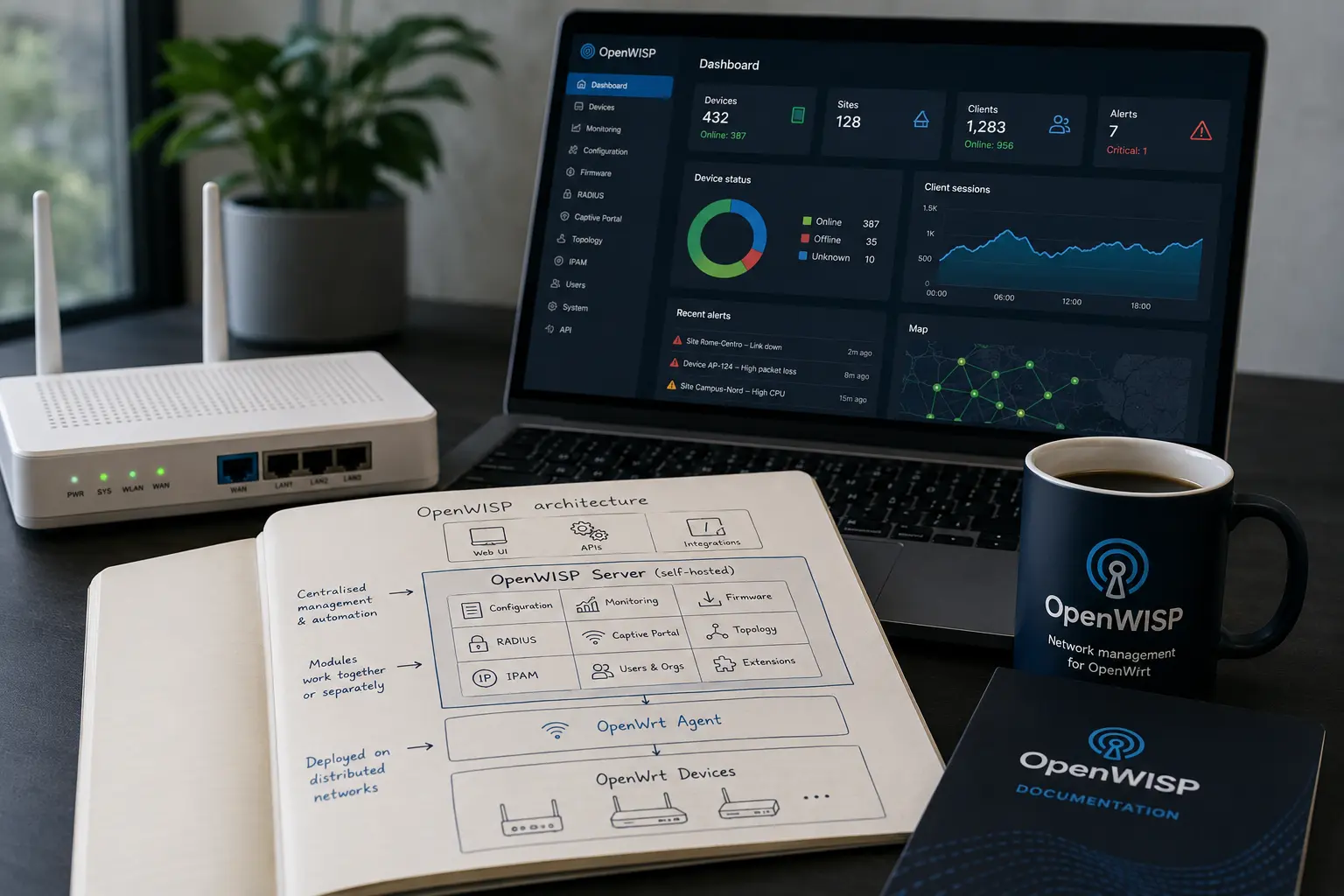
OpenWISP and the control room small networks must build for themselves
Born from a public Wi-Fi programme around Rome, OpenWISP now manages distributed OpenWrt fleets through configuration, monitoring, firmware, identity and topology modules. Self-hosting removes a proprietary controller from the chain, but leaves the operator responsible for the…

Global Institutional
prpl Foundation and the hard limits of an open broadband gateway
prpl Foundation coordinates an OpenWrt-based carrier stack designed to move services across gateway vendors. Its test is whether common APIs and certification can survive proprietary radio firmware, chipset software and the integration work operators still have to buy.

Asia-Pacific National Telecom
Telstra's 106 outage showed why a live emergency line must never look like a test service
Australia's text emergency relay service was unavailable for 12 hours and 46 minutes after a live call route was mistaken for a test service during a server migration. No genuine 106 call was identified in that window, but the Australian regulator found something that matters…

Europe and Middle East Cloud Services
Traefik Labs: The Gateway Layer for Cloud-Native Applications
Traefik Labs evolved from an open-source proxy tracking fast-changing container infrastructure into a company aiming to govern application, API, AI, and Model Context Protocol (MCP) traffic through a single gateway layer. The position that makes Traefik convenient also carries…

Creators
Jamal Hadi Salim and the contract behind programmable Linux networking
Linux Traffic Control began as a queueing framework and now carries classification, redirection and hardware offload. Salim’s work across `tc`, Netlink, ForCES and P4TC shows how hard it is to add programmability without breaking the interfaces operators already trust.