
Summary
- The Energy Sciences Network, ESnet for short, is a network infrastructure of the DOE Office of Science operated by Lawrence Berkeley National Laboratory, and not a commercial telecommunications company
- ESnet6 connects about 15,000 miles of fibre infrastructure with optical transport, routing, private networks, cloud connections, measurement tools and programmable services
- Science DMZ, perfSONAR, OSCARS, SENSE and EJFAT show that scientific performance depends on the entire path from instrument, storage, network and data centre
- American Science Cloud and ESnet7 could integrate the network more deeply into scientific workflows, but are at different stages of planning, research and maturity
A Science Network, Not a Mass-Market Internet Provider
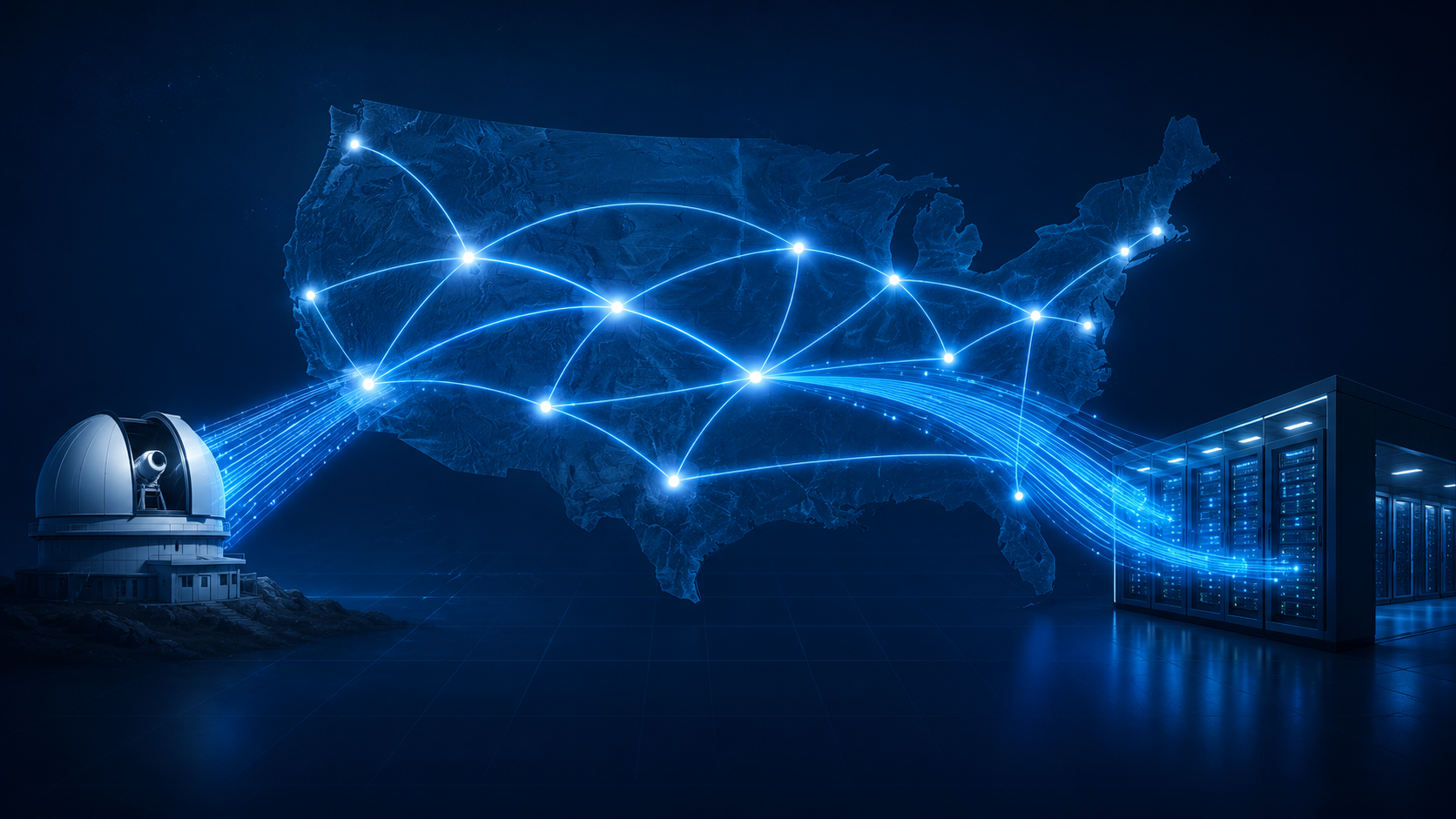
ESnet is best explained by a scientific data set. A detector, telescope, microscope or simulation generates information in a research facility. Acquisition systems collect it, storage and transfer servers prepare it, and the local network brings it to a controlled handover point. From there, an ESnet connection can transport the data across the United States, over the Atlantic, to a Department of Energy supercomputer, over a partner network or into a commercial cloud. What comes back is an analysed data set, an alert, a model or a decision about the next experimental step.
No single organisation masters this complete path. The instrument team, laboratory network, regional research network, cloud provider, international partner and data centre may belong to different operators. ESnet provides the mission-oriented wide-area layer and works together with these organisations. Slow storage, a congested campus link or an unsuitable firewall can render a fast national backbone ineffective; conversely, a disruption within ESnet can isolate a well-designed local facility from the rest of the scientific system.
Institutionally, ESnet is clearly classified. It is a User Facility of the DOE Office of Science, primarily funded and overseen by Advanced Scientific Computing Research, and operated by the Scientific Networking Division of Lawrence Berkeley National Laboratory. Berkeley Lab is managed by the University of California on behalf of the Department of Energy. ESnet has no shareholders, stock exchange listing, standalone corporate valuation or commercial balance sheet, and is therefore to be described as government-funded research infrastructure.
Researchers usually encounter ESnet indirectly through an instrument, a supercomputer, a laboratory service, a university or a partner network. ESnet distinguishes institutional Site Users from Endpoint Users and does not maintain a formal membership list of every individual. The more than 30,000 organisational users cited in the 2024 annual report are thus an institutional metric, not an exact count of individual subscribers.
The comparison with an ordinary carrier falls short. ESnet operates optical transport and IP routing, but also conducts requirements analyses, maintains open-source software, tests new services and assists sites with end-to-end problems. The real value lies in making spatially separated facilities work like parts of a common scientific machine. (ESnet Governance;Network Services)
The History Began with Scarce Computers and Acoustic Couplers
The official history dates back to the mid-1970s, when computing power and long-distance communication were scarce. At the Controlled Thermonuclear Research Computer Center of Lawrence Livermore National Laboratory, staff connected a borrowed Control Data Corporation 6600 via four acoustic modems. The technology belongs to a different era, but the problem remains recognisable: a specialised scientific community needed remote access to a computer that was too expensive to duplicate at every participating site.
In the late 1970s and early 1980s, different research programmes of the Department of Energy built their own networks. High-energy physics and magnetic fusion had different facilities, partners and data flows; precursor systems such as HEPnet and MFEnet reflected these boundaries. Specialised networks made sense when commercial services could not offer the required reach, performance or operational attention. However, they also led to duplicate lines, technologies and operations teams.
With the formal creation of ESnet in 1986, these functions were consolidated. A shared facility could plan across programmes, operate national connections, coordinate international links and retain specialist staff. Capacity thereby became a departmental infrastructure task rather than a single decision by an experiment.
The early model already contained features that persist to this day: access by scientific mission, jointly funded resources, multi-year planning, operations teams with an understanding of scientific consequences, and uneven demand that can be dominated temporarily by a single experiment.
Berkeley Lab had its own networking history. In 1974, a CDC 6600 was connected there to ARPANET; later, researchers contributed to TCP congestion control. The work of Van Jacobson and Mike Karels belongs to the broader environment of the lab and must not be attributed solely to ESnet. The institutional proximity, however, fostered a culture in which protocol behaviour, measurement and performance were treated as technical problems that could be investigated and altered.
In 1996, operations moved to Berkeley Lab, placing it near the National Energy Research Scientific Computing Center, network research, software development and other Department of Energy programmes. This produced today's model, in which production operations and applied research take place within the same institutional setting. (ESnet History)
Why Networking Became a User Facility
A scientific User Facility pools capabilities that are too expensive, specialised or tightly interconnected for individual research groups. A particle accelerator, a light source or a leading supercomputer follows this logic. ESnet applies it to communication. Long-haul fibre and spectrum, optics, routers, international capacity, continuous operations, cybersecurity, measurement and technical consulting are provided collectively.
The shape of scientific demand explains the public funding. A carrier can sell a fast line, but will rarely plan its national architecture around a detector that will only start years later, a possible supernova burst or a workflow with low market volume but high public value. ESnet can invest before measurable utilisation, because scientific capability, not short-term revenue, is the goal.
Formal Requirements Reviews determine future needs. Research programmes describe instruments, data volumes, storage locations, computing goals, time limits, partners and local bottlenecks over a horizon of five to ten years. This can lead to larger site connections, additional physical paths, transatlantic capacity, new orchestration software or changes to the local data architecture.
This process is less visible than a new optical link, but can be more decisive. Spectrum on a submarine cable, a second building entrance or a new router may require years of funding, procurement and construction time. If ESnet waited until an experiment produced its full data volume, a foreseeable infrastructure question would become an emergency.
The reviews do not make predictions certain. Instruments are delayed, data reduction software improves, cloud usage grows and scientific workflows are redesigned. ESnet therefore uses the results as a range of possible requirements and decides where reserve capacity, flexible architecture or incremental investment is justified.
Access remains institutional. Subject to sponsorship and additional costs, sites may bear part of their connection costs. Individual researchers neither pay per gigabyte nor conclude a personal contract with ESnet. The lack of end-customer billing does not, however, mean cost-free: fibre, power, equipment, personnel, colocation and repair are financed from public budgets or site-based contributions.
Success is measured differently from a commercial carrier. ESnet must balance availability, future demand, scientific access, resilience and research. Because these decisions involve public funds and long-lived assets, they require documented assumptions and verifiable outcomes. (Governance;ESCC)
Berkeley Lab Operates the System, DOE Defines the Mission
The institutional chain leads from the Department of Energy through the Office of Science and Advanced Scientific Computing Research to Berkeley Lab and its Scientific Networking Division. The University of California operates the laboratory under contract. Federal mandate and funding are thus separated from day-to-day network operations.
Inder Monga is Executive Director of ESnet and Director of the Scientific Networking Division. Chin Guok is Chief Technology Officer and leads planning and innovation; Adam Slagell is Chief Security Officer; Jon-Paul Herron leads Network Engineering; Susan Lucas is Deputy of Business Operations. The organisation includes specialists in optics, routing, site engineering, systems, software, security, measurement, automation, projects and science engagement.
The breadth of this structure corrects the image of a national network as a collection of fibre and routers. ESnet must procure spectrum, run BGP, build telemetry, maintain open-source tools, investigate packet behaviour, manage security credentials and translate scientific plans into concrete infrastructure. The organisation is simultaneously operator and development environment.
Sites participate through the ESnet Site Coordinators Committee. Each institution designates a person who can authorise changes to its ESnet connection and convey local requirements. That is institutional user governance, not a direct vote of all researchers whose data traverse ESnet.
Public sources do not fully agree on one programme function. The current governance page names Benjamin Brown as the responsible ASCR Programme Manager, while more recent requirements review documents list Carol Hawk as ESnet Programme Manager. The reliable account notes this ambiguity rather than inventing an exclusive current responsibility.
ESnet is neither an autonomous authority nor a purely technocratic network. Contracts, federal budget, laboratory management and site coordination limit technical power. At the same time, accountability becomes more difficult when a workflow passes through several institutions and none of them controls the full path. (ESnet Leadership;Governance)
ESnet4 Separated General Traffic from Exceptionally Large Science Flows
In the mid-2000s, the Large Hadron Collider and other distributed experiments generated transfers that did not fit well into a uniform general-purpose IP network. ESnet4 therefore combined an IP core with the Science Data Network, which used multiple optical 10 Gbps connections and dynamic circuit capabilities.
Science was not meant to leave IP. Rather, a few very large data flows required different resources from general communication. Normal connections remained routed, while planned data movements could use high-capacity, reserved paths. Metropolitan rings and collaboration with Internet2 connected labs and points of presence.
This architecture gave OSCARS a production context. Bandwidth and VLAN resources could be reserved via software and removed after expiry, rather than being set up exclusively manually. The network began to make resources available programmatically.
The separation increased equipment and operational effort and did not eliminate local storage or campus problems. It showed, however, that different traffic patterns can require different mechanisms, while the full path must remain observable. (ESnet4 Architecture)
Science DMZ Moved the Bottleneck to the Edge of the Institution
With a faster backbone, local weaknesses became more visible. A 100 Gbps WAN is of little use if data passes through a general enterprise firewall, a server reads too slowly or an interface drops packets. ESnet and partners developed Science DMZ precisely to address this end-to-end bottleneck.
The model places powerful Data Transfer Nodes on a controlled path near the institutional edge. Security can use router access lists, host hardening, intrusion detection, flow analysis and restricted services instead of forcing large transfers through the same stateful firewall as office and enterprise applications. perfSONAR provides continuous measurements for throughput, latency, packet loss and path changes.
Science DMZ is not an unprotected network. The controls are adapted to specialised systems that still need patching, monitoring, identity management and local responsibility. Removing an unsuitable device from the data path does not eliminate the security task.
The Data Transfer Nodes themselves must also be suitable. Network cards, CPU assignment, memory, TCP buffers, disks and parallel file systems determine whether a long-distance connection reaches its intended performance. ESnet's Fasterdata recommendations and technical consulting translate these details into repeatable procedures.
The model spread beyond the Department of Energy. ESnet can be named as developer and key promoter, but does not operate or own every implementation. Performance and protection depend on how an institution integrates storage, Data Transfer Nodes, security and local network.
Science DMZ also changed fault finding. Distance alone no longer explains poor performance; endpoint, interface, perimeter and WAN must be measured together. A single weak link can determine the performance of the whole chain. (Science DMZ)
ESnet5 Brought Continental 100 Gbps into Production
The American Recovery and Reinvestment Act provided 62 million US dollars for the Advanced Networking Initiative and supported a 100 Gbps long-distance prototype as well as the transition to ESnet5. The network went into production at the end of 2012 with spectrum rights on a national fibre footprint and in close cooperation with Internet2.
The Department of Energy and ESnet referred to it at the time as the world's fastest science network. As a historical statement about an early continental 100G production build, this is usable. It is not a neutral ranking for 2026, because several research networks deploy 400G and use different terms for interface speed, backbone capacity and optical spectrum.
The investment went beyond routers. Spectrum rights gave ESnet more control over later upgrades than repeated purchases of finished lines. However, they also bound the programme long-term to specific routes, facilities and suppliers.
ESnet5 delivered additional capacity and again exposed local bottlenecks. A site needed suitable connections, Science DMZ, fast storage and receiving computing power. The higher speed therefore increased the value of perfSONAR and end-to-end engineering.
The lasting contribution was to move 100G from a technical demonstration into operated scientific infrastructure. At the same time, ESnet5 prepared the optical, operational and software foundations for ESnet6. (ESnet5 100G Launch)
ESnet6 Is an Optical, Packet-Switched and Software-Based System
The ESnet6 project formally began in 2017 and was completed in 2022 after about six years of design and construction. The public launch took place on 11 October 2022. At that time, Berkeley Lab cited more than 46 Tbps aggregated capacity over around 15,000 miles of dedicated fibre infrastructure, with backbone links between 400 Gbps and 1 Tbps. In the 2024 annual report, the aggregated figure rose to 57 Tbps, while individual backbone designs reached up to 1.2 Tbps.
The figures come from different years and describe a growing system. They also do not map the complete architecture. ESnet6 comprises fibre and spectrum rights, optical line systems and amplifiers, core and service routers, programmable telemetry, automation, private networks, on-demand circuits, cloud and internet interconnection, performance measurement and security controls.
The optical layer transports multiple wavelengths and can bundle several packet links. A link labelled 1.2 Tbps is therefore not necessarily a single Ethernet interface fully available to a site. Usable capacity depends on channels, protection mechanisms, route, equipment and policy.
ESnet6 was built as a software-driven network, not just a faster version of ESnet5. Automation sets up services and keeps devices in a more consistent state. Telemetry supports diagnosis, while research hooks and testbed functions enable experiments within defined production boundaries.
The new software layer reduces manual work, but also increases the blast radius of an error. A faulty template, routing policy or inventory record can propagate to many devices. Secure automation therefore requires staged rollout, independent verification, limited privileges and documented recovery procedures.
A network generation thus renews optics, packet layer, software, operations and capacity assumptions together. Quality is shown in migration, availability and scientific benefit, not solely in the highest published number. (ESnet6 Launch;2024 Annual Report)
What 57 Tbps Means — and What It Does Not
The 2024 annual report states about 15,000 miles of fibre infrastructure, 78 router sites, 278 optical amplifier sites, backbone links from 400 Gbps to 1.2 Tbps and 57 Tbps aggregated capacity. Added to this are 2.7 Tbps transatlantic capacity and seven US sites with connections of at least 400G.
ESnet connected all 17 national laboratories of the Department of Energy and reported 28 DOE User Facilities, 277 relationships with research, commercial and other networks in five countries, more than 30,000 organisational users, and 137 employees and contractors in 24 states. These figures describe different populations and must not be summed into a customer count. Routers, facilities, partner networks, institutional users and workforce are separate metrics.
Aggregated capacity sums distributed resources and is not the throughput of a single path. Physical site connections are offered at 10, 100 or 400 Gbps. A backbone link may consist of several channels or interfaces. Real traffic is at all times below the built capacity and is unevenly distributed.
In 2024, ESnet transported 1.77 exabytes, up from 1.7 exabytes in 2023, an increase of four per cent. ESnet has calculated a historical average growth of about 55 per cent per year since 1989. A weak single year is relevant, but does not prove that future instruments, artificial intelligence or rare events require less capacity.
Traffic is also concentrated. According to the annual report, about half fell to activities of the Large Hadron Collider. Fermilab was the largest external sender at 136 petabytes, NERSC was the largest receiver within the Department of Energy at 75.3 petabytes, and Oak Ridge was the largest sender from the Department at 58.3 petabytes. Such figures show important workloads, but do not reflect the entire scientific value.
"Dedicated fibre" does not prove legal ownership of every cable. The infrastructure may include dark fibre, spectrum, lit services, carrier infrastructure and partner paths. ESnet controls dedicated rights on key routes, while ownership and repair responsibility vary by route.
The 57 Tbps metric describes the size of the system, not its scientific impact. That depends on whether transport, routing, site network, storage, computing and application function as a complete workflow. (ESnet by the Numbers)
AS293 Routes for a Mission, Not for the Consumer Market
ESnet's public autonomous system is AS293. It exchanges routes with Department of Energy sites, research networks, commercial networks and paid transit providers, and aligns its policy with scientific reachability, resilience and controlled interconnection.
The peering policy requires BGP, current entries in the Internet Routing Registry and PeeringDB, and routing security practices aligned with MANRS. ESnet discards RPKI-invalid routing and requires IPv6 or dual stack for new sessions; new IPv4-only peerings are excluded.
Private direct interconnection starts at 100G, with 400G strongly preferred. The threshold reflects large scientific data flows and the operational effort of a private relationship. ESnet does not need to peer directly with every network, but seeks connections that improve scientific paths, reduce transit dependency or link key partners.
Published BGP communities distinguish ESnet sites, research and education networks and commercial networks. Sites can derive their own policy from these, but downstream networks are not obliged to interpret the markings in the same way.
Hurricane Electric and Lumen provide paid public transit to destinations that are not efficiently reachable via peering or research network relationships. That supplements reach without making ESnet a consumer internet provider.
RPKI prevents one class of invalid announcements, not all route leaks or misconfigurations. Hijack monitoring and blackholing support response; blackholing protects other systems by intentionally making the attacked prefix unreachable. (Peering Policy)
Physical Connections, Private Networks and Cloud Paths
ESnet offers physical access at 10, 100 or 400 Gbps. Near a point of presence, a direct connection is possible; distant facilities can use a Service On-Ramp, where dark fibre or a lit circuit is procured from a carrier. This local carrier dependency can become the biggest performance or outage risk of the full path.
Layer-3 IP offers IPv4 and IPv6 routing. A Layer-3 VPN creates logically separated IP and BGP environments for programmes with multiple sites. Layer-2 VPNs provide point-to-point or multipoint Ethernet, static or via OSCARS. Experiments, facilities and clouds can thereby obtain controlled private paths.
Private services do not necessarily mean physical isolation. Logical separation depends on routing instances, labels, access controls and operational practice on a shared platform. Faults in that platform can affect multiple services.
Cloud Connect provides private connections to AWS, Microsoft Azure, Google Cloud and Oracle. Such a path bypasses parts of the public internet and can offer more control over the route. It does not, however, eliminate cloud misconfiguration, provider outage, egress costs, regional restrictions, identity issues or vendor lock-in.
The portfolio also includes secondary DNS, time services, route hijack monitoring and blackholing. Each service addresses specific risks, but is no substitute for a capable local architecture. A private path does not make storage faster, and a secure connection does not automatically secure a poorly configured cloud account.
Value arises from the interplay of physical access, routing, logical separation, interconnection and operational assistance. Endpoint and site network remain a local responsibility. (Network Service Menu)
OSCARS Makes Capacity Reservable
General internet traffic uses whatever capacity is available. Some scientific transfers are planned, large and lose significant value if delayed. OSCARS allows authorised users and applications to reserve network resources for a defined period.
A reservation can include endpoints, start and end time, bandwidth, VLAN information, excluded routes and further conditions. The system checks topology and existing reservations, finds a suitable path, installs the required configuration and removes it after expiry.
Automation turns multi-day manual coordination into a service that a scientific workflow can request. The network becomes a schedulable resource alongside storage and computing time.
OSCARS is open-source production software and has been deployed or tested outside ESnet. Some public pages, however, contain historical information, so not every organisation named there should be treated as a current, identical installation.
A reservation does not guarantee application throughput. Slow storage, local packet loss, unsuitable operating system tuning or too few parallel data streams can prevent the reserved rate. Policy must also govern priority, preemption, conflicts and unused reservations.
OSCARS shows how ESnet has translated an operational practice into repeatable infrastructure. The software automates provisioning, while authorisation and resource allocation remain institutional decisions. (OSCARS)
SENSE Attempts to Coordinate Network and End Systems Together
A reserved circuit is no help if storage, transfer service or computing resource is missing. SENSE describes networks and end systems as resources that an application can discover and negotiate across multiple administrative domains.
A workflow formulates the desired outcome, for example the transfer of a data set between two facilities at a certain rate. SENSE collects models of the involved resources, provisions paths and transfers, observes telemetry and then releases the resources. Each organisation retains its own policy, identity and authority.
In the LHC Data Challenge 2024, a SENSE workflow sustained 330 Gbps between Caltech and the University of California, San Diego. That is a concrete live demonstration at significant scale. The 2024 annual report, however, still described SENSE as a research project and not a universal production service.
OSCARS reserves resources within a known service domain. SENSE attempts to coordinate an outcome across multiple owners and resource types. The second task potentially offers greater scientific benefit, but increases the risk of partial failures, model conflicts, authorisation problems and timing miscoordination.
If a declared workflow does not achieve its performance, the cause may lie in the network, the storage system, a credential, a resource model or the application. Orchestration becomes operationally valuable only when its telemetry shows which part of the agreed state was not met.
Production readiness should therefore be measured by repeated use, clear support responsibility, recovery and multi-domain adoption, not solely by the highest demonstration figure. (SENSE;Applied Research 2024)
EJFAT Brings Event Data Directly to the Remote Computing Resource
The traditional workflow writes scientific data into files, stores them and transfers them later. That is robust, but delays feedback and requires local capacity for peak loads. EJFAT distributes UDP-encapsulated events from the instrument to available compute workers, including in remote supercomputing centres.
An FPGA-based SmartNIC reads the event ID and sends all fragments of the same event to one worker. The control plane adjusts distribution to available compute nodes. This event binding distinguishes EJFAT from a general load balancer that would distribute individual packets without knowledge of scientific cohesion.
In April 2024, data from Jefferson Lab in Virginia was streamed at 100 Gbps to Perlmutter in California and processed without intermediate writing to disk. Later tests used about 20,000 cores across several facilities, according to ESnet. These are specific results, not a guarantee for every instrument.
The Facility for Rare Isotope Beams case, published in July 2026, streamed raw data at about 5–6 Gbps. A data volume of 615 GB generated over fifteen hours was processed on eight Perlmutter nodes in twenty minutes using machine learning inference. The scientific time gain was more important than a peak rate.
The model enables shared national computing, but makes the experiment immediately dependent on network, FPGA, security and HPC allocation. A disruption can not only delay a later file transfer, but impair feedback during a live measurement.
EJFAT is an advanced prototype or emerging platform, not a standard service for all ESnet users. Broader adoption requires instrument integration, support, security models and clear behaviour under packet loss. (EJFAT;FRIB Result)
High-Touch, perfSONAR and iperf3 Make the Path Visible
A high-performance network can fail without appearing loaded on average graphs. A microburst can fill a queue, packets can arrive out of order, loss can occur in only one direction, or a path can change between two tests.
High-Touch uses programmable hardware for more detailed packet and flow telemetry than conventional sampling. In 2024, the system helped investigate LHC throughput, packet reordering on the Rubin path and security events. The higher accuracy costs memory, compute and access protection, and creates additional privacy questions.
perfSONAR measures distributed throughput, latency, loss and path behaviour. ESnet is a founding partner, operates more than 30 sites and was part of a worldwide reported network of more than 2,000 measurement endpoints in 2024. The distributed architecture helps identify the segment where degradation begins.
iperf3 generates TCP, UDP or SCTP traffic over IPv4 or IPv6. ESnet maintains the tool and reported tests of more than 150 Gbps on 200G paths under certain conditions. A synthetic test does not model storage or application, but provides a controlled baseline for separating network and endpoint problems.
The three approaches answer different questions. High-Touch examines production traffic with high accuracy, perfSONAR measures paths between institutions, and iperf3 tests the transportable performance of hosts and networks. Together they prevent every operator from declaring only their own segment healthy while the scientific workflow remains slow. (Performance Tools;Operational Innovations 2024)
Sometimes Less Traffic Is the Best Capacity Upgrade
Popular scientific data sets are repeatedly accessed in the same region. Five regional caches investigated in 2024 reduced WAN traffic by an average of 33 TB per day, served two-thirds of requests locally and achieved an average cache hit rate of 94 per cent.
The impact varied: 69.3 per cent WAN reduction in Southern California, 48.4 per cent in Chicago and 6.6 per cent in Boston. Data popularity, user geography, storage size and eviction policy determine a site's benefit.
Caching changes the question from "How fast can the backbone become?" to "Which data need to traverse the backbone at all?". A local copy can reduce latency and traffic and remain available during a remote outage. A cache with little reused data, on the other hand, consumes storage and operational effort without comparable benefit.
The technique brings the network closer to data governance. It must be decided what may be copied, how freshness is ensured, who has access and how erroneous or obsolete content is removed.
The study guarantees no 94 per cent hit rate for every scientific community and does not replace new capacity for unique live data flows. It shows, however, that data placement and network architecture can be designed jointly. (Applied Research 2024)
Transatlantic Science Needs Physical Diversity, Not Just Capacity
ESnet's US mission brings an international obligation. According to the 2024 annual report, about half of the traffic fell to the Large Hadron Collider. A fault between Europe and North America can therefore hit a core scientific load, even if all domestic routers are working.
Between 2024 and early 2025, reported transatlantic capacity rose from about 700 Gbps to 2.7 Tbps. ESnet signed a 15-year contract with Aqua Comms for 25 per cent of a fibre pair between New York, Dublin and London, and shares capacity and costs with GÉANT over several cable systems. The goal is at least 3.2 Tbps on four physically distinct paths, with growth potential of more than 10 Tbps.
Two logical circuits can share the same cable, landing station or terrestrial duct and fail together. Submarine repairs can require permits, a ship, suitable weather and weeks or months. ESnet plans for three simultaneous cable breaks; a single backup route is therefore limited public evidence.
Long-term spectrum rights give ESnet more control over upgrades, but bind the programme to specific systems and partners. ESnet can design diversity without owning or repairing every cable itself.
The collaboration with GÉANT is cooperation between independent networks, not a unified global operator. Both organisations can share costs and capacity, while each remains responsible for its own infrastructure and institutional obligations. End-to-end performance therefore requires transparent handovers, shared measurement and coordinated response to faults. (Transatlantic Milestone;2024 Annual Report)
Scientific Demand Combines Constant Load, Rare Bursts and Hard Deadlines
The Large Hadron Collider generates continuously large data flows between CERN, national laboratories and universities. High-luminosity operations are expected to increase detector data, simulation and replication. The network must carry this load in normal operation while also providing alternative routes for cable or site failures.
The Vera C. Rubin Observatory imposes a time limit. An image of about 13 GB is to reach SLAC from Chile roughly every thirty seconds so that alerts about transient astronomical events can be generated. ESnet cites a target of less than seven seconds over about 12,000 miles. The path includes partner networks in South America and on international segments that ESnet does not control alone.
DUNE plans an exceptional burst. In the event of a supernova, up to 600 TB might need to be moved in 100 seconds, while the programme is expected to generate about 900 PB over twenty years. These are future requirements, not today's normal traffic. A rare astronomical event cannot wait until additional capacity is procured.
Fusion research combines international distance with a long time horizon. In May 2026, 176 TB of ITER data was transferred from Marseille to DIII-D in San Diego at nearly 80 Gbps. ITER was still under construction; the test showed preparation, not normal full operations. Planning documents cite roughly 2 PB per day and at least 200 Gbps for some future workflows.
FRIB, Jefferson Lab, light sources and electron microscopes partly require analysis during data acquisition. Remote computing resources and machine learning inference can provide feedback during precious measurement time. Climate and earth sciences add large simulations and field sensors.
An average value does not describe these patterns. ESnet must support constant load, rare bursts, international collaboration, live streaming and strict deadlines within the same public infrastructure. (Rubin Case Study;DUNE Case Study;Requirements Reviews)
Requirements Reviews Translate Research Plans into Network Architecture
ESnet cannot wait for the first data set before procuring fibre, routers or submarine capacity. Research programmes describe instruments, volumes, storage, computing goals, deadlines, partners, cloud usage and resilience over a period of five to ten years. Engineering teams then examine the complete workflow.
The review is a form of co-design. A demand for 200 Gbps can reveal slow storage, a single building entrance or an unsuitable firewall. The outcome can be a new site connection, Science DMZ, additional cable, orchestration software or a change to the instrument.
The high-energy physics review completed in 2025 and published in January 2026 brought together 127 contributors and 14 case studies in a report of about 400 pages. It does not guarantee every forecast, but creates a common baseline when timelines and technologies change.
Scientific demand does not run smoothly. A rare event or a new AI workflow can be more important than the previous year's growth. Requirements Reviews reduce surprises and show what programme, site, data centre and ESnet respectively must prepare.
The process also distributes responsibility. A laboratory cannot assume that the national backbone compensates for an unsuitable campus network. ESnet cannot, conversely, assume that a site will automatically provide the required storage systems after a backbone upgrade. Documented planning makes such dependencies visible. (Review Reports)
Wireless Edge and QUANT-NET Test the Limits of the Facility
Field instruments are not always on fibre, commercial mobile coverage or secure power. Wireless Edge combines technologies depending on location. A geothermal installation in Nevada published in June 2026 used private 4G in CBRS spectrum, Wi-Fi HaLow, ordinary Wi-Fi, Starlink, directional radio and a self-powered mobile mast.
That was a solution for one site, not a nationwide ESnet service or replacement for fibre. Terrain, weather, frequencies, power and satellite provider limit the result. The key point is that ESnet treated data acquisition, backhaul and WAN as one scientific path, rather than letting its responsibility end at the nearest fixed connection.
QUANT-NET builds a three-node testbed between Berkeley Lab and two University of California, Berkeley sites over about five kilometres. It includes ion traps, photons, entanglement swapping, Bell measurements, time-critical coordination and modular control software.
ESnet's role is primarily in classical control and orchestration. A system that has to be set up manually for each trial is difficult to operate as a shared facility. Open control software can make experiments more reproducible and improve coordination of different devices.
The project is not a quantum internet in production and does not transport large classical research data via entanglement. Wireless Edge and QUANT-NET are to be judged by reusable knowledge, software and technical procedures, not by blanket availability. (Wireless Edge;Quantum Research)
American Science Cloud and ESnet7 Shift Planning from Sites to Workflows
Integrated Research Infrastructure and American Science Cloud aim to connect instruments, data, storage, artificial intelligence and supercomputing into a federated environment. ESnet supplies transport and part of the orchestration; EJFAT, SENSE, OSCARS, Cloud Connect and High-Touch each solve partial problems, but do not alone form the whole system.
At Confab26, Inder Monga was referred to as Project Deputy of the American Science Cloud, and the programme included demonstrations as well as sessions on ESnet7. That proves ongoing institutional work, not a completed universal science cloud. Access rules, identity, resource inventory, support and data responsibility were still under development.
ESnet7 is planning, while ESnet6 remains the current production network. The available documents cite no final architecture, full funding, supplier decision, launch date or migration plan.
The next generation is likely to emphasise telemetry, intelligence, packet inspection and coordination alongside speed. A faster link cannot tell an application where computing is available, explain a microburst or prove that a cross-domain service completed correctly.
The governance question is therefore how much of a scientific workflow should be understood and controlled by the network without creating an overly powerful and overly complex central controller. The technical capability to orchestrate must remain coupled with limited authority and clear accountability. (Confab26;Applied Research)
Federal Funding Carries the Facility, but Is Not Corporate Revenue
ESnet is primarily funded through the ASCR activity High Performance Network Facilities and Testbeds. The budget request for fiscal year 2027 proposed 103 million US dollars, up from 97.261 million US dollars in the prior enacted column.
The budget line is the best publicly available indicator of scale, but also includes testbeds, software maintenance, research and upgrades. It is neither a profit-and-loss statement for ESnet nor an exact figure for the annual cost of the production backbone.
Public funding enables long-term spectrum, open-source maintenance and capacity ahead of commercial demand. It also makes the programme dependent on congressional decisions, Department of Energy priorities and Berkeley Lab's operating contract.
The Site User Cost Policy can pass connection costs to institutions depending on sponsorship and additional effort; individual researchers are not billed. Calling the 103 million US dollars "ESnet revenue" would therefore be incorrect.
The lack of standalone accounts limits financial analysis. Public documents show no complete supplier concentration, depreciation schedule, site-specific cost accounting or annual capital expenditure solely for ESnet. The reliable statement is that a federal programme funds production, renewal, software maintenance and research within a broader budget activity. (ASCR Budget FY2027;ESCC)
Availability, Routing Security and Telemetry Create Their Own Duties
In 2024, the ten Office of Science sites included in a particular metric achieved 100 per cent availability excluding planned maintenance. The report also cited 99.99 per cent for a broader measurement. The scopes are different and do not mean zero outage for all services, sites and international paths.
The Site Resilience Programme examines building entries, routers, power supply and shared failure domains. A redundant backbone is of no help if a laboratory has only one cable path, one room or one power source.
RPKI, hijack monitoring, blackholing and automation reduce risks, but cannot eliminate them. A faulty template can spread quickly, and a route leak can use a valid origin. Staged introduction, independent verification and recovery remain necessary.
The data policy allows unlimited retention of router utilisation and NetFlow, replicated on the east and west coasts. Active perfSONAR measurements are stored for six months on a single disk without backup. Metadata can reveal endpoints, institutions and time patterns, even though ESnet maintains no individual subscriber records.
These statements do not contradict each other. ESnet has no personal membership or billing relationship with every Endpoint User, but can still process technical metadata about connections and data flows.
More visibility improves operations and security, while also increasing requirements for data minimisation, access, purpose limitation and retention review. High-Touch amplifies both the diagnostic benefit and the sensitivity of the captured information. (Availability Milestone;Data Policy;Peering)
What ESnet Stands For
The speed chronicle is real: predecessor networks, ESnet4, ESnet5 with 100G and ESnet6 in the multi-terabit range. More importantly, the organisation changed its architecture whenever bandwidth alone could no longer solve a scientific problem.
The Science Data Network separated exceptional data flows from general traffic. OSCARS made capacity reservable. Science DMZ redesigned the institutional edge. perfSONAR and iperf3 delivered verifiable measurements. SENSE coordinated multiple domains, while EJFAT brought the WAN into the detector loop. Caching reduced demand, and submarine spectrum increased control over international growth.
Authority remains distributed. The Department of Energy and ASCR fund and define the mission. Berkeley Lab operates the system. The University of California provides the institutional contract framework. Sites authorise local changes, while partner networks, carriers, clouds and manufacturers control other parts. Performance arises from coordination, not from ownership of the full path.
Future maturity must be named with equal precision. ESnet7 is planning, SENSE was described as research in the most recent full report, EJFAT is an emerging platform, QUANT-NET is experimental, and American Science Cloud was not complete. The available material contains no independent ranking that confirms ESnet as the world's fastest science network across all current metrics.
The reliable conclusion is more useful than a superlative. ESnet belongs to the most capable publicly documented science networks because it makes distributed science end-to-end operable. Its long-term value will be shown by whether new instruments, data centres and partners can be connected as resilient workflows without control and accountability disappearing into an opaque centralised layer.
Sources
- Governance and Policies
- ESnet History
- ESnet 2024 Annual Report
- ESnet by the Numbers: 2024
- Operational Innovations 2024
- Applied Research 2024
- Transatlantic Milestone
- Availability Milestone
- ESnet Leadership
- ESCC
- Network Service Menu
- Peering and Routing Policy
- Facility Data Policy
- ASCR Budget Request FY2027
- ESnet6 Launch
- ESnet4 and Science Data Network
- Continental ESnet5 100G Launch
- Science DMZ
- OSCARS
- SENSE
- EJFAT
- Performance Tools
- Requirements Reviews
- Wireless Edge Geothermal
- Quantum Networking Research
- FRIB Direct Streaming
- Rubin Case Study
- DUNE Case Study
- Confab26 Programme
Member Briefing
Deeper Profile Context
Sign in with the right membership level to unlock the full briefing and source notes.
Only for Strategic Circle
Strategic Circle
Open to all readers. Unlock profile briefings after joining and signing in.
Join Strategic CircleOnly for Leadership Alliance
Leadership Alliance
For qualified IP-asset owners and management; sign in to unlock alliance briefings.
Join Leadership Alliance