
Summary
- GÉANT supplies Europe’s national research networks with shared continental infrastructure while leaving national networks, universities and scientific facilities under their existing governance
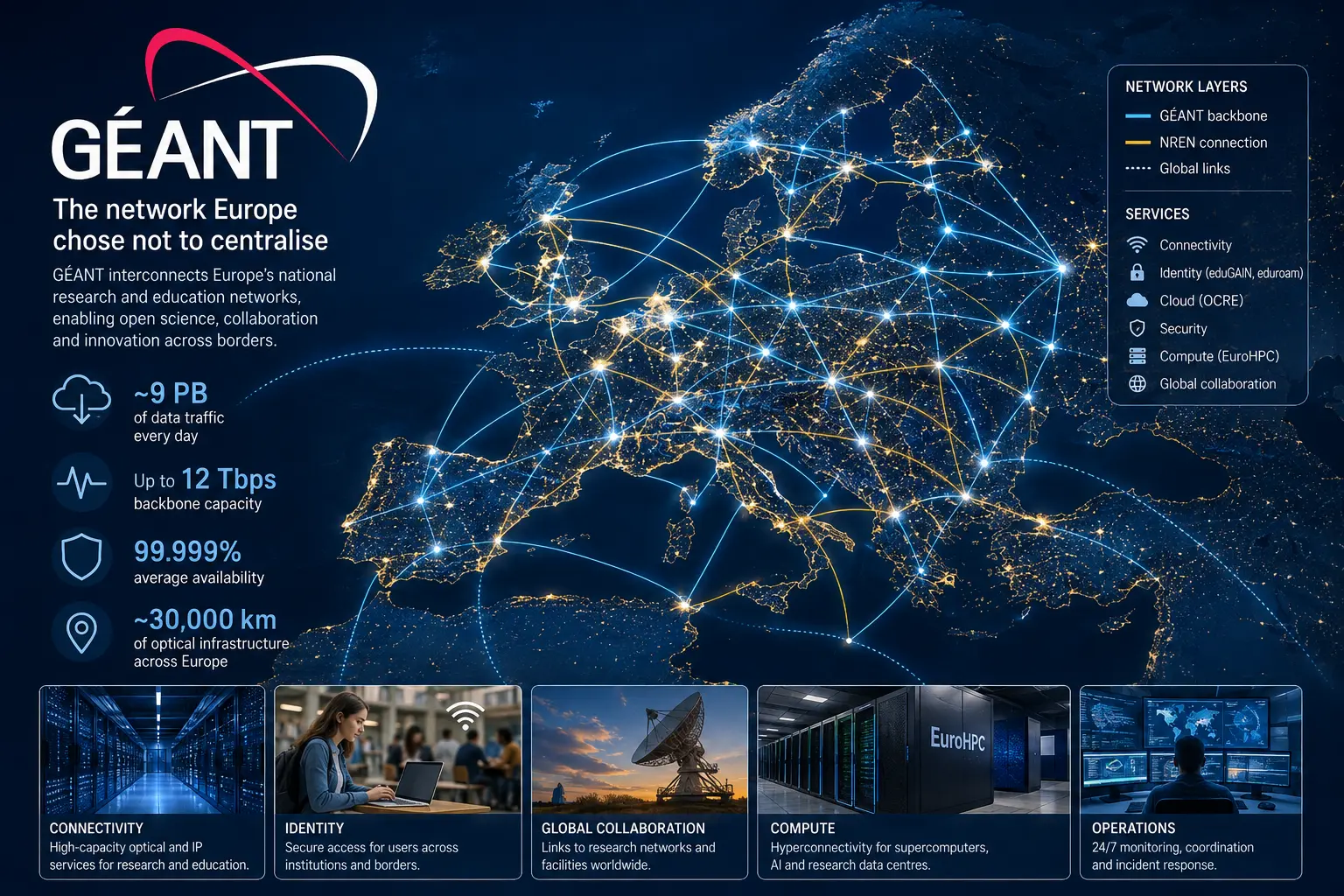
- Its backbone reports roughly 9 petabytes of daily traffic, capacity of up to 12 Tbps and 99.999% average availability, figures that describe different operating layers
- A 2024–2026 packet migration moved 1,240 services across 32 sites and replaced device-by-device configuration with an intent-based automation model
- GÉANT now coordinates identity, cloud procurement, security, global links and strategic computing access, increasing both its institutional value and its supplier dependencies
A live migration exposed how the federation works
Between June 2024 and January 2026, GÉANT replaced the routed core of its continental network while it remained in production. Engineers moved 1,240 services across 32 sites, introduced three new locations, transferred 29 existing sites to a Nokia IP/MPLS platform and prepared the packet layer for interfaces of up to 800GE. GÉANT reported no service disruption attributable to the migration.
The scale of the work is the clearest introduction to what GÉANT does. It operates infrastructure that carries European research traffic, but it does not own the universities, national research networks, supercomputers, clouds and scientific facilities at either end. Every migrated service therefore represented more than a router configuration. It connected institutions with their own policies, budgets, equipment and operating teams.
The migration also changed how the network was defined. GÉANT did not reproduce every legacy command on new equipment. Engineers documented the services the network was supposed to provide, modelled those intentions and used the GÉANT Automation Platform to translate them into configuration. The process exposed undocumented behaviour accumulated over years of operation and forced the organisation to decide which behaviour represented a real requirement and which was merely historical residue.
That distinction captures the wider GÉANT model. Europe has a continental scientific network, but not one central owner of European research connectivity. GÉANT creates common layers where scale brings a clear advantage, while national research and education networks—usually called NRENs—retain authority over domestic infrastructure and institutional relationships.
The result can look centralised from a user’s perspective. A researcher may reach a remote instrument, supercomputer or data service through one apparent path. Operators see a sequence of campus systems, national networks, GÉANT infrastructure, commercial carriers, cloud platforms and partner networks. The service works only when those organisations can combine their responsibilities into one usable route.
Europe built a federation because no central operator could replace the national networks
European research networking developed from a fragmented starting point. Universities and scientific institutions used national academic networks, EARN, X.25 services and early internet systems under different technical standards, funding arrangements and telecommunications markets. Cross-border cooperation had to connect those investments rather than discard them.
RARE was established in 1986 to coordinate European research networking before the region had a single production backbone. It gave network organisations and engineers a forum for technical work, planning and policy. RARE then established DANTE in 1993 to procure and operate pan-European network services, separating community coordination from the commercial and operational work of signing capacity contracts and running production infrastructure.
EARN and RARE merged in 1994 to form TERENA. TERENA continued member representation, technical collaboration and professional development, while DANTE handled much of the shared network operation and procurement. The division reflected two different requirements: Europe needed a community that could agree on common work and an organisation capable of executing it.
The first GÉANT programme began in 2000, and the network became fully operational in December 2001. It gave the NRENs a predictable continental layer for research traffic. Scientific projects no longer needed to assemble every international path through a fresh set of bilateral arrangements, although local access and national operations remained under separate control.
This structure was not a temporary compromise awaiting centralisation. It became the operating model. Public funding, geography, institutional authority and national policy differed too widely for one organisation to take over every campus and domestic network. Federation allowed common investment where continental scale mattered while preserving national decision-making where local knowledge and public accountability remained important.
The model also distributed failure. A high-capacity GÉANT path cannot compensate for an undersized campus firewall, a poorly configured transfer server or a weak NREN access circuit. A well-designed national network cannot avoid disruption if the continental backbone, a subsea route or a remote partner fails. GÉANT’s value lies in coordinating these domains, not pretending that organisational boundaries have disappeared.
One name covers several centres of authority
The name GÉANT refers to three related structures. GÉANT Vereniging is the Dutch legal association that employs staff, signs contracts, holds assets and is governed by its members. The GÉANT network is the optical, packet and service infrastructure. The GÉANT Project is the sequence of European Commission and NREN co-funded programmes through which the association and partner organisations develop services and technology.
The distinctions decide who controls people and money. A contributor to a GÉANT project may work for CESNET, DFN, GARR, Jisc, RENATER, SURF or another NREN rather than for GÉANT Vereniging. An NREN can be a legal member, a project participant and an operating partner without transferring ownership of its national network.
DANTE and TERENA joined in October 2014 to create the present association. The union brought member governance, production operations, technical communities, identity work and programme delivery into one organisation. It consolidated institutions with established contracts and operating histories rather than creating a conventional startup.
The association is registered in the Netherlands, maintains a UK branch and opened a small Brussels policy office in 2025. The Brussels presence reflects the growing influence of European policy on research infrastructure, including funding, cybersecurity, cloud procurement, artificial intelligence and technological sovereignty. It is not a new network operations centre.
Membership figures vary according to what is being counted. GÉANT describes 43 NRENs as forming the wider European community, while the legal membership structure counts some Nordic networks through NORDUnet and treats associate members separately. Project consortium figures measure another category again. A federation can represent many national systems without giving each represented network an identical legal status.
The General Assembly is the highest governing body, and members elect the Board of Directors. Executives manage network services, shared services, finance, operations, communications and programme delivery. This makes GÉANT both a supplier and a shared institution: NRENs consume services from an organisation they collectively govern.
Member control does not eliminate differences in bargaining power or implementation capacity. Large NRENs may have deeper engineering teams, stronger procurement functions and more resources for migration. Smaller networks can gain proportionally more from shared infrastructure but may depend more heavily on central assistance. A common service therefore creates equal continental reach without necessarily imposing equal local costs.
The workforce extends beyond the association’s employees. GÉANT reported 171 employees at the end of 2024 and a net increase of eight staff during 2025, but the later report did not provide one explicit closing headcount. Project contributors employed by NRENs further expand the effective delivery organisation without appearing in GÉANT Vereniging’s employee total.
This distributed workforce is an advantage when services must function inside national networks. The people designing automation, identity, security or performance tools often understand the systems that will eventually adopt them. It also means that responsibility for development, maintenance and deployment must be stated carefully rather than attributed to one central team.
Optical control came without complete ownership
GÉANT’s backbone is assembled from dark-fibre rights, leased spectrum, managed capacity, subsea systems, commercial colocation and equipment supplied or operated by several organisations. GÉANT does not own every cable, trench, landing station or building shown on its network maps. It combines legal rights and operating relationships into a system with enough control to plan capacity, services and recovery.
The GN4-3N programme, carried out between 2019 and 2023, rebuilt much of this optical foundation. GÉANT reported 69 routes placed into production, 405 Infinera nodes deployed, 50 legacy links retired and 26,047 kilometres of dark fibre or spectrum lit across 34 countries.
Later descriptions place the wider network at roughly 30,000 kilometres. The two figures measure different dates or scopes. The project total records what GN4-3N delivered, while the broader network figure can include subsequent additions or infrastructure outside the programme boundary.
GN4-3N deployed an Infinera FlexILS open line system. The architecture separates the fibre, amplification and reconfigurable optical layer from transponders, coherent pluggables and the packet routers above it. GÉANT can therefore introduce newer transmission equipment without replacing the entire line system or remaining tied to one generation of transponder.
The design increases choice but does not remove dependence on suppliers. Multivendor optical systems need careful spectrum planning, qualification, power management and fault isolation. A degraded route may involve a fibre owner, line-system supplier, coherent-device vendor, colocation operator and packet-platform team. Openness transfers some power away from a single appliance vendor and towards the organisation capable of integrating the components.
The same trade-off appears in managed wavelength and spectrum services. A managed wavelength gives a scientific project or NREN dedicated capacity operated by GÉANT. A spectrum service can allow the user to deploy compatible coherent equipment over part of the open line system. The second arrangement provides more technical control but also requires the user to manage optical compatibility, lifecycle planning and support.
Long-term fibre and spectrum rights can give the research community more influence over upgrades than repeated purchases of finished carrier circuits. They also bind the network to particular routes, suppliers and facilities for years. The value lies in the balance between control and flexibility, not in absolute ownership.
Rebuilding the packet layer changed how GÉANT operates
The Nokia migration replaced a Juniper routed layer selected in an earlier operating period. GÉANT chose the new platform in 2023 through a framework led by Nomios. The programme supported 800GE interfaces, but interface capability alone does not create an 800G end-to-end service. Optical capacity, remote equipment, route engineering and NREN handoffs must all support the same requirement.
The more consequential change was the use of intent models. The GÉANT Automation Platform, or GAP, is built around the open-source Workflow Orchestrator and related tools. A service request is represented as data, validated against the intended design, translated into equipment configuration and checked against streaming telemetry after deployment.
This approach turns the network definition into something closer to maintained software. Inventory, intended state and observed state can be compared, reducing reliance on commands known only to individual engineers. The migration showed that automation becomes reliable only after the organisation documents and standardises what the service is meant to do.
The same consistency creates a wider failure radius. A manual error may affect one device; a flawed intent model can distribute the same mistake across many locations. Production-like laboratories, approval stages, restricted credentials, staged deployment and reconciliation against live telemetry are therefore part of the operating system rather than optional project discipline.
GÉANT reported no service disruption attributable to the migration, although the wider network experienced unrelated incidents during the period. The claim supports a narrower conclusion: the organisation changed a continental packet platform without a planned shutdown or a reported migration-caused outage.
The migration also concentrated the routed layer around a principal vendor and integration framework. A common stack reduces operational variation and makes continent-wide automation more practical. It increases the importance of Nokia’s software lifecycle, component availability and security response, as well as Nomios’s integration knowledge. The long-term test is whether GÉANT retains enough documentation, skills and architectural flexibility to migrate again when the next platform no longer meets its needs.
Capacity figures only make sense when the layer is named
GÉANT reports backbone capacity of up to 12 terabits per second, roughly 9 petabytes of daily traffic and average availability of 99.999%. Its 2025 report recorded 3.6 exabytes of traffic for the year, equivalent to about 9.9 petabytes a day when averaged.
These figures describe different properties. The 12 Tbps number refers to aggregate engineering capacity in parts of the backbone, not a circuit available to every institution. Daily traffic records data moved over time. Availability averages the operation of defined services or links. None of the figures identifies the performance of a particular scientific path.
A route may include optical spectrum, several 100G or 400G wavelengths, an 800GE-capable router interface and a smaller national or campus access connection. A dedicated scientific service and ordinary routed traffic may also occupy different logical layers on the same physical system.
GÉANT’s 400G ZR+ field test over more than 3,400 kilometres in 2025 illustrates the distinction between tested capability and standard service. The experiment supplied evidence that coherent pluggable optics could operate across a long multi-span route under defined conditions. It did not convert every path or establish identical optical margin across Europe.
Availability requires similar context. GÉANT’s 2025 operating record included 23 Priority 1 service-loss incidents and 1,581 Priority 2 resilience-loss incidents, with an average Priority 1 resolution time of two hours. These figures can coexist with five-nines average availability because a redundant service can remain operational after one component fails, while a short or localised outage contributes little to a continental average.
Incident counts reveal the work hidden by a percentage. They show how often engineers had to investigate loss of service or resilience, even when the network-wide average remained high. For a scientific user, the relevant measure is whether the particular end-to-end workflow remained available during the period in which it was needed.
One European service still crosses several operating domains
GÉANT IP provides private routed transit for eligible research and education networks. GÉANT World Service procures commercial internet access for NRENs. Dedicated point-to-point capacity, managed wavelengths, spectrum, virtual private networks and multi-domain services support projects that require more predictable capacity, isolation or endpoints than shared routing provides.
GÉANT Open offers eligible organisations a controlled interconnection environment through shared facilities. It resembles an internet exchange in physical form but does not have unrestricted commercial membership. It allows direct research and education relationships while complementing, rather than replacing, the routed backbone and commodity internet access.
Each service assigns responsibility differently. A dedicated wavelength requires optical engineering and compatible endpoints. A virtual private network creates logical separation while relying on shared routers and transmission systems. A multi-domain circuit may cross a campus, an NREN, GÉANT and another regional network before reaching its destination.
GÉANT can coordinate such a service and provide a common contact, but it cannot directly configure every domain. Provisioning, maintenance and repair depend on partner organisations following compatible procedures and supplying evidence when something fails.
The GÉANT Operations Centre monitors the production network continuously and handles incidents, maintenance, escalation, ticketing and partner coordination. Its visibility is strongest inside infrastructure controlled directly by GÉANT and weaker where the path enters an NREN, campus, commercial carrier, cloud provider or regional partner.
Performance tools help narrow those gaps. The research and education community uses perfSONAR and specialised data-transfer-node testing to measure throughput, latency, loss, routes and host performance. A controlled test can distinguish a congested backbone from an undersized firewall, slow disk, weak server or local access limitation.
Measurement does not create one central operator. It provides a common body of evidence to organisations that retain separate authority. That evidence is what allows a distributed operating model to behave like one service from the researcher’s perspective.
Identity and cloud became infrastructure dependencies
GÉANT’s role expanded as cross-border scientific work became dependent on more than packet delivery. A researcher may have a functioning physical path but still be unable to use a remote resource because identity metadata is stale, a certificate has expired, an entitlement is missing or a cloud account has been configured incorrectly.
eduroam allows users to authenticate through their home institutions when visiting participating organisations. Authentication moves through institutional and national RADIUS systems rather than through one GÉANT password database. At the end of 2025, eduroam was available at about 45,000 locations in 112 territories and recorded 9.2 billion authentications during the year.
The scale demonstrates the value of federation but also exposes its limits. Security depends on device configuration, certificate validation and the identity practices of the home organisation. A shared trust system can make credentials portable without making every participant equally mature.
eduGAIN applies a related model to web and research services. It distributes trusted metadata about identity and service providers, allowing a service to recognise assertions from institutions in other national federations. By the end of 2025, eduGAIN had 83 participating members, seven candidate countries and more than 10,100 entities, including roughly 6,200 identity providers and 3,900 service providers.
MyAccessID and MyAcademicID extend federated access into scientific computing, research infrastructure and academic mobility. MyAccessID supports communities including the European Open Science Cloud and the EuroHPC Federation Platform. These services make identity part of the infrastructure required to use remote compute and data rather than a convenience added after connectivity.
The model depends on routine maintenance. Signing certificates, contact information, assurance policies and technical endpoints must remain current. An identity failure can interrupt access to a supercomputer or dataset even when the optical and packet networks remain healthy.
Cloud procurement created another common layer. GÉANT’s OCRE frameworks aggregate requirements and establish supplier and reseller arrangements for European research and education institutions. By the end of 2025, more than 1,100 institutions in 29 countries were actively consuming services through the frameworks, while the catalogue contained offers across 39 countries. Cumulative framework value was expected to exceed €500 million.
OCRE improves procurement leverage and reduces duplicated contracting. It does not operate the commercial platforms. Product retirement, egress pricing, jurisdiction, service availability and internal security remain under the control of providers and customer institutions.
Collective procurement can also deepen concentration. Standard terms and simplified access make it easier for institutions to adopt large cloud platforms, after which data placement, application design and identity integration can make switching expensive. The relevant measure is therefore not only consumption but whether users retain practical technical and contractual alternatives.
GÉANT’s security work includes DDoS mitigation, flow analysis, certificate services, eduVPN, TF-CSIRT, TRANSITS training and incident-response coordination. The association achieved ISO/IEC 27001 certification in 2025, evidence that a defined information-security management system was assessed against the standard. The certification does not extend automatically to every NREN, partner, project or downstream service.
Security remains federated for the same reason connectivity does. GÉANT can protect shared infrastructure and coordinate trusted contacts, but a compromised campus account, unpatched institutional system or weak national assurance process remains under another organisation’s authority.
Global reach depends on routes GÉANT cannot command
European science depends on facilities and collaborators in North America, Africa, the Middle East, Latin America and Asia-Pacific. GÉANT works with Internet2, ESnet, CANARIE, RedCLARA, TEIN*CC, ASREN, WACREN, the UbuntuNet Alliance and other regional organisations.
The result is not one global backbone. It is a federation of regional federations, each with its own members, funding and operating responsibilities. GÉANT can coordinate capacity and service relationships, but it cannot take ownership of the networks through which an international scientific path continues.
AfricaConnect programmes support networking in sub-Saharan Africa, while EUMEDplus works with ASREN and countries around the Arab Mediterranean. GÉANT contributes programme coordination, procurement, technical support and European links. Regional organisations and national networks remain responsible for the infrastructure’s local meaning and long-term sustainability.
In July 2026, GÉANT announced three capacity agreements with Sparkle. The routes strengthened connections involving ASREN, the SESAME facility in Jordan, Egypt’s ENSTINET, WACREN and the UbuntuNet Alliance. The agreements connected regional systems through commercial capacity; they did not place those regional networks under European ownership.
Subsea capacity carries a different set of dependencies. GÉANT’s international portfolio includes transatlantic spectrum, participation in Blue-Raman and preparations for Medusa. Long-duration capacity rights can reduce dependence on short-term managed circuits and give the research community more control over upgrades.
They also expose GÉANT to cable faults, landing-station concentration, carrier solvency, repair availability, regulation, sanctions and geopolitical change. A technically sound route may become commercially or legally difficult to use.
Diversity cannot be established from a topology diagram alone. Two services can appear separate while sharing a landing station, terrestrial corridor or supplier. The practical test is whether the paths remain independent during the failures the network is designed to survive.
Compute strategy raises the cost of coordination failure
In September 2025, the EuroHPC Joint Undertaking awarded GÉANT a contract worth up to €60 million over 48 months to design, implement and operate hyperconnectivity for European supercomputers, national high-performance-computing centres, AI factories, quantum facilities and research data centres. The first services were expected during 2026.
The contract gives GÉANT a defined role in Europe’s strategic computing infrastructure. It does not mean every facility became connected at the award date. Site readiness, NREN capacity, security policy, identity, local interfaces and resource allocation determine whether a high-capacity path becomes a usable scientific service.
EuroHPC also increases the consequences of coordination failure. A researcher needs network capacity, authorisation, a resource allocation and working storage or transfer services. A problem in any one layer can prevent the compute resource from being used even when the others remain available.
GÉANT signed a five-year framework with EUMETSAT in May 2026 to coordinate connectivity involving several NRENs and regional networks. The arrangement covers terrestrial meteorological-data distribution, site connectivity, monitoring, reporting and contract management through a common coordinating interface.
The value lies partly in reducing institutional complexity. EUMETSAT can work through one coordinating body rather than manage every national segment independently. GÉANT still does not acquire direct control of all participating networks. Its responsibility is to assemble their work into a coherent service and escalation route.
Scientific data movement exposes the limits of ordinary enterprise networking. Particle physics, astronomy, Earth observation, climate modelling, genomics and artificial-intelligence research can produce flows that exceed the assumptions of a typical campus network. Useful performance requires capable instruments, transfer nodes, storage, campus systems, national networks and destination infrastructure.
A 400G continental link cannot deliver 400G if a server, disk, firewall or local access circuit is slower. Data-transfer-node testing addresses these dependencies by examining network interfaces, CPU placement, storage, congestion control and transfer software as one system.
The Helsinki Declaration signed by GÉANT and regional research networks in June 2026 committed the organisations to closer cooperation on Earth-observation data. It was a statement of collaboration rather than a new circuit or guaranteed service. Its significance lies in recognising that satellite and environmental data cross regions, institutions and clouds that no single network controls.
The network is becoming part of the scientific instrument
GÉANT has also used its optical infrastructure for experiments in quantum-key distribution, precise timing, coherent transmission and distributed acoustic sensing. These projects treat fibre as more than a communications path. Its optical properties become part of the experiment.
In 2025, GÉANT reported quantum-key-distribution work over 254 kilometres of ordinary telecommunications fibre. The trial explored operation under conditions closer to a production network than a short laboratory link. It did not establish a Europe-wide quantum-key service.
A production system would require key management, optical-loss engineering, classical authentication, monitoring, support procedures, standards and a viable cost model. The trial establishes technical evidence, not operational maturity.
A Prague–Vienna pilot used White Rabbit technology to explore precise time and frequency distribution. Radio astronomy, particle physics, metrology and quantum systems may require clocks that remain traceable and closely synchronised across distant locations. Delay asymmetry, optical equipment and calibration make this a specialist engineering service rather than ordinary packet transport.
In December 2025, GÉANT used a production backbone fibre between Amsterdam and Zandvoort for distributed acoustic sensing. The system examined changes in reflected light to detect vibration, and one hour of testing produced 160 GB of sensing data.
The experiment points towards cable monitoring and geophysical observation while introducing new questions about calibration, privacy, data storage and coexistence with communications traffic. A live fibre can become a sensor, but the scientific output creates another data and governance problem for the network to manage.
GÉANT’s developing Digital Research Environment takes this integration further. The programme seeks to combine network connectivity, identity, security, community and commercial cloud, resource allocation and usage management.
The work remained at proof-of-concept and innovation stage at the research cutoff. A proposed resource wallet could allow projects to manage entitlements and usage across several providers. Such a mechanism could simplify fragmented allocations while concentrating decisions about which resources can be combined, how costs are reconciled and what happens when a supplier changes its terms.
The test is whether the environment can simplify scientific work without requiring institutions to surrender policy control or become trapped inside one technical and commercial arrangement.
Public funding pays for the common layers
GÉANT reported €58.159 million in income and €56.627 million in expenditure before tax for 2025, producing a €1.509 million result after tax. The GÉANT Project was its largest income line at €39.760 million, and European Commission grants represented 63% of total income. Membership fees contributed €5.225 million.
The funding mix supports services whose benefits cross national borders and are difficult for one NREN to finance alone. It also makes development capacity dependent on European programme cycles, eligibility requirements and budget priorities.
GÉANT has no public shareholders, market valuation or distributable dividend. Its €19.802 million general reserve supports organisational continuity rather than investor returns. The nonprofit structure changes where the value goes; it does not remove the cost of equipment, capacity and specialist staff.
At the end of 2025, GÉANT reported €130.545 million in total assets, including €61.075 million in cash and €54.555 million in debtors. Short-term liabilities stood at €108.935 million. The cash balance cannot be treated as an unrestricted acquisition or investment fund because project pre-financing can create cash alongside obligations for future eligible expenditure.
The gap between membership-fee income and programme funding creates a recurring decision. A grant can finance the development of an identity service, automation platform or cloud framework, but a production service needs continuing support after the project phase ends. Members and programme funders must decide which capabilities become permanent common infrastructure and how their operating costs are shared.
GÉANT’s 2026–2030 strategy, “Powering Knowledge for Europe”, places physical and human networks, scalable digital services and financial sustainability at the centre of the next period. The agenda reflects a wider mission than operating a backbone.
The strategy also creates a risk of overextension. Identity, cloud, security, compute access, subsea infrastructure and experimental optical services all have credible cross-border value. They compete for specialist staff, funding and management attention. A member-governed association still has to decide which promising functions genuinely belong in the common layer.
The observable test is portability
GÉANT gives European research institutions greater control over important layers of infrastructure. Long-term optical rights, shared routing, identity federation, collective procurement and coordinated operations can reduce dependence on any one national or commercial arrangement.
The same system relies on Nokia, Infinera, Nomios, commercial cloud providers, fibre owners, carriers, subsea operators and regional partners. European control therefore means governed choice and credible alternatives rather than technical self-sufficiency.
The central risk is that temporary dependencies become structural before their long-term funding and exit conditions are understood. A project-funded identity service may become essential to scientific access. A cloud framework may make one provider operationally difficult to leave. A router platform or subsea contract may outlive the assumptions that justified it.
GÉANT’s durable achievement is not the centralisation of European research networking. It is the creation of common infrastructure that independently governed networks can use without giving up their national role.
The next phase can be judged through an observable test: whether Europe can deepen integration across network, identity, cloud and compute while preserving route diversity, open interfaces, local fallback and a practical ability to change suppliers. Federation remains resilient when the shared layer is valuable enough to coordinate the system but not so closed that the system cannot operate without it.
Member Briefing
Deeper Profile Context
Sign in with the right membership level to unlock the full briefing and source notes.
Only for Strategic Circle
Strategic Circle
Open to all readers. Unlock profile briefings after joining and signing in.
Join Strategic CircleOnly for Leadership Alliance
Leadership Alliance
For qualified IP-asset owners and management; sign in to unlock alliance briefings.
Join Leadership Alliance