
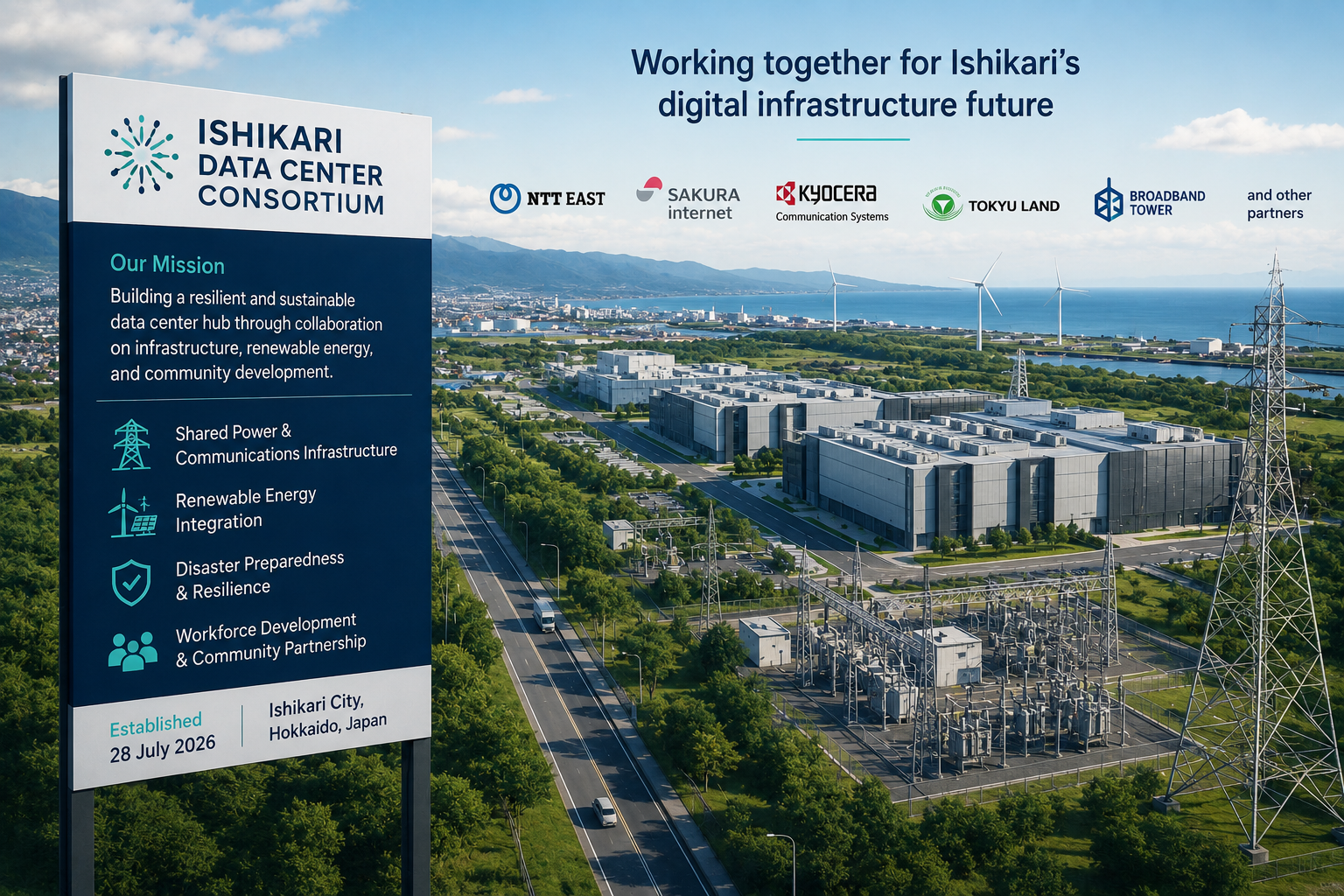
- Ishikari City and 11 companies established the Ishikari Data Center Consortium on 28 July
- Members will examine shared power and communications infrastructure, renewable-energy use, disaster planning and workforce development
The fact
Ishikari City and 11 companies have established the Ishikari Data Center Consortium to coordinate work across the city’s data-centre cluster. Members include NTT East, Sakura Internet, Kyocera Communication Systems, Tokyu Land, Broadband Tower and several energy and communications infrastructure providers. The group will examine shared power and communications infrastructure, greater use of locally generated renewable energy and joint disaster planning. It also plans to support technical training, employment and public understanding of data-centre operations.
The consortium may submit proposals to the national and Hokkaido governments on green-transformation zones, special districts and subsidies. Ishikari City cites renewable-energy resources, relatively low disaster exposure and access to the Sapporo labour market among the area’s advantages. The announcement included no new power capacity, fibre route, data centre or funding commitment.
The assessment
The consortium allows the city, data-centre operators and infrastructure providers to plan common requirements together. This could include power connections, communications routes, emergency procedures, and technical training that serve several facilities.
The members must still decide which assets should be shared, who will pay for and own them, and how capacity and operating responsibilities will be allocated. No infrastructure plan, budget or construction timetable has been published. The arrangement will affect delivery only when the group agrees on specific projects and assigns responsibility for completing them. For BTW readers, Ishikari now has a structure for coordinating infrastructure across the cluster. It has not yet increased the region’s power, connectivity, or operating capacity.
What to watch
Watch for a published infrastructure plan, named power and fibre projects, cost-sharing rules and joint disaster procedures. Government proposals on special zones or subsidies would show the policy work advancing. Construction starts, additional grid capacity, diverse long-haul fibre routes or shared operating systems would show the consortium moving into delivery.
Member Briefing
Deeper Profile Context
Sign in with the right membership level to unlock the full briefing and source notes.
Only for Strategic Circle
Strategic Circle
Open to all readers. Unlock profile briefings after joining and signing in.
Join Strategic CircleOnly for Leadership Alliance
Leadership Alliance
For qualified IP-asset owners and management; sign in to unlock alliance briefings.
Join Leadership Alliance