
Summary
- APJII launched the Indonesia Internet Exchange in August 1997 to make domestic interconnection possible inside Indonesia, rather than routing local exchanges through networks abroad.
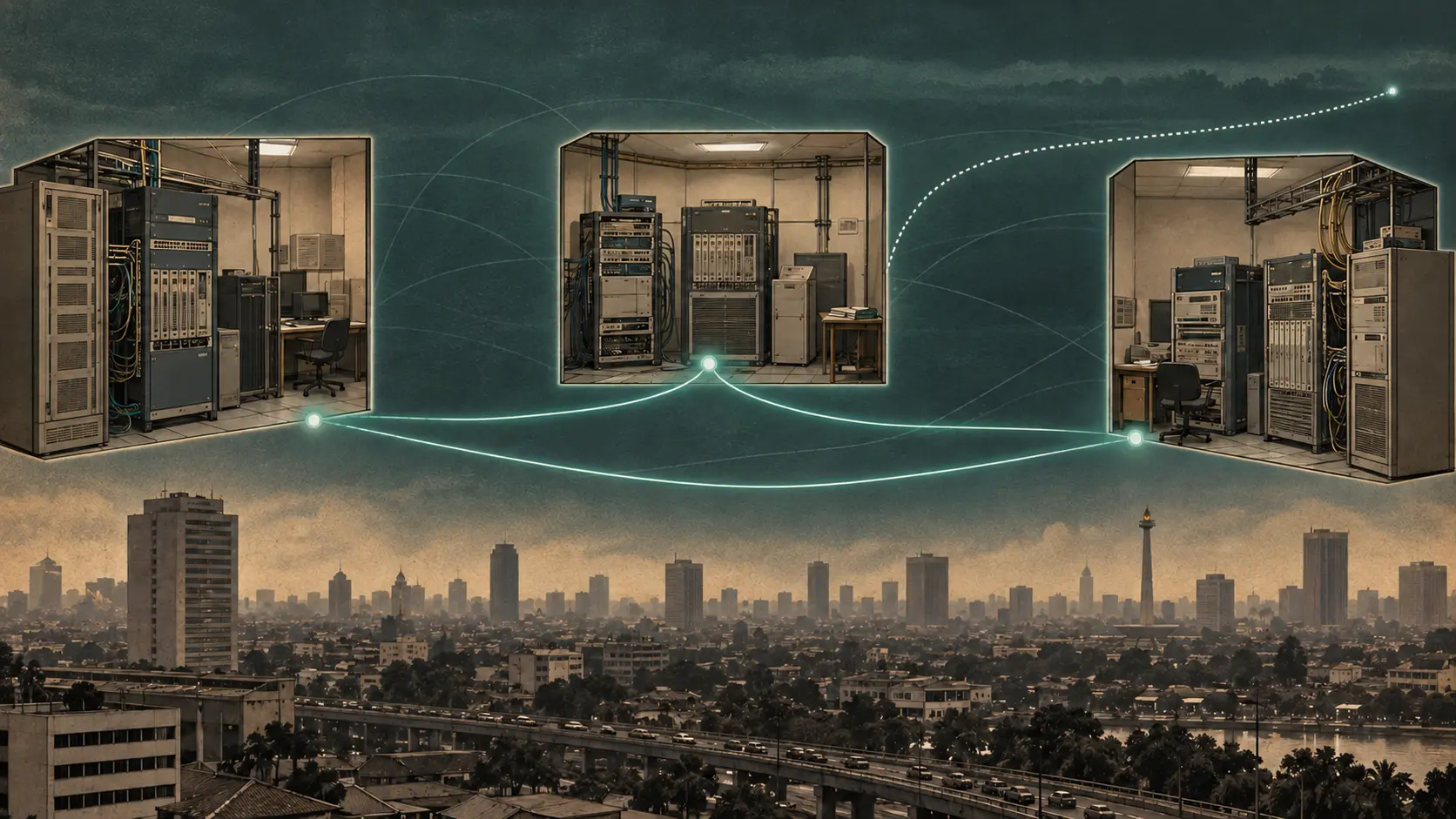
- Its first phase linked three separate sites hosted by Telkom Indonesia, Satelindo and Indosat. Providers could choose among them according to circuits, commercial relationships and preference.
The international detour
A local message does not care where a border lies. A network does. In July 1997, APJII’s institutional history counted 41 preliminary permits for internet service providers. The association argued that Indonesian providers lacked a national exchange: traffic moving between local networks could depend on international interconnections, including routes through the United States. That could add cost and leave operators dependent on capacity they did not control.
This was APJII’s case for an exchange, not a measured account of every packet. The same history notes that some Indosat and Satelindo customers already exchanged traffic through their respective carriers. The missing piece was an independent national arrangement that could connect providers across those separate networks. Local peering promised an alternative and a backup path; it did not make domestic circuits free, uniform or independent of telecom companies.
APNIC’s 2015 interview with Johar Alam Rangkuti dates an APJII task force to June 1997 and IIX’s launch to August. Rangkuti later recalled an informal conversation as the project’s spark. It is a participant’s retrospective, not a surviving meeting transcript. The institutional record and the technical design make a more durable point: IIX was organized as a practical interconnection project, not a decree that every provider must join.
Three rooms, one exchange idea
The phase-one technical overview, updated in December 1998, describes three exchange sites: Telkom Indonesia, Satelindo and Indosat. These were separate carrier-hosted locations, not a single national building or a new backbone replacing existing networks. An ISP could choose a site based on the circuits available to it, its upstream or customer relationships, or organizational preference. The design therefore combined a shared aim—domestic traffic exchange—with a distributed operating surface.
The arrangement mattered because peering is both a routing choice and a commercial one. A provider still needed a circuit to a site and had to decide which carrier relationship made sense. Three locations could widen the options compared with one meeting point, while also leaving access shaped by the operators that hosted them. APJII’s record does not provide a complete member list or a price schedule for each site, so the design should not be mistaken for equal access in practice.
A boundary written in routes
The 1998 overview also describes how the exchange was meant to behave. Some providers that did not yet have their own autonomous system number could use a shared exchange ASN and route-reflector arrangement; APJII encouraged providers to obtain their own ASNs. Route filters were intended to limit what members announced and to prevent routes learned from foreign transit or non-members from leaking across IIX.
That detail is central to the history. The exchange did not keep traffic local merely by placing routers in Indonesia. Operators needed a routing boundary that distinguished member networks from routes learned elsewhere. The design describes the intended control; it is not a packet trace proving that every policy worked in every session.
APNIC’s 2004 status minutes later recalled that Indonesian providers had previously connected to San Francisco and described expansion after an early node reached capacity. Those minutes offer useful community memory, but they are retrospective. They do not provide a before-and-after traffic series. Likewise, a 2015 interview reports that some providers faced international bandwidth bills of US$88,000 per month. That figure belongs to the interview’s account of some ISPs, not a universal Indonesian tariff.
The evidence supports a narrower conclusion than “IIX made all Indonesian traffic stay home.” APJII set out to replace an overseas detour with local interconnection; the phase-one record documents three sites and filters designed for that purpose. Whether a particular flow used IIX depended on network participation, circuits and route policy. The achievement was a new place—and a new rule boundary—for Indonesian networks to meet.
Sources
- APJII, “History of IIX” — institutional account of the 1997 problem and project.
- IIX-APJII, phase-one technical overview — design record, peering since August 1997, updated December 1998.
- APNIC, interview with Johar Alam Rangkuti — retrospective participant account.
- APNIC, IIX status minutes — 2004 community retrospective.
Member Briefing
Deeper Profile Context
Sign in with the right membership level to unlock the full briefing and source notes.
Only for Strategic Circle
Strategic Circle
Open to all readers. Unlock profile briefings after joining and signing in.
Join Strategic CircleOnly for Leadership Alliance
Leadership Alliance
For qualified IP-asset owners and management; sign in to unlock alliance briefings.
Join Leadership Alliance