
Policy continuity, legitimacy, and accountability signals across internet governance institutions.
Governance
Governance
Internet governance intelligence tracks institutions, policy processes, standards activity, registry operations, accountability disputes, and implementation signals that affect internet infrastructure. BTW.
RIR WatchdogCase FileNumber Resource SocietyICANNIETFHistory of InternetNOGs

RIR Watchdog, Case File, NRS, ICANN, IETF, History of Internet, and NOG sessions.
Coverage prioritizes implementation evidence and institutional behavior over declarative positions.
Latest Coverage
Latest from Governance
7,602 articles
History
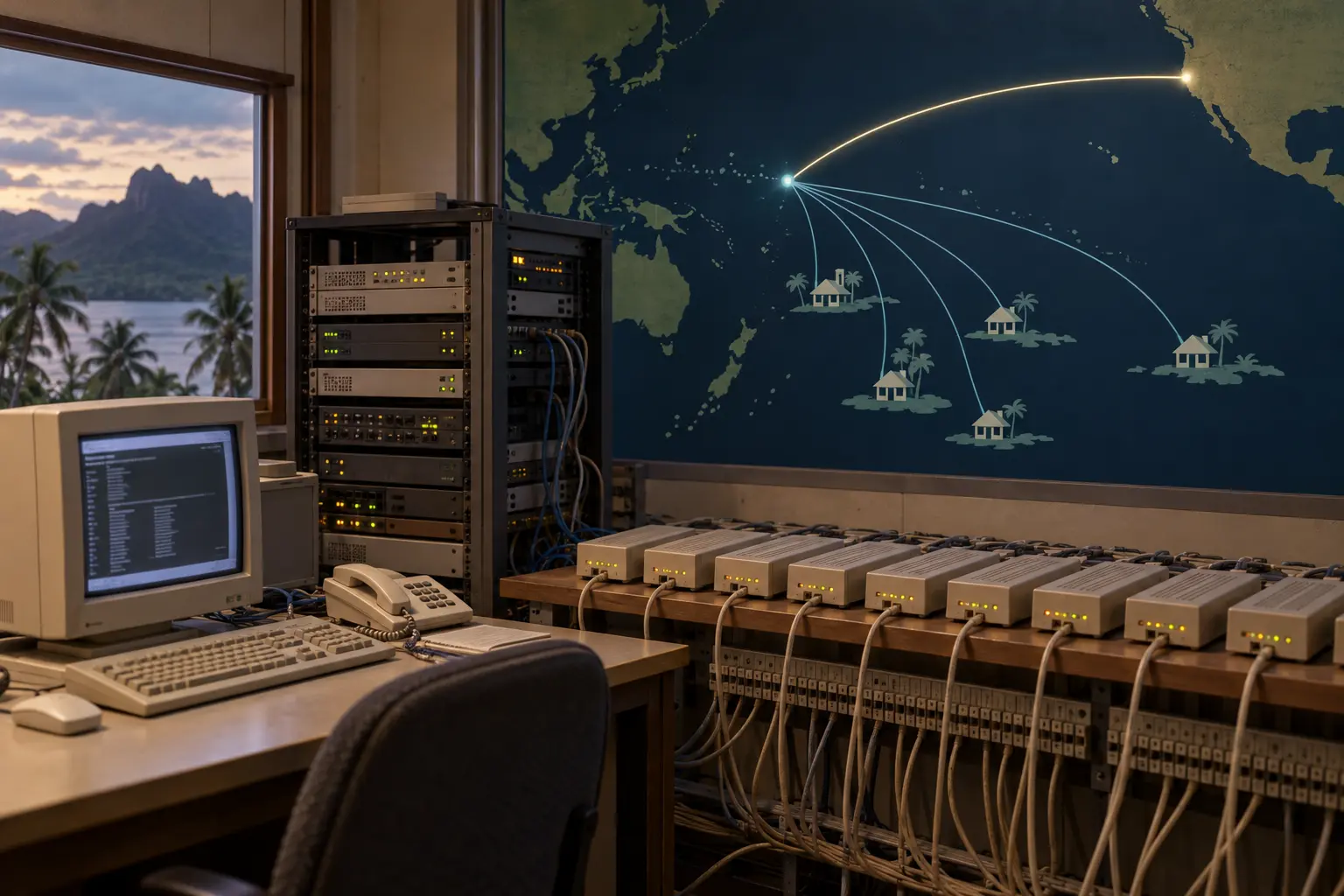
280 Customers, No Dedicated Line: FSM Telecom’s Internet in 1997
FSM Telecom reported 280 customers across the Federated States of Micronesia in February 1997, but said none had a direct connection. They dialled into a shared service carried over a 128 Kbps Sprint link from Pohnpei to California. The same report put a dedicated 64 Kbps line at…

CASE FILE
CWU’s DM26 pause complicates Ofcom’s one-year stamp-cap bridge
Ofcom’s proposed year-long extension of the Second Class letter cap buys time for evidence on postal reform. A union-announced pause in further rollout now makes the pace of that evidence less certain, without changing the proposal itself.

History
One UK Traceroute Reached American Samoa Through Sacramento in 1997
Two PEACESAT messages described American Samoa as lacking a live link in 1995 and 1996. A year later, one UK operator traced a path to a Samoatelco server. The records mark a change in observable reachability, not a proven launch date or a map of who could connect.

Story
ARIN’s Survey Calls Customer Service an Exception. Its Table Shows a Smaller Gap.
ARIN’s 2026 satisfaction report says the overall distance between expectations and perceived performance narrowed. Yet its narrative names Customer Service as an exception while the same page’s table moves that dimension from a nine-point gap to six. The sample also changed, so…
History
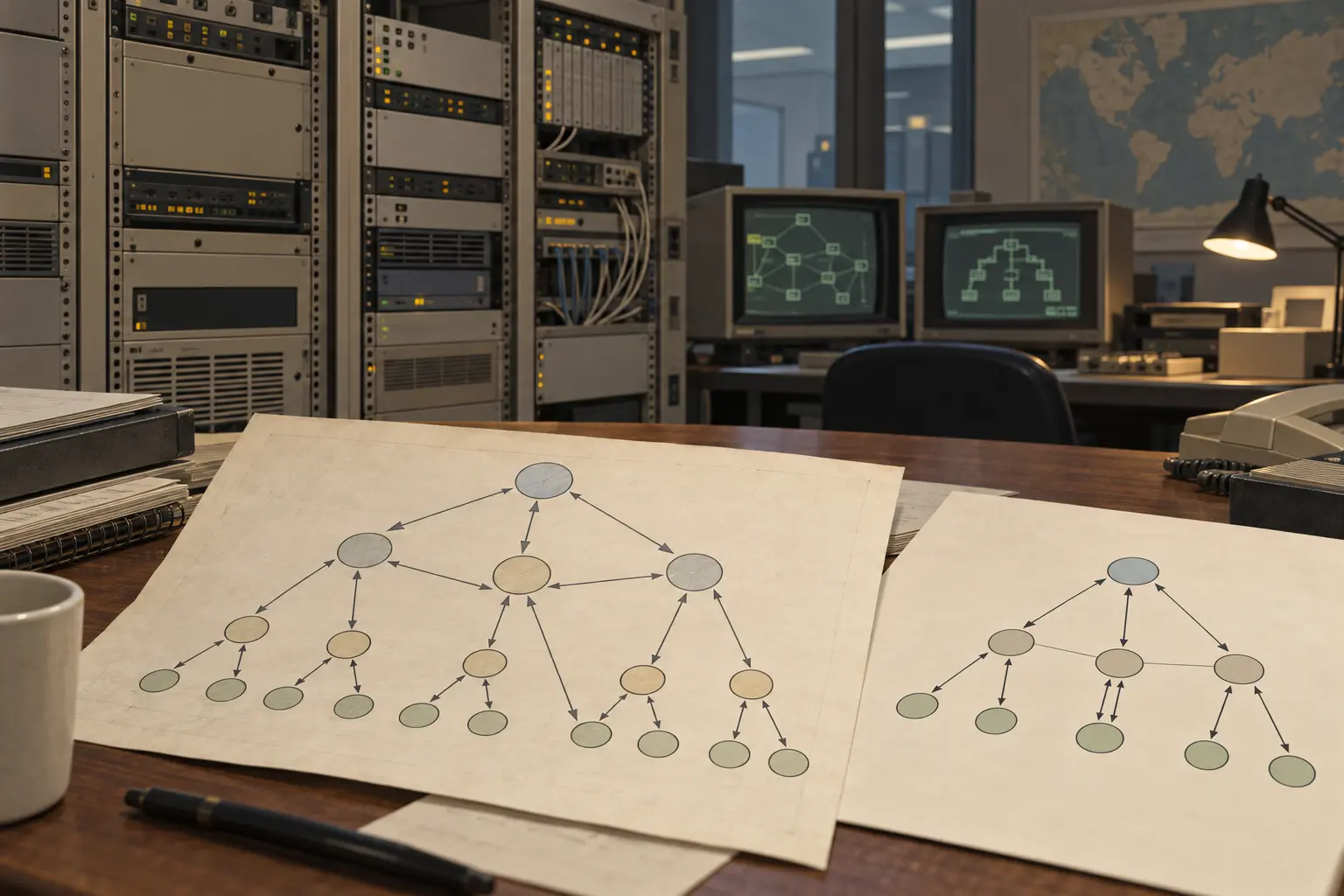
BGP Was Already Running in Cisco and NSFNET in 1989
By the time BGP appeared in an RFC, Cisco routers and NSFNET’s Nodal Switching Systems already had implementations. The June 1989 document captured a protocol still taking shape; a year later, its successor was a proposed standard that openly invited deployment experience to…

CASE FILE
X appears to meet Ofcom’s response-time targets; takedown results remain unsettled
Ofcom says X’s first quarterly report appears to meet the review-time windows it accepted in May. The regulator has yet to test the metrics against its own evidence and still questions whether illegal content is being removed effectively.

History
Two Exits, One X.25 Workaround: Ireland’s Internet Routes in 1991
In 1991, Trinity College Dublin and University College Dublin did not reach the Internet by the same route. One used a low-speed EUnet line through Britain and Amsterdam; the other carried IP across X.25 and IXI to an Amsterdam gateway.

ICANN
Neither House can choose the next GNSO Chair alone
Samantha Demetriou and Vivek Goyal will face the Council’s 21 October vote at ICANN87 under a rule that requires 60% support in both the Contracted Parties House and the Non-Contracted Parties House.

History
A Stable Link Was Still Prohibitive: AUB’s Internet Route through Paris, 1992–95
At the American University of Beirut, a working Internet path did not mean an affordable service. A 9.6-kbps X.25 link could be described as stable while cost, bandwidth limits and a pending telephone-agreement kept access narrow.

History
A London Poll, a Washington Mail Run: Sierra Leone’s Two Email Routes, 1994–95
Before a browser could make the Internet feel continuous, Sierra Leone’s early users reached it through scheduled mail exchanges. Contemporary accounts describe several gateways with different operators, costs and operating states—not one national switch being turned on.

ICANN
A DNSSEC comment asks ICANN to align its DS report with RFC 10026
A 16 October submission points to a registry-lock rule that the June assessment describes inconsistently. The distinction matters before ICANN turns its review into requirements for registry operators.

History
Four Plans, One Meter: BruNet’s 1995 Dial-Up Tariff
A December 1995 message from Brunei’s Telecommunications Department records four BruNet plans, each pairing a monthly subscription with a stated dollar value of “free traffic,” then charging extra use by the minute at different peak and off-peak rates.

ICANN
IAB seeks broader voting and appeal safeguards for root governance
A 15 October letter asks ICANN to settle representation, voting, appeals and funding controls before the proposed Root Server System Council is chartered. The current model gives operators 12 of 24 votes and leaves some safeguards for later phases.

History
Libya’s Internet Had More Than One Opening Date, 1998–2000
Libya’s Internet chronology changes with the threshold being measured: institutional connection, licensed service, eligibility to connect, and ordinary public use do not begin on the same day. Contemporary accounts disagree most sharply just as public venues started to appear.

Story
APNIC’s 41% RDAP Figure Measures a Moving Rank, Not One ASN’s Share
APNIC’s 41% RDAP Figure Measures a Moving Rank, Not One ASN’s Share intelligence summary explains the development, the public evidence available to readers, the organisations involved, the regional context, market exposure, and the infrastructure consequences that may follow. The…

History
Three Gateways, Three Client Groups: Timor-Leste’s Internet, 2000–02
Timor-Leste’s early postwar Internet did not begin as one national service. From 2000 to mid-2002, three gateways served separate client groups, and only one—the Telstra gateway—operated commercially.

ICANN
RySG urges ICANN to resource a staged root-server governance launch
The registries group wants the ICANN Board to adopt the RSS Governance Working Group’s model, support a staffed start and set target timelines. The Board’s public preview still describes continued discussion, leaving implementation—not a new operational power—as the immediate…

History
Public Dial-Up, UUNET by Satellite: Gulfnet Kuwait, 1994–97
Three messages from Gulfnet’s director trace two access layers: a satellite connection reported in 1994, public UNIX dial-up in 1995, and a 1997 account of satellite backhaul to UUNET/AlterNet beside domestic modem access. These are operator snapshots, not proof of a continuous…

History
AlterNex Turned ECO-92 into a Public Internet Gateway, 1989–92
Brazil’s first academic Internet links and AlterNex’s public-facing service mark different milestones. The 1992 Rio conference connected an NGO-run communications node to an RNP-operated international IP path, while the earlier AlterNex network had already moved civil-society…

Story
Timor-Leste’s 450 Starlink links are meant to hand over to fibre
The government says nearly 450 village headquarters have been connected through Starlink, but the programme was designed as a bridge: a planned public fibre network is expected to reach many of the same offices, after which the temporary satellite terminals are to be switched…
Session Map
Governance Branch
RIR Watchdog
Five regional sessions tracking allocation policy, board legitimacy, and institutional continuity.
Open RIR WatchdogCase File
Long-cycle governance dossiers with legal, election, and institutional stress analysis.
Open Case FileNumber Resource Society
Membership, charter, and resource-governance intelligence from the NRS ecosystem.
Open NRS SessionICANN
DNS coordination, accountability frameworks, and global multi-stakeholder process dynamics.
Open ICANN SessionIETF
Protocol standardization trajectory and interoperability risk under fragmented policy conditions.
Open IETF SessionHistory of Internet
Long-cycle infrastructure history used for governance interpretation and structural forecasting.
Open History SessionNOGs
Operator-level implementation intelligence from APRICOT plus regional and national NOG ecosystems.
Open NOGs Session