
Summary
- AlterNex began in 1989 as IBASE’s non-profit email and conferencing service in the Association for Progressive Communications, before it had the conference-era public Internet path.
- ECO-92 joined that civic network to an RNP-operated 64-kbit/s international link; contemporary and later sources call this a first public-access milestone, distinct from Brazil’s earlier academic TCP/IP connections.
The useful date in Brazil’s Internet history depends on what the network could do and for whom. FAPESP accounts describe academic TCP/IP operation there from early 1991, with a separate UFRJ connection later that year. Carlos Afonso’s 1996 account describes another milestone: from June 1992, AlterNex was the first full Internet system in Brazil open to public access. These statements need not cancel each other. One concerns early academic connectivity; the other names a service available beyond university research networks.
AlterNex did not begin as an ordinary Internet service provider. IBASE, a non-profit institute in Rio de Janeiro, joined the APC network project in 1988. Its 1989 node ran on UNIX and offered electronic mail and conferencing. Afonso’s account describes an X.25 connection to Brazil’s RENPAC packet network, followed by a dial-up line for local callers. International mail moved through partner nodes using UUCP: systems exchanged queued batches rather than offering every user continuous, interactive IP reachability. A 1996 account says calls were scheduled twice daily from the United States because the international call cost less there.
That service boundary mattered to Brazilian civic groups. APC was organized as linked non-profit nodes that shared technical resources while retaining local autonomy. The 1989 report situates AlterNex among groups working on human rights, public information, health and environmental issues. It records 159 AlterNex users in February 1990 and estimates monthly operating costs near US$6,500. Those figures are the author’s snapshot and estimate, not an audited account, but they expose the constraint: a network built for lower-cost communication still needed skilled staff, reliable power, maintenance and paid international circuits.
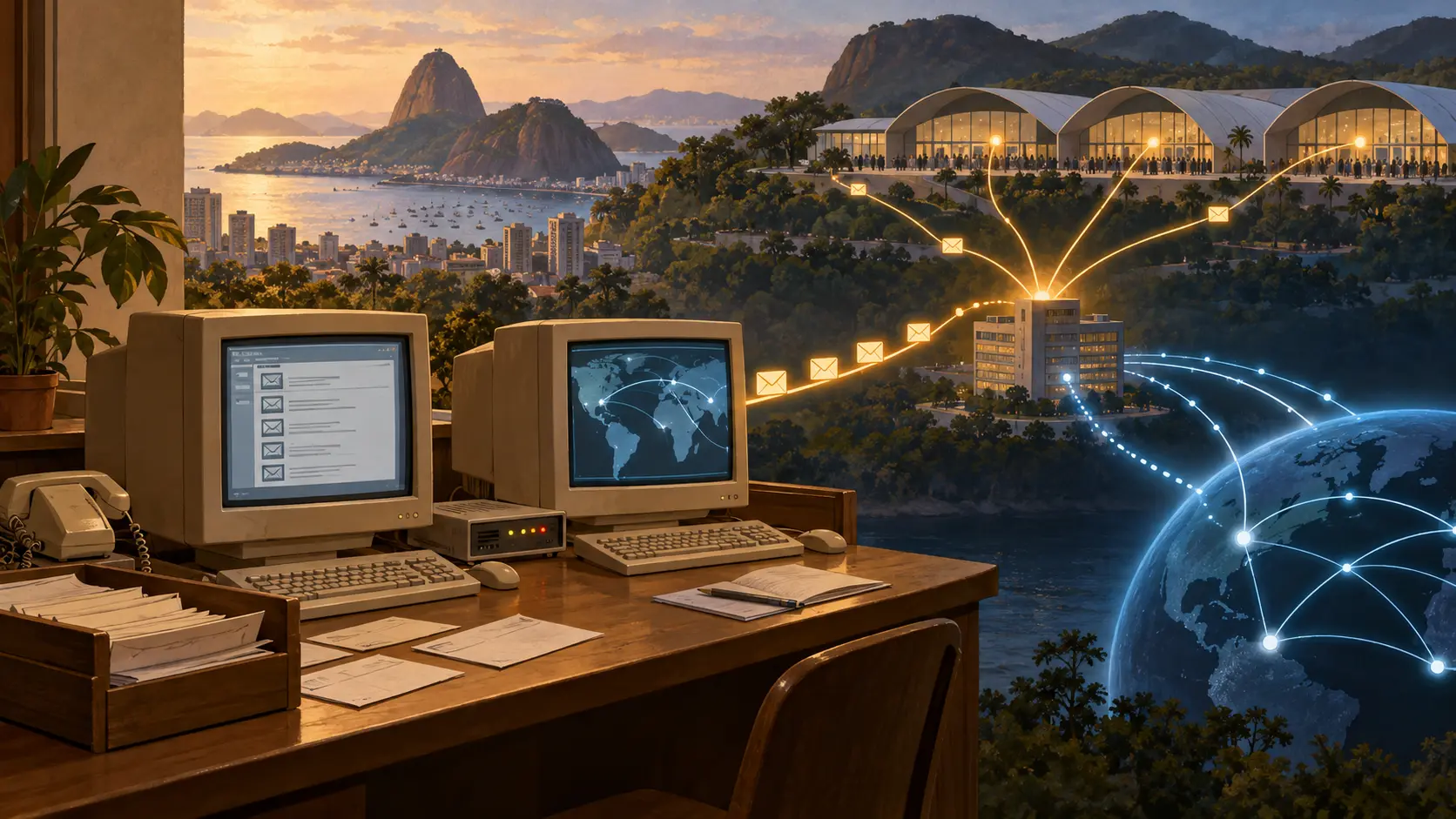
The shift began with an event requirement. In late 1990, environmental organizations asked IBASE to develop an electronic communications system for the UN Conference on Environment and Development in Rio, later known as ECO-92. IBASE submitted a project to the conference secretariat; Afonso’s account says it entered Brazil’s host-country agreement with the United Nations. The project was called ISP/Rio. The conference spread across three venues, so organizers had to make the local networks, leased circuits and international service work together.
When the conference opened in June 1992, computers at official sites were linked by leased lines to AlterNex and then through an international 64-kbit/s link to the United States operated by RNP, according to Afonso’s 1996 account. A later FAPESP retrospective adds that RNP connected AlterNex to transit points at UFRJ and FAPESP, while Telerj supplied dedicated circuits between conference sites. The accounts differ in how they describe the international circuits; they agree that AlterNex depended on the research network and telecommunications infrastructure rather than building a standalone international backbone itself.
This was an institutional arrangement as much as a technical one. IBASE contributed the civic network and project work; RNP supplied routing and international connectivity; the UN and Brazilian government made the conference access part of the host arrangement; Telerj supplied local circuits. The result connected NGOs and other users to a broader set of Internet services during the event. It did not make every citizen an Internet user, and a conference network is not proof of nationwide household service.
The record therefore supports a more precise history than a single “arrival” date. Academic TCP/IP links, APC email gateways, conference-site Internet access, public-facing full Internet service and later commercial subscriptions were separate operating states. ECO-92 mattered because it aligned an NGO network, an academic backbone and public institutions around a working service—and made that service visible beyond the university system.
Sources: Carlos Afonso, IBASE’s near-contemporary account of AlterNex and APC; Carlos Afonso, “Internet in Brazil,” CGI.br; FAPESP, ECO-92 and Brazil’s pioneering Internet experience; FAPESP, “The Internet’s Early Days”; RNP, “Internet 30 Years”; Folha de S.Paulo, “The Brazilian experience”.
Member Briefing
Deeper Profile Context
Sign in with the right membership level to unlock the full briefing and source notes.
Only for Strategic Circle
Strategic Circle
Open to all readers. Unlock profile briefings after joining and signing in.
Join Strategic CircleOnly for Leadership Alliance
Leadership Alliance
For qualified IP-asset owners and management; sign in to unlock alliance briefings.
Join Leadership Alliance