
Summary
- A January 1994 message said Kuwait already had satellite Internet connectivity to the United States, while public dial-up was still expected “any day now.”
- By 1995 Gulfnet said anyone interested could connect through a UNIX dial-up host; in 1997 it described satellite backhaul, mostly dial-up domestic IP traffic, separate customer and upstream costs, and unavailable new leased circuits.
The surviving Gulfnet messages are best read as three operating snapshots, not one launch announcement. They distinguish the international connection that brought Internet service to Kuwait from the telephone lines customers used to reach a local host.
On 5 January 1994, John W. Temples wrote that a satellite link to the United States was already providing Internet connectivity. Public dial-up, by contrast, would be available “any day now”; he knew of no restrictions on who could connect. This records an upstream connection and an imminent public-service expectation, not the dial-up launch date, actual usage or satellite capacity. NSRC record, 5 January 1994
On 2 January 1995, Temples said Gulfnet was providing access to anyone interested through a UNIX dial-up host. He named Kuwait University, the Public Authority for Applied Education and Training, and Kuwait Petroleum Corporation as also online, and expected more companies and ministries later that year. This is a provider’s contemporary account, not an independent census. NSRC record, 2 January 1995
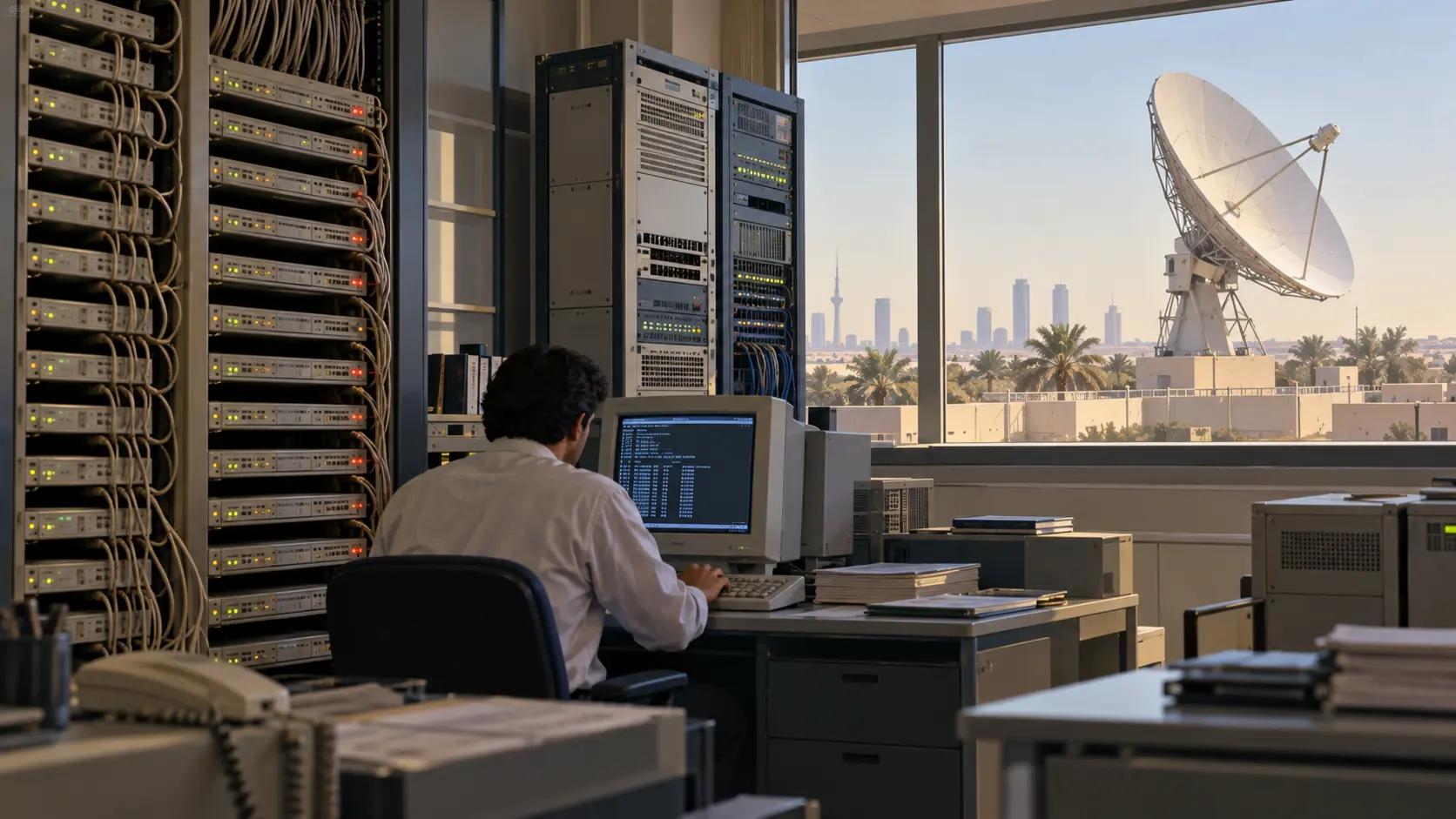
The 17 March 1997 account described a leased satellite circuit back to UUNET/AlterNet in the United States. Most domestic IP traffic, Temples said, used dial-up. Modems ran at least 28.8 kbit/s, mostly 33.6, and he described the telephone infrastructure as generally good. These are customer-side modem speeds, not international satellite bandwidth. The record gives no satellite operator, transponder, circuit capacity, latency or traffic measurement; it also cannot establish that the 1994 and 1997 circuits were continuous or identical. NSRC record, 17 March 1997
Gulfnet listed monthly dial-up prices of US$150 for a student, US$215 for an individual or company, and US$330 for a dedicated dial-up line. Separately, it put its own network-connectivity costs at US$1,000–2,000 per month, varying with bandwidth and user count. The first figures are customer tariffs; the second are provider costs. They are not comparable prices. Without income, exchange rates, customer totals or audited accounts, they do not establish affordability or profitability.
Temples said new leased circuits were unavailable for “political rather than technical” reasons, but named no decision-maker or cause. He also called Gulfnet the region’s first public-access Internet site; that remains his claim, not an independently verified ranking. The records support a bounded history of what one operator reported at three dates—not an exact 1994 launch day, a continuous national route, or a proven regional first.
Sources
Member Briefing
Deeper Profile Context
Sign in with the right membership level to unlock the full briefing and source notes.
Only for Strategic Circle
Strategic Circle
Open to all readers. Unlock profile briefings after joining and signing in.
Join Strategic CircleOnly for Leadership Alliance
Leadership Alliance
For qualified IP-asset owners and management; sign in to unlock alliance briefings.
Join Leadership Alliance