
Summary
- The familiar 1998 and 2000 dates describe different stages, while a 1999 human-rights report still found no public access through a local ISP.
- A September 2000 report counted at least twenty Internet centres in Tripoli; a July report’s claim of more than 3,000 cafés and 300,000 daily users in 1998 is not independently reconcilable.
A country’s Internet does not become public in one clean instant. In Libya, the year changes according to what the writer means by “arrival”: computers inside state institutions, an experimental connection, the first provider licence, permission for selected customers, or a place where an ordinary resident could pay to browse. The surviving record supports a sequence of thresholds, not a single uncontested launch day.
Later accounts often put the beginning at 1998. OpenNet Initiative’s 2007 study says access officially came at the end of that year but was not widely available until early 2000. Freedom House’s 2012 country report describes institutional access in the mid-1990s and public availability in 1998, initially expensive and limited to a small elite. Those summaries are not identical: “official,” “public,” and “widely available” carry different tests, and Freedom House points back to an Arabic report from 2004 rather than a surviving connection log.
A contemporary check complicates the neat 1998 story. On 1 July 1999, Human Rights Watch wrote that Libya, Iraq and Syria were the regional exceptions to public access through a local Internet service provider. Its earlier regional account also said that, by May 1999, Libya and Iraq lacked a form of international connectivity. These are related but separate claims. A state institution might have an experimental or restricted link without a local provider offering public service; conversely, a licence does not prove that a customer could already reach the global network.
The reports do not identify a specific Libyan first circuit or reconcile their definition with later accounts.
The regulatory record supplies a date, but not a launch certificate. A General People’s Committee decision of 7 August 1999 issued rules governing telecommunications services provided by the General Posts and Telecommunications Company. Its Arabic text includes information-network services and conditions for network use. Freedom House later reports that the state operator GPTC awarded Libya Telecom and Technology (LTT) the first ISP licence in 1999. This makes 1999 an important institutional hinge: service was being classified and licensed. Neither item, by itself, settles when public Internet access became practically available.
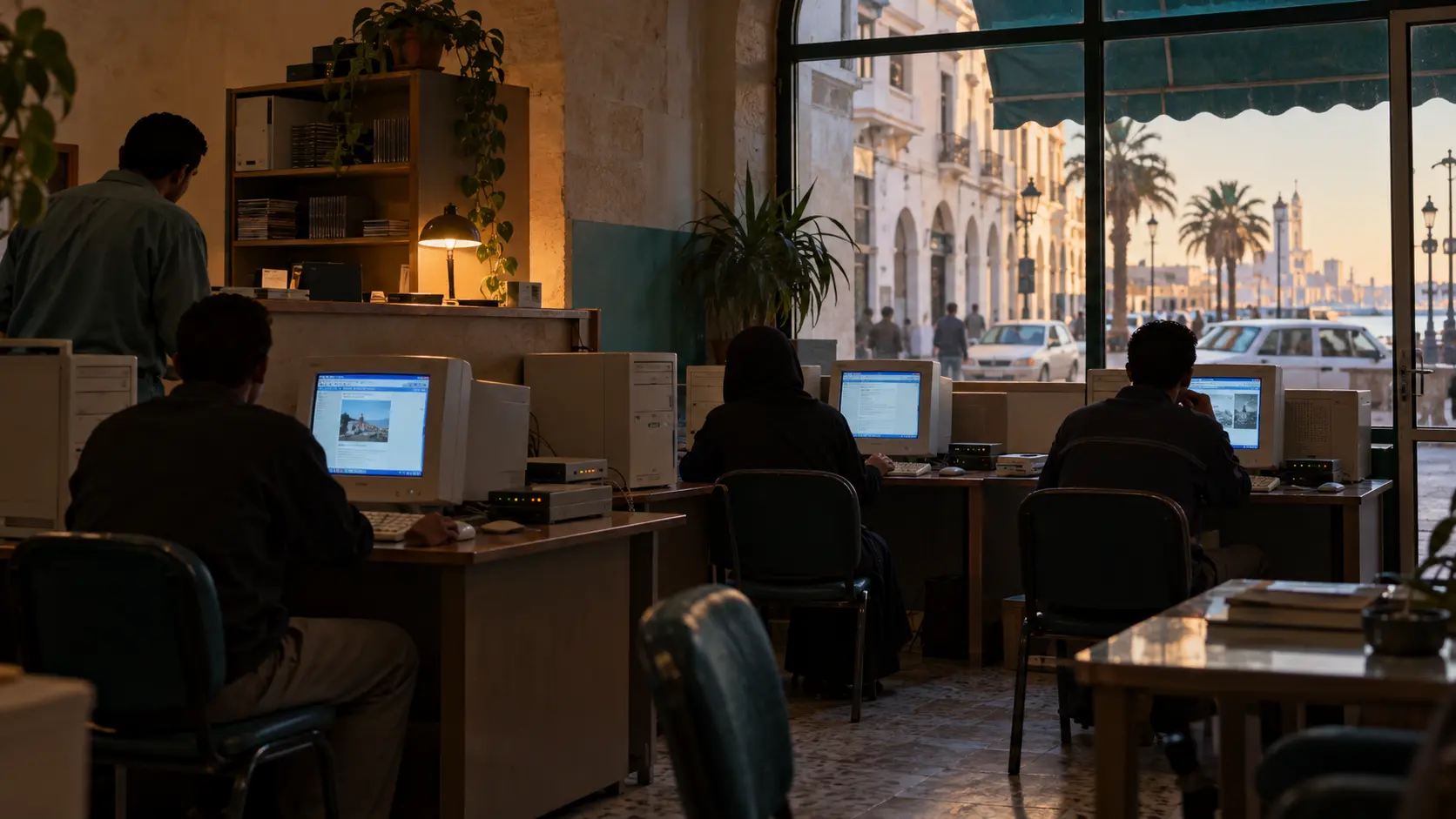
The most concrete public-use evidence arrives in 2000. Reporting from Tripoli on 7 September, L’Orient-Le Jour said at least twenty Internet centres had opened there since the start of that year. It described Libyans using email and browsing overseas sites, while noting that the opening remained controlled. Its figure is a local, dated observation, not a national census. Al Bayan, in an Arabic report dated 28 July, relayed a government-linked account of a gradual connection plan begun in late 1999, with universities, research institutions and schools to be connected under a 2001–05 programme.
The same article claimed more than 3,000 cafés across several cities in 2000 and, implausibly, 300,000 daily Internet users in 1998. The latter is at odds with the article’s own gradual-expansion narrative and with other evidence. The café figure also sits uneasily beside the September report’s twenty Tripoli centres. Different dates, venue definitions or a reporting error could explain part of the gap; the available sources cannot decide which.
Sanctions’ suspension in April 1999 forms part of the setting, not a proven switch that turned the network on. The September 2000 dispatch links the changing atmosphere and lower prices to that wider opening, yet still describes controlled access and security presence. The evidence therefore supports a cautious conclusion: institutional or experimental use preceded a late-1990s service framework; selected public access is claimed for 1998; the 1999 contemporaneous record disputes broad local-provider access; and public venues are directly visible in Tripoli by 2000.
How many people could connect, where else they could do so, and when access became routine remain unresolved.
Sources
Member Briefing
Deeper Profile Context
Sign in with the right membership level to unlock the full briefing and source notes.
Only for Strategic Circle
Strategic Circle
Open to all readers. Unlock profile briefings after joining and signing in.
Join Strategic CircleOnly for Leadership Alliance
Leadership Alliance
For qualified IP-asset owners and management; sign in to unlock alliance briefings.
Join Leadership Alliance