
Summary
- From 2000 to mid-2002, Timor-Leste had three Internet gateways serving different client sets: the UN system, a UNDP development project and Telstra. A 2006 government account says only Telstra operated commercially.
- The gateway count describes separate service constituencies, not three equally open providers or three proven independent international routes. Timor Telecom’s July 2002 contract included the commercial gateway; UN organizations retained internal services.
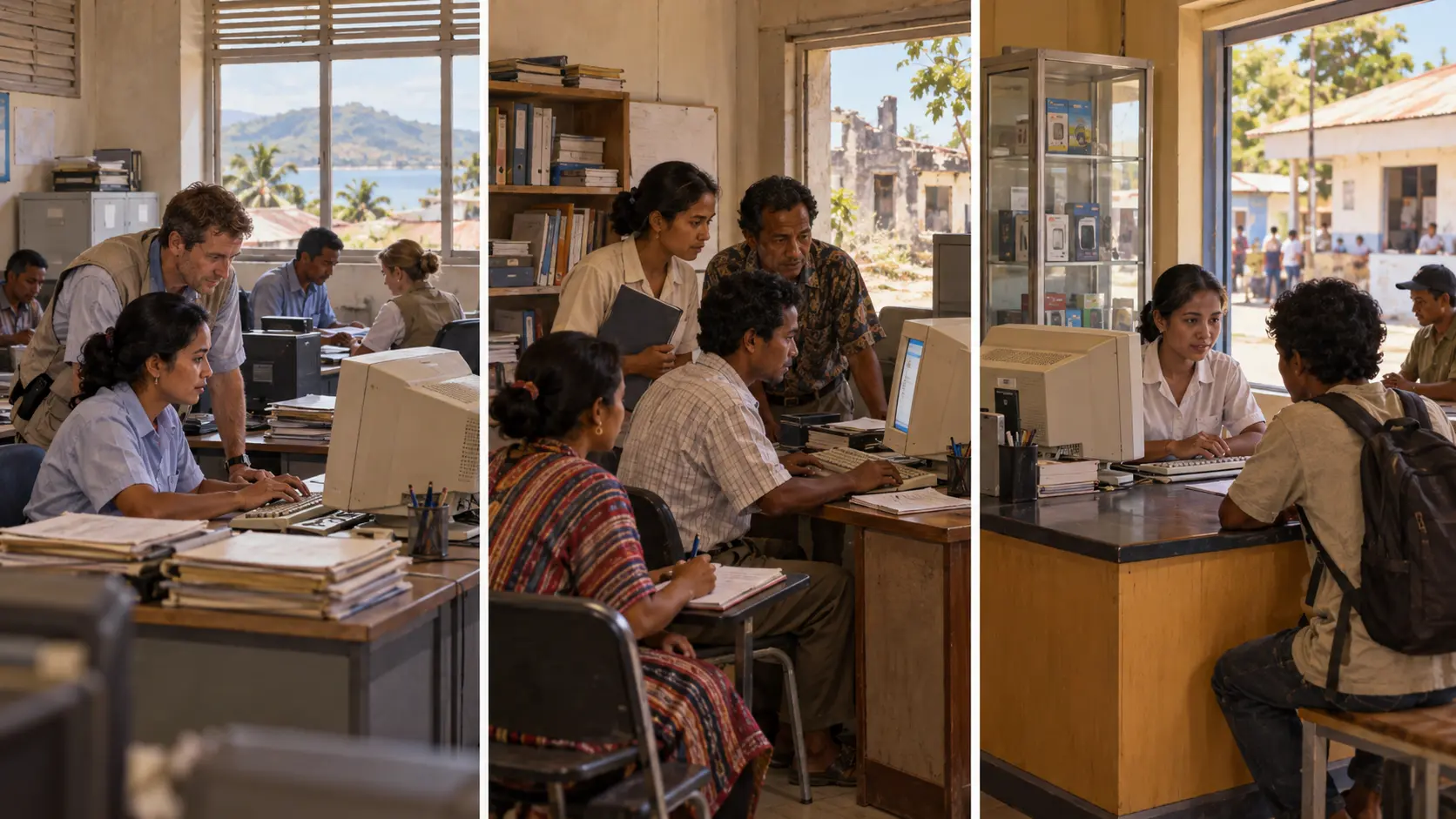
After the 1999 destruction of communications infrastructure, restoring connectivity was part of rebuilding administration. That did not make every connection part of one public network. In an April 2006 presentation, Timor-Leste’s Ministry of Transport and Communications looked back on the period from 2000 to mid-2002 and identified three Internet gateways: one for the UN system, one for the UNDP Internet Network for Development Project, and one operated by Telstra. The ministry said the three served different client groups and that only Telstra’s gateway was commercial. The distinction is the story: a country could have Internet access in several institutions before it had a common retail market. (Ministry of Transport and Communications, “Internet & Intranet Services in Timor-Leste,” 2006)
The institutional setting explains the first division. The ministry paper says UNTAET needed communications among offices spread across the territory when little infrastructure remained. UNDP then began its Internet Network for Development Project in November 2000, aiming to serve the public administration, civil-society organizations, diplomatic missions and some UN agencies. The project’s devices were to pass to the government when the project ended. That was a development programme with a defined client mission, not an assertion that every resident could subscribe on the same terms. (UN Security Council, SC/6745, 25 October 1999; Ministry of Transport and Communications, 2006)
The two records disagree on the project's start. The ministry dates its launch to November 2000, while the project manager dates the first connection to 2 February 2000. They may describe different stages, but the sources do not reconcile them; the sequence should remain unresolved.
A project report by UNDP’s Michael Mwaura, archived by the Network Startup Resource Center in August 2002, gives a closer view of that service. It dates the project’s first Internet connection to 2 February 2000 and says it was initially extended to UN agencies in the building. The link began at 64 Kbps and rose to 128 Kbps in April. Later, the project offered direct connections, wireless access, leased-line dial-up and individual dial-up. It reported monthly prices that varied by client and service type: organizations paid more than individual NGOs, while UN agencies at the UN House had their own direct-connection rates. The project’s capacity therefore grew alongside its client list and service menu. (UNDP Internet Project in East Timor, report archived by NSRC, 13 August 2002)
The later bandwidth figures need care. Mwaura’s report describes the May 2001 upgrade as 512 Kbps upstream and 128 Kbps downstream. The 2003–04 Digital Review of Asia Pacific chapter gives the opposite direction, 128 Kbps outgoing and 512 Kbps incoming. The figures should not be silently harmonized. Both accounts support growth from the initial 64 Kbps connection and a 2001 upgrade; the supplied records do not settle the direction of that later asymmetric link. (UNDP project report; Digital Review of Asia Pacific 2003/2004, Timor-Leste)
Telstra occupied a different position. It was the only gateway the ministry identified as commercial during the period. In July 2002, Timor Telecom won the international Build-Operate-Transfer tender; the ministry says the contract included operation of the country’s commercial Internet gateway. That award marks a change in who would operate the commercial access channel, not proof that all institutional networks immediately merged. The same 2006 account says UN offices and some diplomatic missions maintained gateways for internal use, with Telstra serving as backup. (Ministry of Transport and Communications, 2006)
The chronology is often reduced to a single “first Internet connection” date, but the records describe services at different scopes. Mwaura’s February 2000 date concerns the UNDP project. The ministry’s count covers three gateways and distinct client groups from 2000 to mid-2002. Neither statement establishes when every institution, business or household could connect. This article therefore treats the gateways as service boundaries, not a map of three independent cables or a measure of national reach.
The 2002 transition also makes Timor Telecom more than a closing date. Its directory profile now tracks the company’s present network identity; the historical ministry account supplies the narrower evidence that its contract included the commercial gateway. A contract can transfer an operating role without proving that internal UN services, public access and physical transport became one system. (Timor Telecom, SA directory profile; Ministry of Transport and Communications, 2006)
The useful historical unit is not a national connection but a service and its clients. UNTAET needed administrative communications; UNDP’s project widened institutional and development access under its own funding and pricing; Telstra supplied the commercial gateway. Timor Telecom’s 2002 award changed the commercial operator. Keeping those boundaries visible prevents an institutional connection from being mistaken for universal public access—and prevents a gateway count from being mistaken for physical route diversity.
Sources
- Ministry of Transport and Communications, “Internet & Intranet Services in Timor-Leste” (2006)
- Michael Mwaura, UNDP Internet Project in East Timor, archived by NSRC (2002)
- Digital Review of Asia Pacific 2003/2004, Timor-Leste chapter
- UN Security Council, SC/6745 (1999)
- UNDP, East Timor Human Development Report 2002
- Timor Telecom, SA directory profile
Member Briefing
Deeper Profile Context
Sign in with the right membership level to unlock the full briefing and source notes.
Only for Strategic Circle
Strategic Circle
Open to all readers. Unlock profile briefings after joining and signing in.
Join Strategic CircleOnly for Leadership Alliance
Leadership Alliance
For qualified IP-asset owners and management; sign in to unlock alliance briefings.
Join Leadership Alliance