Summary
- Foldit's cookbook let players turn sequences of moves into recipes that others could run, change and share.
- The 2011 research traced different patterns of public and team sharing, while the best use of a recipe still depended on a player's judgment.
Giving your opponent the instructions for your best trick sounds like an eccentric way to climb a leaderboard. Foldit made room for exactly that. In this online game, players manipulated protein models to improve their computed scores. Alongside the competition grew a cookbook: a place where a useful sequence of moves could acquire a name, an author and descendants.
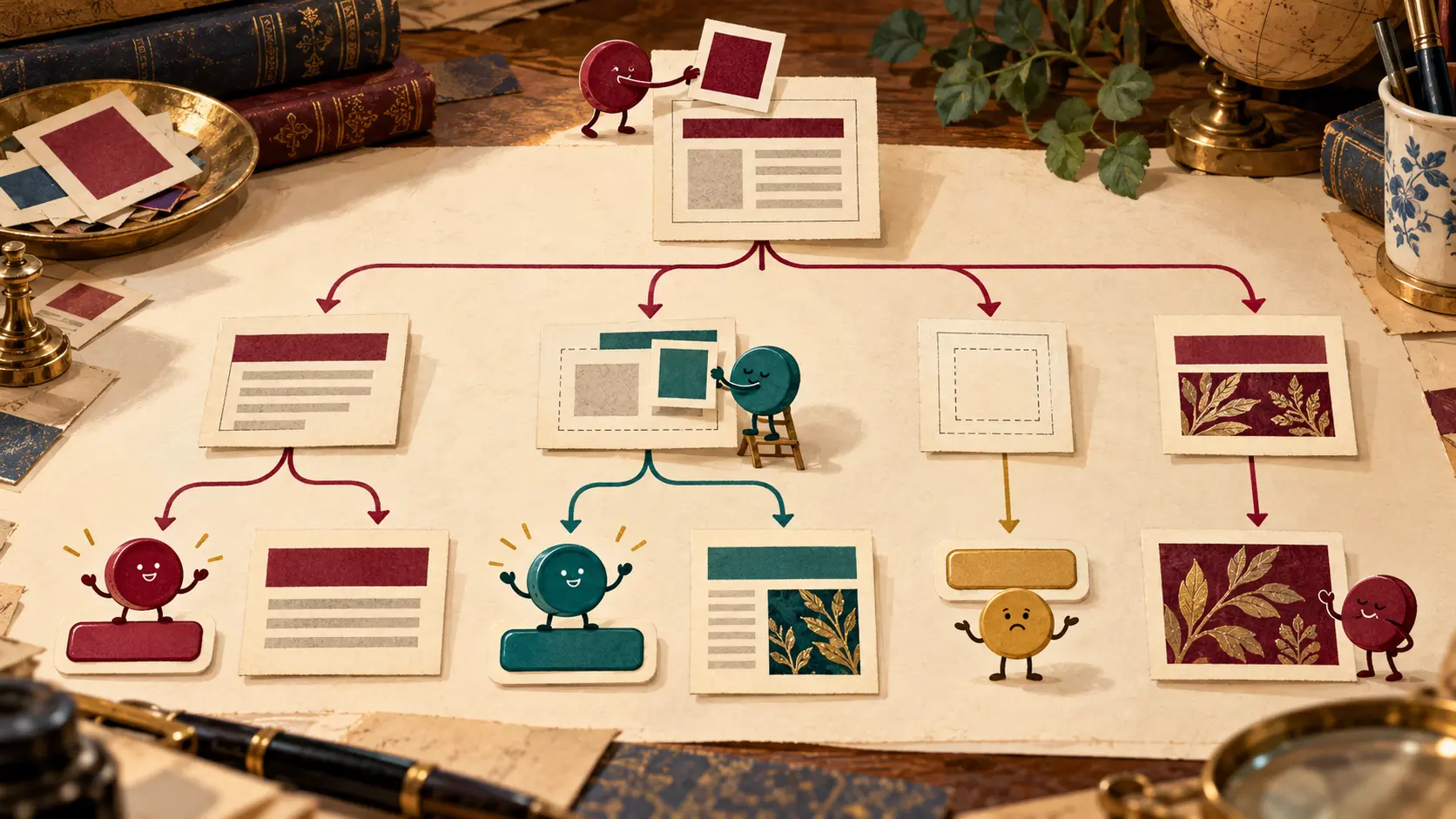
Players had already put strategies on a wiki and asked for automation. The project team's 2011 design paper describes the practical next step. A recipe could be uploaded to the game servers, found on the website and added to another player's cookbook with a button. Advice had become something the recipient could run.
The author chose the audience. A recipe could stay private, circulate within a team or go to the whole community. Its page carried comments, ratings and links to parent and child recipes. Someone who could spot a useful technique could borrow it without first learning to write it. Someone who could improve it had a starting point and a visible family connection.
The resulting families had distinct habits. Blue Fuse v1.1 descended from Acid Tweeker v0.5 and acquired many variations. Loop Rebuild passed through versions shared with a group before version 2.0 was made public. The Quake family in the paper included descendants kept within groups or privately. The cookbook had both a communal table and cupboards whose owners kept the keys.
Blue Fuse's author, known as Vertex, explained the willingness to share in University of Washington's November 2011 account: competition coexisted with a desire to advance the scientific work. The same account acknowledged the recipe's debt to Acid Tweeker. There was something more useful to pass around than a screenshot of a high score.
Two ways of writing helped the exchange. Visual blocks arrived in June 2009; Lua scripting followed in October, according to the team's algorithm study. Scripts offered loops, conditions and more game actions. The simpler block interface continued to attract use and new recipes after scripting appeared. A larger toolbox had left the smaller one useful.
Blue Fuse also stood up well in a carefully bounded comparison. In the researchers' benchmark it improved on the older Classic Relax algorithm; the full Rosetta version of Fast Relax performed better. Reimplementing Fast Relax with Foldit's simpler tools changed the race: Blue Fuse did better below 200 seconds. Its observed average run lasted 122 seconds. The available tools and the time allowed belonged in the result.
Players still had to decide when to use them. Polishing a stretched-out starting chain could waste work if its shape would soon change radically. An effective recipe, deployed at the wrong stage, could be a very industrious distraction.
Even the feedback system had human habits. Many users declined to rate recipes, despite prompts; those who did usually awarded five stars. Recommendations and actual use supplied clues the star display struggled to provide. Foldit had taught tactics to travel over the network. The little rating box was still having trouble getting people to talk.
Member Briefing
Deeper Profile Context
Sign in with the right membership level to unlock the full briefing and source notes.
Only for Strategic Circle
Strategic Circle
Open to all readers. Unlock profile briefings after joining and signing in.
Join Strategic CircleOnly for Leadership Alliance
Leadership Alliance
For qualified IP-asset owners and management; sign in to unlock alliance briefings.
Join Leadership Alliance