Summary
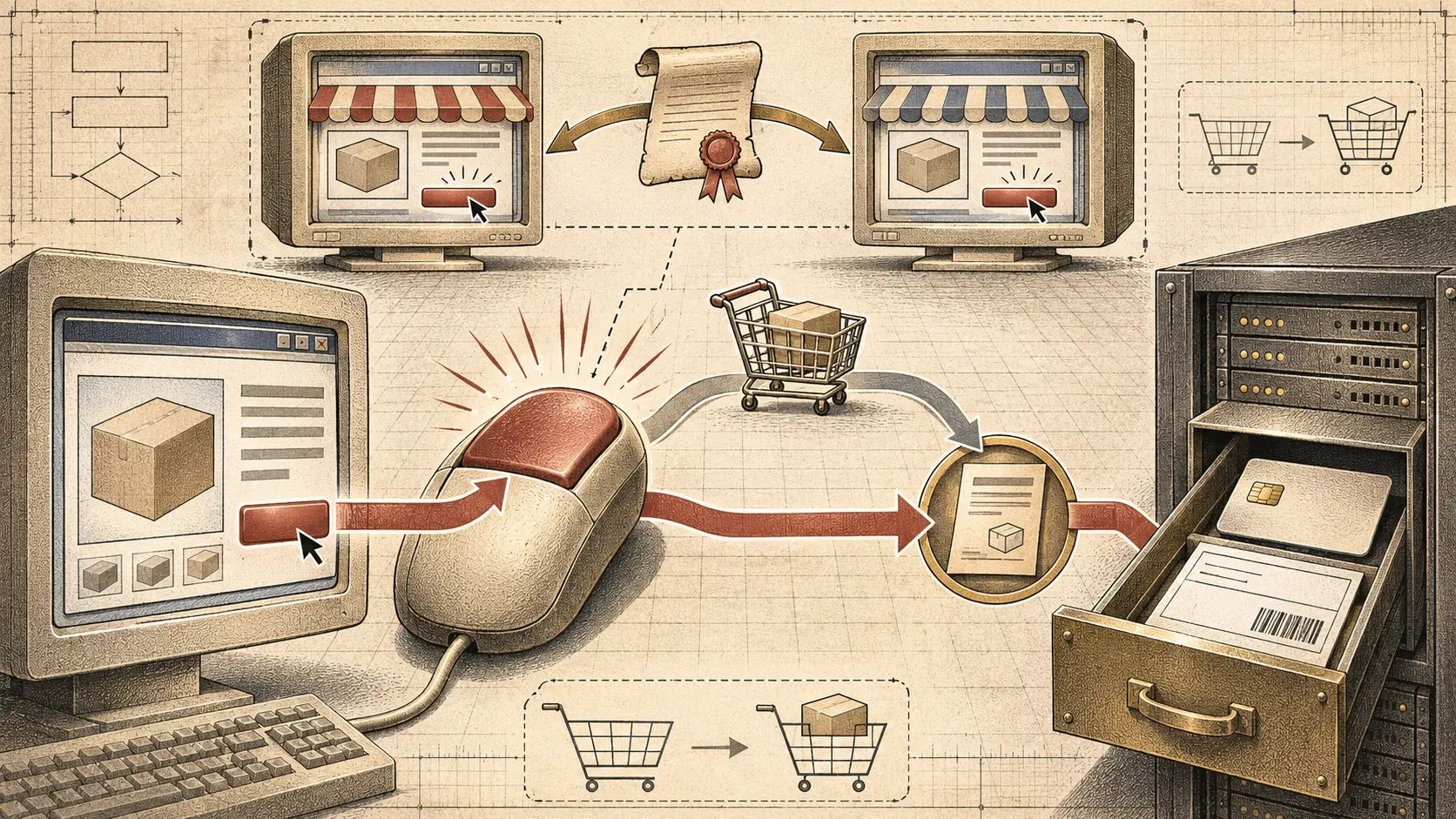
- Amazon's 1999 patent described a server that linked a client identifier to payment and shipping details already stored for a buyer, then generated an order after one action on an item page.
- Apple announced a patent and trademark cross-licence for 1-Click in September 2000. The USPTO's July 2010 reexamination certificate amended claim 1 so the item could also be purchasable through a cart model, while the single-action order remained independent of that cart.
The shopper saw a product and a button. The important work had happened earlier: the server already knew whom the browser represented, where the order should go and how to charge for it. Amazon's U.S. Patent 5,960,411, filed on 12 September 1997 and issued on 28 September 1999, described this handoff. A client identifier connected the browser to previously supplied buyer information. The page identified the item and displayed an order button. One action sent a request; the server retrieved the stored information and created the order. The apparent simplicity was an arrangement of memory, identity and authority behind the button.
The patent's first claim drew a sharp boundary. It covered a single action that sent a purchaser identifier and led the server to retrieve stored information, generate an order and fulfil it. Its last clause said the item was ordered without using a shopping-cart ordering model. Yet the original document did not ban the cart from every corner of the invention. Claim 6 described a client system with both a single-action ordering component and a shopping-cart ordering component. Amazon had put two paths on the same technical map and claimed a distinct route through one of them.
That distinction mattered outside Amazon's own store. On 18 September 2000, Apple announced that it had licensed Amazon's 1-Click patent and trademark for the Apple Online Store as part of an e-commerce patent cross-licensing agreement. The new store version offered 1-Click shopping that day. Apple said returning customers could purchase selected items with one mouse click because billing and shipping information was securely stored. The company also presented iMovie 2 as a $49 software download available through the same feature. The release did not publish the financial terms of the cross-licence. It did show that a checkout path designed for one retailer could become a permission another retailer sought.
The visible button was easy to imitate in a drawing. The claimed system was harder to reduce to a color or a shape. It included the prior collection of customer details, an identifier retained by the client, a server-side association between that identifier and the customer, and an order created from those records after the click. Apple could place a similar shopping action in its own store because it had secured a licence for the protected method and name. The patent made the route from recognized customer to completed order the contested asset.
Ten years after the 1999 grant, the language at the cart boundary changed. The same official USPTO PDF includes a reexamination certificate issued on 13 July 2010. It says claims 1 and 11 were patentable as amended and claims 6 through 10 were confirmed. In amended claim 1, the item is described as purchasable through a shopping-cart model. The single action still places its order without using that cart model. The old wording had described the order as occurring without using a shopping-cart ordering model. The revision placed a conventional cart alongside the shortcut while keeping the shortcut's actual order path separate.
That is a more exact story than “Amazon patented a mouse click.” The 1999 filing attached one action to stored identity and checkout data. Apple's 2000 announcement shows the method and mark moving by licence into a different storefront. The 2010 certificate shows the patent office adjusting the formal line between a cart's availability and the independent single-action order. The click was the customer's gesture. Control over the path it activated was the business.
Original records
- USPTO, U.S. Patent 5,960,411 and 2010 C1 reexamination certificate: original abstract and claims, grant date, and the amended claim text.
- Apple, 18 September 2000 announcement: patent and trademark cross-licence and the Apple Online Store launch.
Member Briefing
Deeper Profile Context
Sign in with the right membership level to unlock the full briefing and source notes.
Only for Strategic Circle
Strategic Circle
Open to all readers. Unlock profile briefings after joining and signing in.
Join Strategic CircleOnly for Leadership Alliance
Leadership Alliance
For qualified IP-asset owners and management; sign in to unlock alliance briefings.
Join Leadership Alliance