
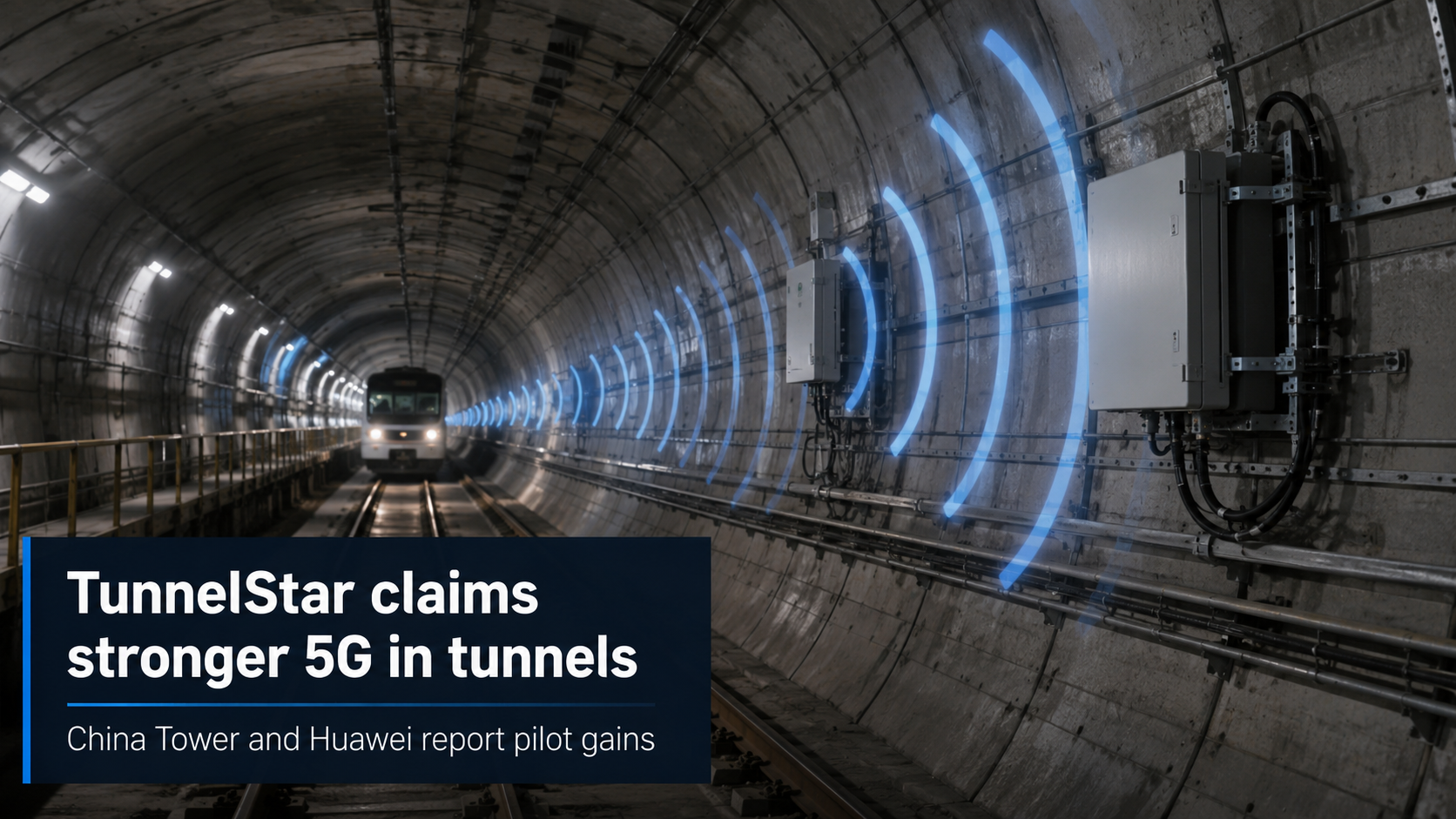
- Pilots at 3.5GHz in Wuhan and 4.9GHz in Guangzhou produced the performance figures reported at launch.
- China Tower and Huawei have not disclosed the full test conditions, commercial deployments or maintenance results.
The fact
China Tower and Huawei launched TunnelStar on 4 August 2026 as a mobile-coverage system for tunnels. The product uses a specially designed excitation source to guide radio signals through the tunnel and distribute coverage more evenly. The companies said TunnelStar improved cell-edge coverage by more than 10dB and increased user speeds by more than 40% compared with traditional antenna solutions.
They also reported 9dB of uplink gain and a 20% increase in uplink speed. Pilot tests were conducted at 3.5GHz in Wuhan and 4.9GHz in Guangzhou. The results were reported by the companies and described as meeting their design targets. They did not publish the full test methods, tunnel layouts, passenger-load conditions, handover results, maintenance data or plans for wider commercial deployment.
The assessment
The Wuhan and Guangzhou pilots do not yet show how TunnelStar performs in day-to-day service. China Tower still needs to demonstrate stable handovers on moving trains, reliable coverage at busy times and a workable maintenance process and Guangzhou pilots do not yet show how TunnelStar performs in day-to-day alongside equipment already installed in tunnels. For BTW readers, TunnelStar may suit some routes, but it is not yet a proven replacement for existing systems. Wider use will depend on results from tunnels with different curves, stations and construction materials.
What to watch
China Tower and Huawei should publish the pilot layouts, test methods, tunnel lengths, passenger-load conditions, and handover results. Commercial deployments and maintenance records would show whether the Wuhan and Guangzhou results can be repeated through curves, junctions, stations, and other more demanding tunnel environments.