
Summary
Bhutan’s public DrukNet inauguration on 2 June 1999 made Internet service visible, but it was not evidence that every district or household could connect.
By 2002, ITU described two DrukNet access numbers billed as local calls and said connectivity cost the same anywhere in Bhutan; field reports still described busy lines, few computers and expensive public sessions.
The national price rule narrowed one geographic difference. It did not create a telephone line, an available modem port, a computer, a reliable international path or a trained user.
The busy signal came before the national promise
In 2001, a visitor to a small Thimphu Internet café was told that the practical problem was not finding a website but reaching DrukNet. The café operator said all 32 dial-up lines were so often busy that connecting could be difficult. A separate passage in the same PBS FRONTLINE/World field report described the international connection through British Telecom’s Concert UK as fully occupied by DrukNet’s 600 subscribers. The two observations sit at different points in the path: the first concerns dial-up access to the ISP; the second concerns an international upstream. They do not establish that there were 32 international circuits, or that all 600 customers were online simultaneously.
That distinction is the story of Bhutan’s first public Internet service. A national price could make a remote caller’s bill resemble a capital resident’s bill. It could not make the local telephone exchange, the ISP’s dial-up pool and the route beyond Bhutan one unlimited pipe.
A ceremony marked an opening, not a census
The Irish Times reported that DrukNet was ceremonially opened on 2 June 1999. Queen Ashi Dorji Wangmo Wangchuck sent an email greeting to students and Bhutanese missions abroad. PBS likewise dates the inauguration to that day and says the service had initially been conceived as domestic email before the decision was made to allow wider World Wide Web access. These reports document a public opening and an early service choice. They do not identify the first packet sent in Bhutan or measure the number of places that could connect.
The state’s communications network had been expanding before then. The Bhutan Infocomm and Media Authority’s later chronology places a national telecommunications network linking the headquarters of all 20 Dzongkhags in June 1998. The ITU’s 2003 country report describes a digital microwave backbone and smaller-capacity spur routes. A network reaching district headquarters is important infrastructure, but it is not a household Internet census: the same report says connectivity was concentrated in district centres, towns near roads and a small number of rural areas.
What “the same price anywhere” meant
The clearest description of the national price rule comes from an ITU News report based on a 2002 pilot study and interviews. It says DrukNet offered two access numbers, 100 and 101, billed as local calls, and that the connectivity price was the same anywhere in Bhutan. The report described DrukNet as the country’s sole Internet provider and a subsidiary of Bhutan Telecom.
The arrangement addressed a real geographic problem. If a subscriber in a provincial town could call an access number through a local exchange, then the phone charge did not rise simply because the subscriber was far from the server in the capital. PBS’s account of DrukNet’s mandate gives the same idea in practical terms: a user on a provincial telephone line connected by microwave links would pay the same phone and user charges as someone near the server.
But a tariff rule describes what a qualifying connection costs. It does not establish that a household had a telephone, that the line could reach the ISP, that a dial-up port was free, or that a computer was available. Even the 2002 ITU account framed the same-price statement as a reported service arrangement, not the result of a national bill audit. Equality in one part of the price schedule was not equality of practical access.
The path had several gates
For a dial-up user, the route began with a working telephone line and modem, continued through a DrukNet access number and an available modem port, then depended on an international connection for traffic beyond Bhutan. Each step could constrain use. PBS’s busy-line observations show why “Internet service existed” and “a user could connect now” were different propositions. In September 2001, PBS reports, DrukNet added KDTI in Japan as another upstream provider. That is evidence of a change in international connectivity, not by itself proof of better reliability, more capacity at the local dial-up pool or nationwide coverage.
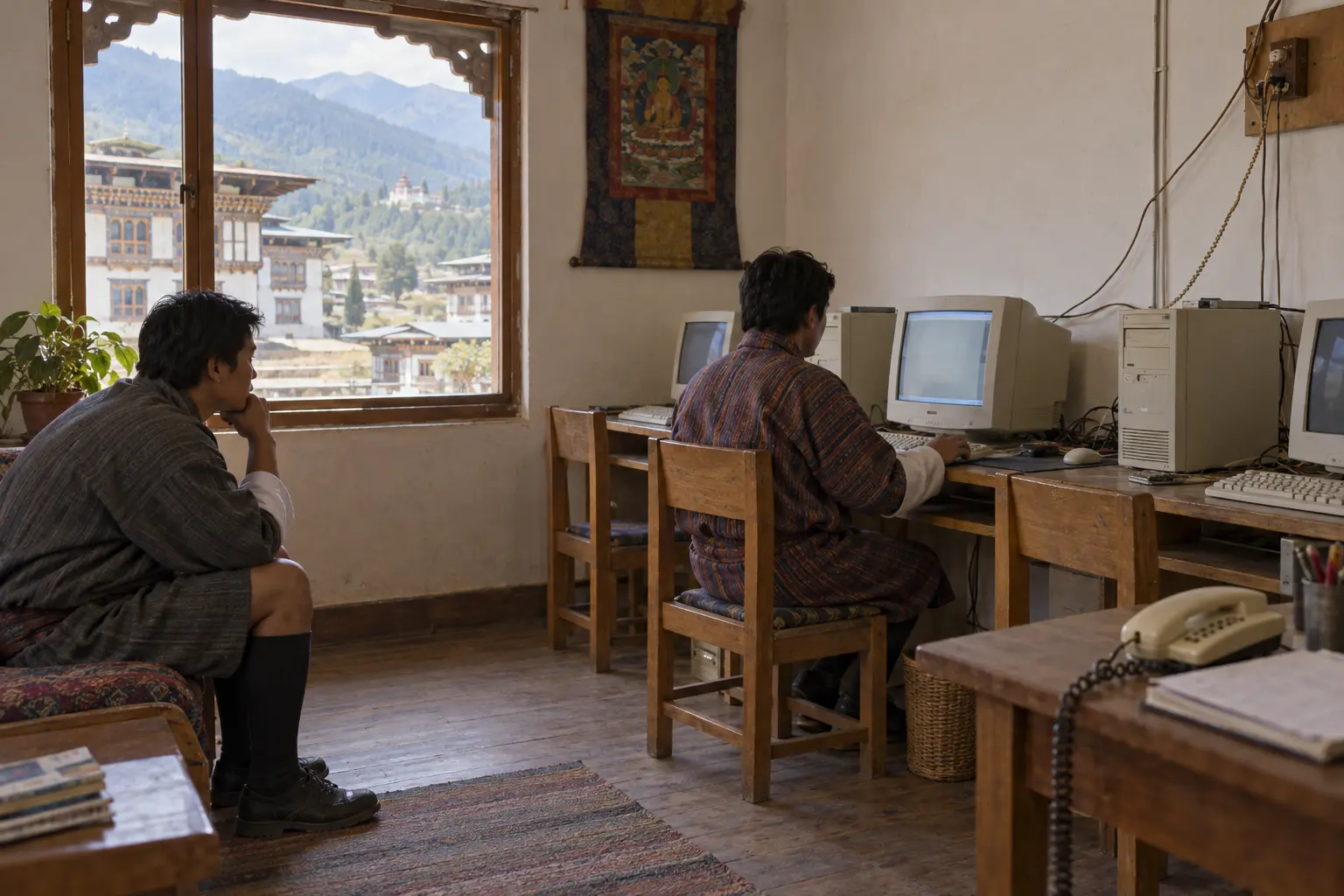
A further constraint was the equipment at the user’s end. The 2002 ITU article reported roughly 8,000 to 10,000 computers in Bhutan, most concentrated in Thimphu and other urban centres, and relayed an estimate that private Internet access was below one person in a thousand. The ITU’s 2003 country report gives a different snapshot: about 1,750 dial-up customers and 26 leased-line customers in DrukNet’s fourth year, around 15 Internet cafés and at most 5,000 people accessing the Internet. A dial-up customer, a leased-line customer, a connection and a person are different units; these reports do not form a clean time series or a representative count of users.
Public access did not remove the price barrier. PBS described one Thimphu café charging 3 ngultrum a minute in 2001. The later ITU pilot report cited a charge of US$1.25 for 20 minutes and said this could place café access beyond the reach of even above-average-income Bhutanese. Those are observations from different dates and a specific venue, not a national café tariff. They still show that a national call-pricing rule did not determine the retail price of a public session.
Shared access was another route, still a limited one
Bhutan had experimented with community access before the public Internet launch. ITU’s 2002 account says Bhutan Telecom established a telecentre at Jakar in 1998 with ITU assistance and that more than 450 people received basic information-technology training there. Training was not the same as an Internet subscription. It did, however, create a local institution through which people could encounter computers without buying one.
The same report proposed using post offices for email and electronic post, with some remote offices connected by satellite. It argued that post offices reached places where Internet infrastructure and literacy were scarce. The proposal was a plan, not evidence that all the proposed kiosks opened or that every resident used them. In the survey of postal clients, only 8 percent of respondents who used computers were reported to use email. The sample was drawn from people visiting post offices, so it cannot be treated as a national usage rate.
Its value is narrower: it shows how much the promise of a national service still depended on local institutions, devices and assistance.
Some businesses nevertheless found value in the service before access was widespread. PBS quotes a trekking company manager saying that websites and email had reduced the firm’s international telephone bills by 90 percent. That is one operator’s account, not an audited industry result. It illustrates a distinct effect: a limited number of connected businesses could use the Internet to replace some costly communication even while many households could not reach it.
The national rule and the lived network
The 1999 launch is sometimes harder to date than the ceremony. Contemporary reporting and the ITU country account use DrukNet for the 1999 service, while the National Statistics Bureau’s 2019 yearbook separates Internet service in 1999 from a DrukNet brand launch in 2003. The sources do not explain whether they are using “DrukNet” differently. This account leaves that naming discrepancy unresolved; it does not move the public inauguration or claim a definitive technical first.
The evidence supports a bounded conclusion. Bhutan opened an Internet service in 1999, built a national price arrangement around local-call access numbers, and later described that price as the same anywhere in the country. That was meaningful: it reduced one distance penalty. Yet busy dial-up lines, scarce computers, costly cafés, limited private use and uneven physical reach remained. A national price was a rule about the cost of a route when a route worked. It was not proof that the route, the equipment or the user was everywhere.
Sources
- BICMA, Study on History of Telecom System in Bhutan (2021) — retrospective telecom chronology; it does not establish universal Internet availability.
- ITU, TDS National Reports — ITU Telecom World 2003, Bhutan section — reported service and connection counts; dates and units are kept distinct.
- ITU News, “Multipurpose community telecentres — connecting people from Timbuktu to Kabul” (2002) — contemporary tariff, telecentre and pilot-survey reporting, not a national tariff audit or census.
- PBS FRONTLINE/World, “Bhutan — The Last Place: Gross National Happiness” (2001) — field observations and attributed interviews about access and early use.
- The Irish Times, “Bhutan opens website” (2 June 1999) — the public ceremony, not proof of the first packet or nationwide deployment.
- National Statistics Bureau of Bhutan, Statistical Yearbook of Bhutan 2019 — its later 2003 brand-launch wording conflicts with contemporaneous use of “DrukNet” in 1999; the discrepancy remains unresolved.
Member Briefing
Deeper Profile Context
Sign in with the right membership level to unlock the full briefing and source notes.
Only for Strategic Circle
Strategic Circle
Open to all readers. Unlock profile briefings after joining and signing in.
Join Strategic CircleOnly for Leadership Alliance
Leadership Alliance
For qualified IP-asset owners and management; sign in to unlock alliance briefings.
Join Leadership Alliance