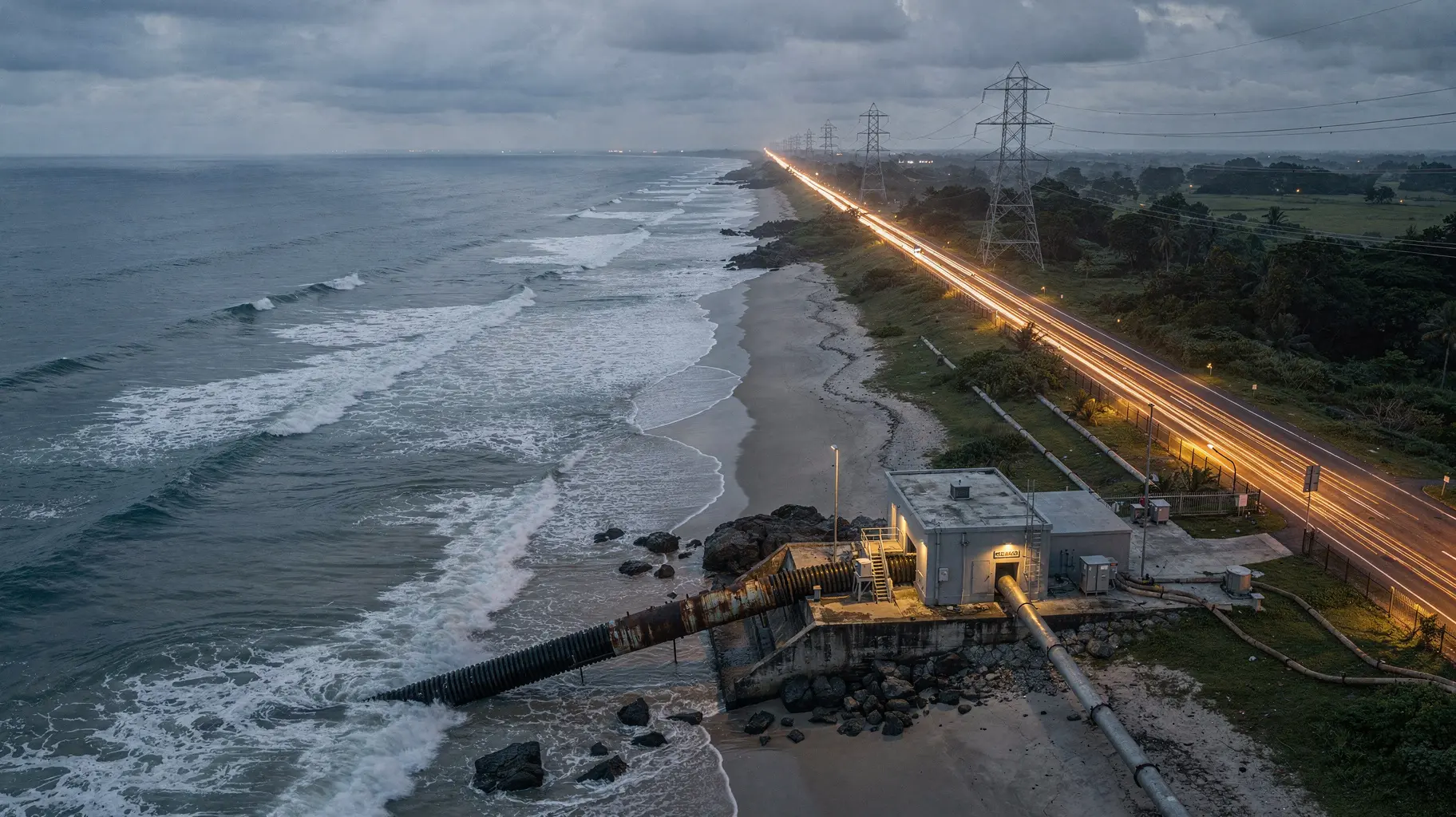
Summary
- Bangladesh Submarine Cable Company's annual reports show international bandwidth utilisation at 74.7% of ultimate achievable capacity in June 2023, 37.3% in June 2024 after the SMW4 upgrade landed, and 49.3% in June 2025. The country bought headroom faster than it filled it.
- The same reports record that more than 95% of in-country SMW5 traffic ran eastbound toward Singapore. The second system added capacity on one route, not a second route.
- Three different measures — achievable capacity, lit capacity and bandwidth used — plus a separate sold-capacity table mean "how much of Bangladesh's cable is in use" has at least two defensible answers, and the reports do not reconcile them.
A cable that really was full
The pre-upgrade baseline is not a story about slack. For the year ended 30 June 2023, the operator reported ultimate achievable capacity of 3,420 Gbps, lit-up capacity of 3,050 Gbps and in-country utilisation of 2,556 Gbps (Annual Report 2022-2023). Put those together and utilisation was running at roughly 74.7% of achievable capacity and 83.8% of lit capacity, my arithmetic on the company's own figures.
The binding detail sits one level down. SMW4 was described as an 850 Gbps system with almost all of it in use, and the report said upgrade #6 was expected to add 3,800 Gbps and be completed by the end of 2023 (Annual Report 2022-2023). The next report confirms completion in December 2023 (Annual Report 2023-2024). Bangladesh was not overbuilding. It was spending on the only lever it had.
What one upgrade did to the ratio
By June 2024 the reported maths had changed shape. Ultimate achievable capacity stood at 7,220 Gbps, lit-up capacity at 6,850 Gbps, and bandwidth used in Bangladesh at 2,696 Gbps (Annual Report 2023-2024). Capacity rose by 3,800 Gbps across that pair of June snapshots. In-country use rose by 140 Gbps.
The ratios follow mechanically. Utilisation fell from 74.7% to about 37.3% of achievable capacity, and from 83.8% to about 39.4% of lit capacity. That is what a successful upgrade looks like on paper: the denominator jumps, the numerator barely moves, and the country is suddenly awash in nominal headroom.
It is also where a lazy headline would stop. "Bangladesh doubles its international capacity" is true and tells you nothing about what the country can do with it.
Then demand caught up at 32% a year
By June 2025, bandwidth used in Bangladesh reached 3,563 Gbps against the same 7,220 Gbps achievable and 6,850 Gbps lit-up totals (Annual Report 2024-2025). That is 867 Gbps more than the prior June, an increase of roughly 32% in twelve months, and utilisation recovered to about 49.3% of achievable capacity and 52.0% of lit capacity.
Two readings, both defensible. The optimistic one: demand is compounding fast, and a country that was rationing bandwidth in 2023 is now buying it at a third more every year. The uncomfortable one is arithmetic. At 32% annual growth from a 3,563 Gbps base, the 6,850 Gbps of lit capacity is consumed in a little over two years. One upgrade cycle bought roughly that much runway. That is an operating buffer, not a surplus, and it was bought with a single maintenance window on a single legacy system.
The 95% that decides the resilience question
The capacity numbers are only half the record. SMW5's 2,200 Gbps of lit capacity is split 2,100 Gbps toward Singapore and 100 Gbps toward France, while SMW4 carries 4,650 Gbps toward the west (Annual Report 2024-2025). Two systems, two different directions, and a genuinely diversified topology on paper.
What the traffic did with it is in the prior report: more than 95% of SMW5 traffic inside Bangladesh ran eastbound toward Singapore, with only a small portion of westbound capacity utilised (Annual Report 2023-2024). The FY2022-23 report had already recorded roughly the same share (Annual Report 2022-2023). That is the operator's own characterisation of its traffic, not an independently measured traffic matrix, and it is the most consequential sentence in three annual reports.
A second cable is not route diversity if the demand behind it all leans one way. If the eastbound path degrades, the westbound lit capacity does not absorb the load by existing; someone has to have bought capacity on it, engineered backhaul to it, and arranged transit on the far side. Buying wet plant is the easy part. Standing up a second direction of demand is the work.
Two numbers, one word
The reports also carry a capacity-sold table, and it does not agree with the capacity-used series. As of 30 June 2025 the company listed IPLC at 3,123.4 Gbps, IPLC export at 863 Gbps, local IP transit at 323.84 Gbps and export IP transit at 10 Gbps (Annual Report 2024-2025). Those sum to 4,320.24 Gbps. The utilisation figure is 3,563 Gbps.
Both are the company's numbers and they measure different things. The utilisation series excludes 863 Gbps of IPLC export to STC, TM and Orange (Annual Report 2024-2025); the sold-capacity table includes it. The reports present the two tables separately and publish no reconciliation between them.
That gap is not a scandal. It is worse in a quieter way: it is an invitation to quote whichever number flatters the argument. Cite 4,320 Gbps and the cable looks fuller than it is. Cite 3,563 Gbps and the revenue line disappears. Anyone assessing this market needs to say which measure they mean, and the annual report will not do it for them.
What the reports do not price
Three inspected annual reports publish no per-megabit price and no count of who buys the capacity. So the question that actually decides whether Bangladeshi operators can afford to light up the westbound path — what international bandwidth costs and who is permitted to buy it — is not answered by this document set, and nothing here should be read as if it were. The capacity record is clear. The commercial gate is not in these pages.
Why the registry record belongs in this story
BTW's directory carries Bangladesh Submarine Cable Company Limited as an APNIC membership and number-resource holder, explicitly not as a proven seller of ISP, transit or cloud services (BTW directory entry). That is the right kind of caution, and it also points at something the cable debate keeps separating. A landing party holds two different kinds of asset: wet plant that cannot be moved, and address resources that exist in a registry whose transfer rules condition who may hold them. The first is measured in Gbps and June snapshots. The second is measured in membership and audit trail. Neither substitutes for the other, and a capacity argument that ignores the registry layer is only describing half of what the company actually controls.
The company's report archive runs back further than the series above, including an FY2021-22 volume (reports archive), and the FY2021-22 PDF itself was not retrievable for this piece (Annual Report 2021-2022). FY2024-25 remains the latest full annual report carrying a capacity-utilisation table in the material examined here.
The bounded conclusion
Bangladesh's international connectivity problem in 2026 is not a shortage of glass. It is a surplus of capacity pointed mostly in one direction, being filled at roughly a third a year, measured in at least two incompatible ways, and reported without the price or purchaser data that would let an outsider judge the commercial gate.
The next real number to watch is not another landing announcement. It is whether the westbound share of SMW5 lit capacity moves off "a small portion" in the FY2025-26 report — and whether utilisation of that 6,850 Gbps crosses half of lit capacity while the country still has no second direction of demand to fall back on.
Member Briefing
Deeper Trend Context
Sign in with the right membership level to unlock the full briefing and source notes.
Strategic Circle
A daily briefing in your language, built from changes we have verified.
Join for USD 20/monthCancel anytime.
Public reporting stays free. Member research, the daily briefing and the forum need a membership.