Summary
- Amkor disclosed a $1.3 billion South Korea agreement with NVIDIA; NVIDIA set a target of more than 300% growth in interposer-wafer capacity by the end of 2028.
- Neither company published the present wafer count, target package output, Korean site schedule, minimum purchase volume or exit terms.
- Amkor’s filings say specialized packaging equipment must stay busy and can be hard to redeploy when a line is built for one or a few customers.
The little bridge under the expensive chip
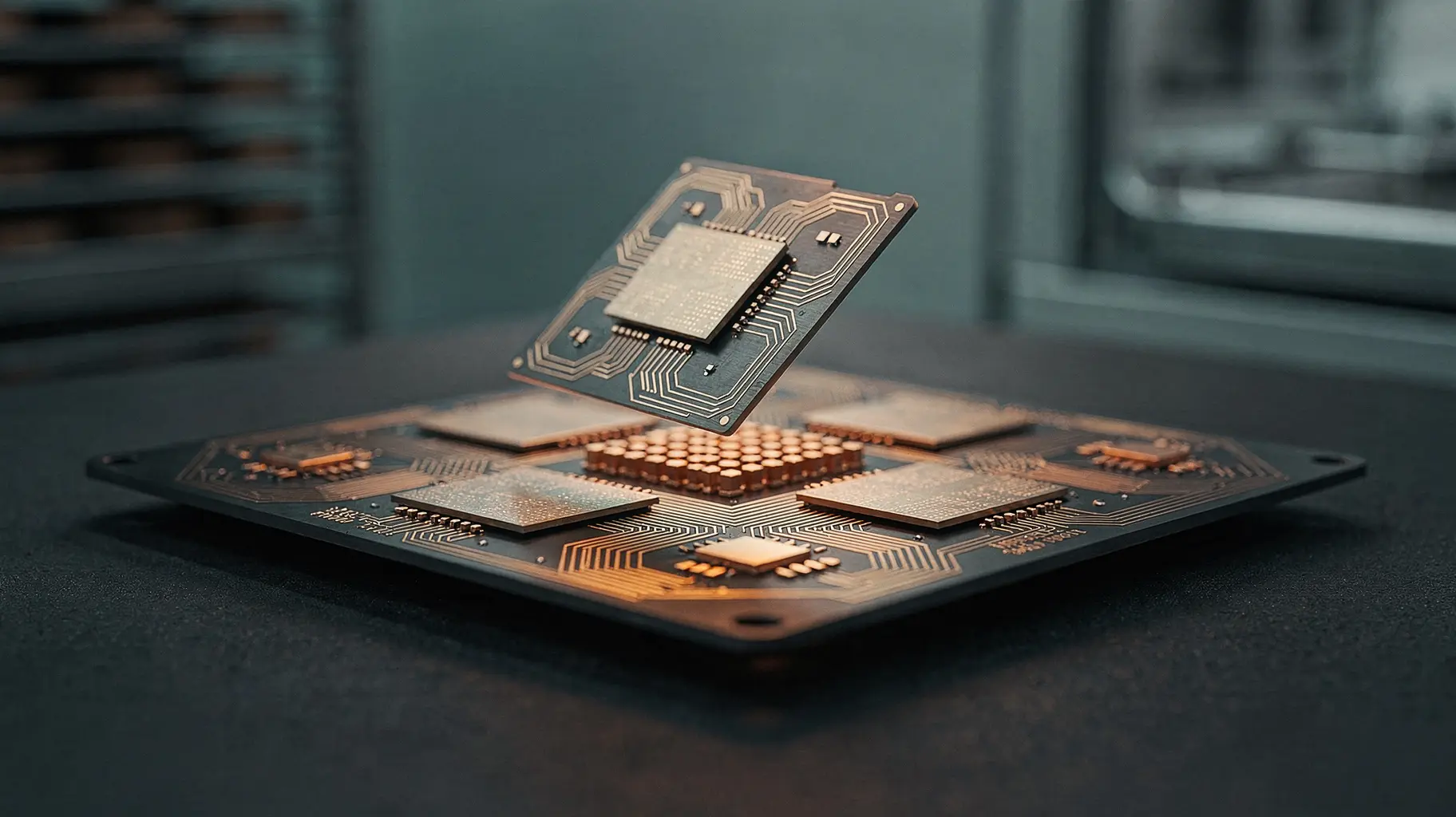
A high-performance processor is no longer just a die with a logo on it. Amkor’s own 2025 annual report describes packages that place high-bandwidth memory and graphics processors together, sometimes connected through a silicon interposer. Think of the interposer as the bridge that lets several expensive pieces behave like one system. Build more bridges and the system can grow; build them before anyone promises to cross, and the bridge starts charging rent.
That is the commercial question behind the Amkor–NVIDIA agreement announced on 21 October. Amkor put a $1.3 billion value beside additional South Korean capacity. NVIDIA’s same-day announcement says the companies plan to raise interposer-wafer capacity in South Korea by more than 300% by the end of 2028.
The package is becoming a capital-allocation decision in its own right. A chip design can be brilliant and still wait for the physical work that joins dies, attaches memory, tests the package and gets a shippable part out of the factory. Amkor lists a long service chain: package design, wafer bump, wafer probe, back-grinding, packaging, burn-in and final testing. Capacity at one step does not automatically produce accepted packages at the other end.
A large percentage can hide a small denominator
“More than 300%” sounds like a factory swallowing a mountain. The release does not say how many interposer wafers Amkor processes now, how many it wants to process, or how that count maps to saleable packages. It also does not name the Korean facility or publish a commissioning and qualification calendar.
That missing denominator matters. A wafer is an input; a package that clears the customer’s qualification process is output. The distance between them contains equipment installation, process control, yield learning, customer qualification and delivery timing. A percentage attached to the first stage cannot substitute for a count at the last.
The investment is not imaginary. Amkor says the new agreement supports South Korean expansion and that its multi-year Arizona and Korea agreements with NVIDIA total $3 billion. It also says prepayments align manufacturing capacity with NVIDIA’s long-term plans. But the release does not assign a separate cash-prepayment amount, schedule or cancellation rule to the $1.3 billion Korea agreement. Agreement value and cash received are different rows in the ledger.
Amkor’s July announcement supplies a useful comparison without collapsing the two projects. On 23 July, the company said NVIDIA would provide a $1.5 billion prepayment to support Amkor’s U.S. advanced-packaging capacity in Arizona. The Korean agreement arrived three months later with its own $1.3 billion headline and a different manufacturing geography.
Amkor has already described the empty-line problem
Amkor does not need a consultant to explain why capacity can become expensive furniture. Its 2025 Form 10-K says packaging and test need specialized equipment, factories and skilled labour, and that facilities have to run at high utilization to be cost-effective. It also says equipment bought for a business opportunity with one or a few key customers may not be readily usable for other customers. If demand does not fill that capacity, or redeployment fails, utilization and gross profit can suffer.
The Q2 2026 Form 10-Q shows why that warning belongs in the story. Amkor spent $688.4 million on capital expenditures in the first half and expected $2.5 billion to $3.0 billion for 2026, with the increase primarily tied to Arizona. First-half free cash flow, under the company’s definition, was negative $269.9 million. At 30 June, cash and short-term investments totalled $2.512 billion while debt was $2.486 billion; purchase obligations were $1.465 billion, with $1.395 billion due within twelve months.
Those figures describe the company before the Korean ramp arrives. They do not identify the Korea line’s cost. They do show that the investment cycle has real weight before a wafer becomes a paid shipment.
The cash ledger has three different boxes
The July 23 NVIDIA release named a $1.5 billion prepayment for U.S. capacity. Amkor’s 10-Q, filed five days later, said it had entered an advance-payment agreement with an unnamed customer in July and expected about $1.5 billion in 2027. The amount and month line up with the public NVIDIA announcement; the filing itself leaves the customer unnamed. That is the precise public join still missing.
The October release then put the new Korea agreement at $1.3 billion and said the two-country multi-year agreements total $3 billion. It refers to prepayments in the plural, but does not publish how much cash is due for the Korean build, when it arrives, what the payment offsets, or what happens if the line is late or the platform changes.
A prepayment can bring cash forward and help fund equipment. It does not answer whether Amkor has a binding volume floor, whether the equipment can be shifted to another program, or how much of the new factory NVIDIA can reserve. Those are contract questions, not adjectives in a launch release.
A factory is not a shipment
The success metric should move down the production line: installed equipment, qualified process, accepted packages, repeat shipments, and utilization. NVIDIA’s 2028 target is an input-capacity ambition. The revenue test sits later, after customer qualification and delivery.
That difference protects both sides from an easy story. NVIDIA gets a plan to reserve scarce packaging capability for current and next-generation platforms. Amkor gets a named customer, a long horizon and an announced funding relationship. But the supplier owns the buildings, tools and operating costs. The public releases do not show the floor volume or exit protection that would tell readers exactly how much demand risk has moved to the customer.
A new Korean line could diversify where packages are made while deepening reliance on the same customer’s product roadmap. Geography and customer mix are separate forms of resilience. The first changes if the factory map changes; the second changes only when more buyers use the equipment.
The next fact that changes the call is a Korean facility schedule tied to qualified package output and a minimum customer volume. Until then, “300%” is a capacity target; the traffic counter is still dark.
Sources
Member Briefing
Deeper Profile Context
Sign in with the right membership level to unlock the full briefing and source notes.
Only for Strategic Circle
Strategic Circle
Open to all readers. Unlock profile briefings after joining and signing in.
Join Strategic CircleOnly for Leadership Alliance
Leadership Alliance
For qualified IP-asset owners and management; sign in to unlock alliance briefings.
Join Leadership Alliance