Summary
- BTW's directory entry for Samoa Submarine Cable Company lists three supporting public references and states plainly that there is no confirmed operator yet; the citation set behind that count holds no registry, routing or address-allocation object.
- Summaries retained on 10 November 2026 named the Tui-Samoa cable, autonomous system AS132832 and an APNIC registration presence — three separate claims, and not one of them establishes who originates routes, answers a fault call or signs a capacity contract.
Every submarine cable arrives with a small crowd of legal persons behind it. There is the special-purpose company holding title to the wet plant, the consortium behind that company, whoever runs the landing station, whoever holds the maintenance agreement, whoever sells the capacity, and whoever actually originates the routes customers reach. On a good day those roles are separated and disclosed. On a bad day they collapse into one convenient noun: operator.
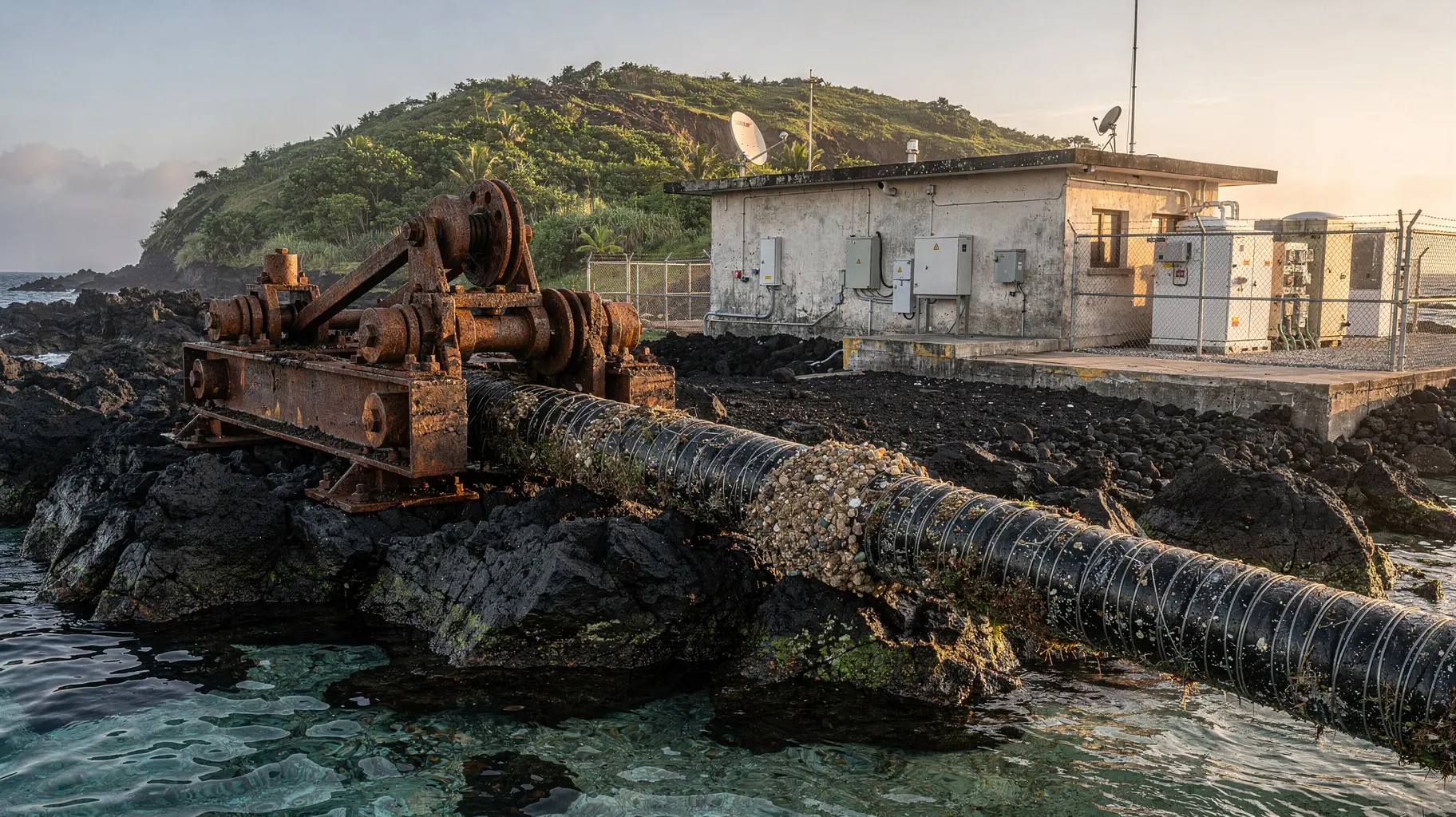
Samoa Submarine Cable Company is a Pacific case where the collapse is visible in the record itself. BTW's directory entry on the company, read on 10 November 2026, carries a summary worth quoting for what it concedes: three supporting public references, and no confirmed operator yet. Re-read that day, the citation set behind the count is thinner than three. Four rows resolve to three distinct URLs. One row carries no URL at all and is labelled a network directory record. One points at the public cable record for Tui-Samoa (cable record); two point at the same public record for Manatua (cable record). No whois object, no autonomous system, no allocation and no membership entry appears anywhere among them.
That is a statement about a citation list, not about Samoa. An empty registry field in our entry is a gap in our evidence; it is not evidence that nobody operates the network. The distinction matters, because the temptation with a count of three is to let volume stand in for identity.
Outside the entry, retrieval on 10 November 2026 retained three pages whose summaries point somewhere else. The company's own site describes Samoa Submarine Cable Company as the owner and operator of the Tui-Samoa Cable (company site). A public BGP toolkit search reports that routing registry data indicates the company maintains AS132832 (toolkit search). An APNIC whois search reports registration data identifying an entity of that name with managed IP resources and APNIC participation (APNIC search). None of the three survived as verbatim text. Each was retained as a summary dated that day, so each claim belongs to the summary that made it and travels no further than the record it describes.
What a registry record does, even read in full, is narrow. It associates a name with a handle, an object type and sometimes a class and a set of resources. It does not show that the named organisation originates a route, that its engineers take the fault call, that it holds the maintenance agreement on a repeater, or that it has a vessel on standby. An autonomous system number labels a routing policy domain. Somebody has to run it. The number does not say who.
So here are the four jobs, and what each one actually requires.
- Cable owner. Settled by a primary cable document or a landing-party disclosure naming the legal owner. Not settled by a cable appearing in a public catalogue.
- Capacity seller. Settled by the executed offer and by the entity named on an actual order. BTW reported on 13 October 2026 that this company publishes a regulator-approved reference interconnection offer setting 36-month capacity leases against 15-year IRUs. That is what BTW reported. Those terms are prior reporting, not current proof of who signs today.
- Number-resource holder. Settled by a registry object carrying an organisation handle, a membership class and dated resources. A summary saying "managed IP resources" identifies none of the three.
- Network operator. Settled by dated prefix origination under the company's own resources, together with documented responsibility for faults and maintenance. This is the job that nothing retained on 10 November 2026 establishes.
The practical consequence is not abstract. A buyer negotiating a 15-year IRU needs to know whether the counterparty holds the asset or merely sells time on it. An ISP wanting to peer needs the organisation holding the routing policy, not the one holding the title deed. A regulator needs the licensee. An investor needs whoever carries the liabilities. If all four resolve to a single legal person, diligence is one folder. If they do not, checking one against another is a category error, and it survives every meeting right up to the first fault, the first invoice dispute or the first acquisition.
Samoa's cable exists. The company's name on it exists. What stays open, on the record read on 10 November 2026, is which of those four jobs the name actually signs for. That is answerable, and not with more summaries: ask for the registry object, the executed contract, the maintenance agreement, and one dated route.
Member Briefing
Deeper Trend Context
Sign in with the right membership level to unlock the full briefing and source notes.
Strategic Circle
A daily briefing in your language, built from changes we have verified.
Join for USD 20/monthCancel anytime.
Public reporting stays free. Member research, the daily briefing and the forum need a membership.