Summary
- The company that sells fibre and connectivity across Queensland as Yurika Telecoms is an APNIC member in its own right: an organisation handle of its own type, an autonomous system of its own, and a carrier licence older than most of the networks it now runs against.
- The only printed IPv4 total anywhere in this record is 3,840 addresses, on a third-party routing mirror — beside an eleven-line prefix list which, added up as printed, comes to 5,632, because seven of the eleven lines are more-specifics carved inside four larger ones.
Queensland's state-owned energy group sells more than electricity. Under the Yurika brand it sells fibre, connectivity and managed network services to large customers, and the legal person actually holding the telecommunications assets and permissions is not the parent but a small company with its own regulator file, its own registry handle and its own routing identity. Call it Ergon Energy Telecommunications Pty Ltd, ABN 34 106 459 465, trading as Yurika Telecoms.
That company is a good test of a habit the number-resource world has not broken: treating address space as something a registry knows, when in practice the registry records custody of an identifier and a third party counts the routes. Walk the ladder of documents that mention this company and each rung answers a different question. None of them answers the obvious one — how much address space does it hold — and the closest thing to an answer contradicts itself by 46.7 per cent.
The rung that answers a different question
Start where the record is strongest. APNIC's own query for the company returns an organisation object, ORG-EETP1-AP, registered to Ergon Energy Telecommunications Pty Ltd with organisation type LIR, country AU, an address in Newstead, and a last-modified stamp of 2025-10-28 (APNIC query).
Read that for what it is. It attests that a legal person holds a registry handle, that the handle carries a type, and that somebody touched the object in October 2025. It does not list a single prefix. The same query did not return an autonomous system at all; the AS attribution has to be assembled from mirrors, which is exactly the kind of step that gets quietly upgraded into a fact in retelling.
The autonomous system, as the mirrors carry it, is AS24479: APNIC-registered, organisation ORG-EETP1-AP, as-name EET-NEXIUM-AS-AP, description Nexium, Ergon Energy Telecommunications. / Wholesale Internet Service Provider. / Queensland, Australia, last modified 2020-09-15 (mirrored aut-num record).
Three rungs, then, and they are not interchangeable. The organisation object says who holds the registry handle. The aut-num says which routing identity is tied to that handle. Neither says how much space is under either. A judge reading this file would call the first two documents identification, not inventory.
A lever still stamped NEXIUM
There is a small, telling artefact in that aut-num: the name. EET-NEXIUM-AS-AP. The description still begins with Nexium, a brand the retail market stopped seeing years ago and the company's own customer paperwork no longer uses.
The explanation is not mysterious, and it is not a scandal. Ergon Energy Corporation Limited's 2012/13 Statement of Corporate Intent described the subsidiary as a licensed telecommunications carrier providing high-speed data services to external customers on a commercial basis from spare Ergon Energy telecommunications capacity, and elsewhere in the same tabled paper noted EET trading as Nexium (Queensland tabled paper). The registry object was created in the Nexium era and, as the last-modified date shows, has not been rewritten since 2020.
What matters editorially is not that the label is stale. It is that a registry record can be simultaneously accurate and uninformative about the thing a reader wants to know. The object correctly records custody. It does not record a network, a customer, a capacity or a count of addresses, and no amount of reading it will produce those.
Ownership is a further trap. That 2012/13 document describes Ergon Energy Corporation Limited as a 100 per cent shareholder, and it is the only document in this record that does. Energy Queensland was created in 2016, and nothing read here establishes what the share register says today. Historical corporate intent is evidence of a date, not of a current cap table, and it is used here only for what it says about the brand.
What the mirror prints, and what the list adds to
Now the counting, which is where this record earns its place.
Route-observation mirrors report that AS24479 originates thirteen prefixes: eleven IPv4 and two IPv6, and they print 3,840 IPv4 addresses beside that list (BGP observation). A BGP observation is not a registry allocation — it is a snapshot of what a network is announcing at a moment — but it is the only object in this entire corpus that puts an address count next to this company's name.
The eleven IPv4 entries, as printed, are 203.3.167.0/24, 203.170.2.0/23, 203.170.2.0/24, 203.170.4.0/22, 203.170.8.0/21, 203.170.8.0/24, 203.170.9.0/24, 203.170.10.0/24, 203.170.12.0/24, 203.170.13.0/24 and 203.170.14.0/24. The IPv6 side is two lines: 2402:4d40::/32 and 2402:4d40::/36.
Look closely at the eleven. Four of them are blocks: 203.3.167.0/24, 203.170.2.0/23, 203.170.4.0/22 and 203.170.8.0/21. Seven of them are more-specifics that sit inside those blocks — 203.170.2.0/24 inside the /23, and 203.170.8.0/24, 203.170.9.0/24, 203.170.10.0/24, 203.170.12.0/24, 203.170.13.0/24 and 203.170.14.0/24 inside the /21.
So the reader has a choice, and the choice produces two different numbers, and this is the whole argument in one paragraph.
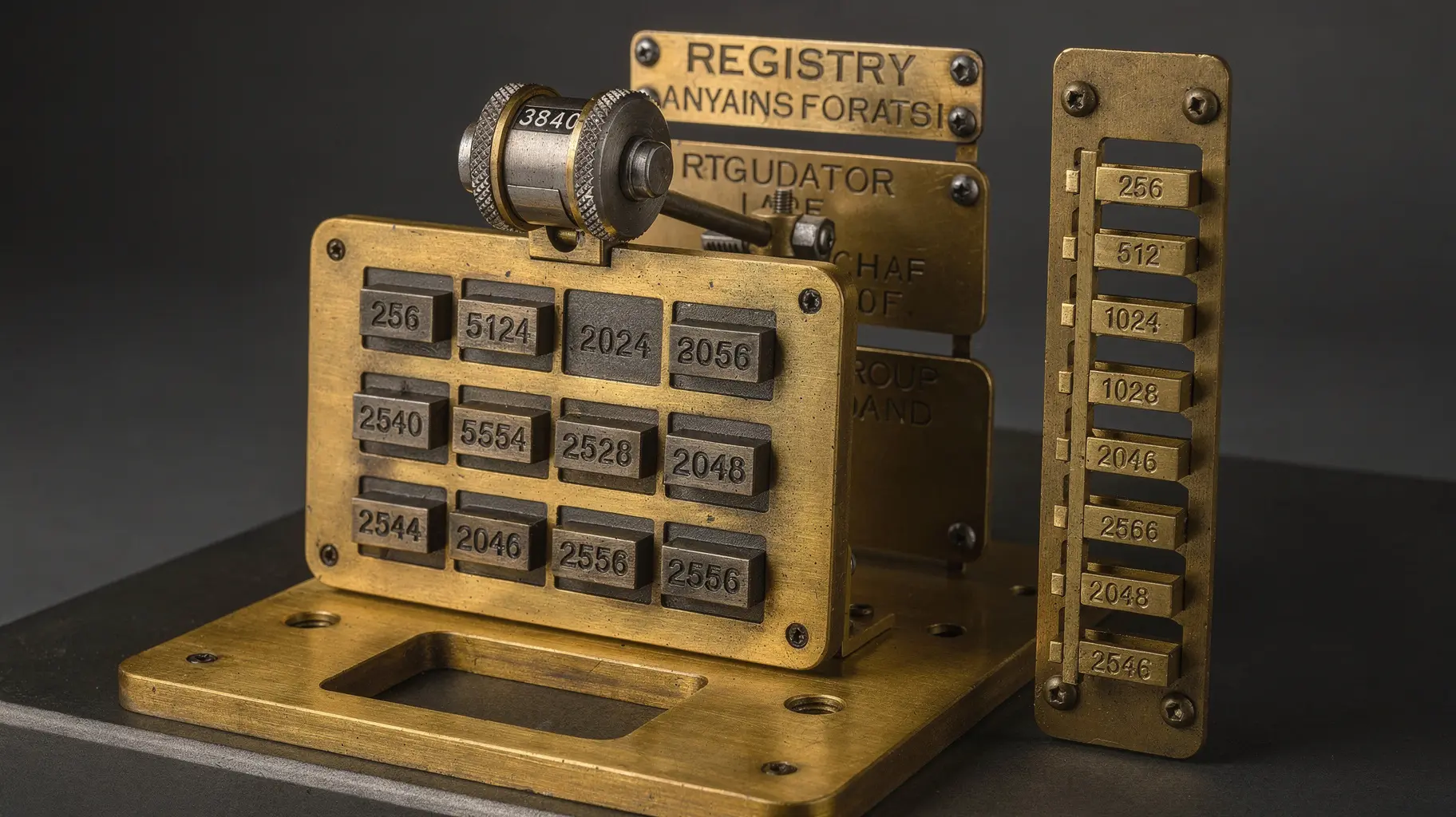
Add the four disjoint blocks and you get what the mirror prints: 256 + 512 + 1,024 + 2,048 = 3,840 addresses. That is my arithmetic, and it reconciles exactly with the total on the page.
Add all eleven printed lengths instead, treating each line as separate space, and you get 3,840 + 256 + 256 + 256 + 256 + 256 + 256 + 256 = 5,632. Also my arithmetic. The difference is 1,792 addresses counted twice — 46.67 per cent of the printed total, and a naive sum 1.47 times the total the mirror itself prints.
Neither figure is wrong in the sense of being fabricated. 3,840 is the union of the announced space; 5,632 is what you get if you trust each line of a table to be a separate quantity, which is what tables normally invite. A reader who tallies the list and compares it to the headline beside it will find the headline short by 1,792 addresses and will have no sentence on the page to explain why.
I should be precise about the limit of this observation. It is a discrepancy between a list and a total on mirrors of a BGP table, not a proof of anything about the company's registry holdings. Some mirrors note that wider views include downstream announcements and report different prefix counts; the eleven-line list is the printed list, and the arithmetic above is done on the printed list only.
The IPv6 side deserves one sentence of restraint. The corpus gives two IPv6 lines — a /32 and a /36 — and no total, no comparison to the IPv4 space, and nobody who printed either. Dividing 2^96 by 3,840 would produce a number no operator printed and no customer could check, so it is not computed here. Two lines is what the record contains.
One prefix checked at registry level
Of those eleven, exactly one carries a registry-level check in this corpus. RIPEstat's resource view for 203.3.167.0/24 returns the APNIC inetnum with netname EET-AU, the description Ergon Energy Telecommunications Pty Ltd, country AU, organisation ORG-EETP1-AP, an abuse contact, and status ASSIGNED PORTABLE; it also records that the prefix is announced by AS24479 and that the announcement is RPKI valid (registry resource view).
That is a genuinely strong document, and it is strong about a specific thing: for this one /24, the registrant, the announcing network and the cryptographic attestation line up. It does not extend to the other ten IPv4 entries or the two IPv6 entries, which were not individually verified in inetnum or route6 records for this article. Anyone quoting the RPKI-valid line as a description of the company's whole address estate is quoting one prefix and calling it a portfolio.
The ratio here is worth stating plainly because it is the honest shape of the evidence: one of eleven IPv4 prefixes was checked at registry level. The rest of the count rests on the observation, not on the registry.
The regulator's two documents
Leave the routing world for the regulator, where the record is older and, in one respect, sharper.
The Australian Communications and Media Authority's register of licensed carriers lists carrier licence number 126 against Ergon Energy Telecommunications Pty Ltd, ACN 106 459 465, with status Current and a grant date of 14 November 2003; the row records no date surrendered and no date cancelled (ACMA carrier register). From that grant date to the date this package was compiled is 23 years and 10 days — my subtraction, not the regulator's.
Status on a register is a point-in-time observation, and this one is offered as exactly that. What it establishes is that a legal person held a carrier licence for more than two decades. What it does not establish is a single thing about capacity, customers, revenue or addresses.
The second document is the more interesting one, because it is a bill. ACMA's Telecommunications Industry Levy Assessment 2024-25, dated 13 November 2025, lists ERGON ENERGY TELECOMMUNICATIONS PTY LTD with ACN 106 459 465, carrier licence 126, and an assessed levy of $216,515.30 (levy assessment, 13 November 2025).
Here is where a lazy reading would do damage. A six-figure assessment invites the inference that the company earns a six-figure-multiple revenue, and from there a per-customer or per-address figure, and from there a story. None of that is in the document. The assessment prints a liability. It prints no eligible revenue, no revenue base, no subscriber count and no per-service rate. The statutory base from which the levy is calculated is not printed in this corpus at all, so no conversion to revenue is performed here, and any number presented as the company's turnover on the strength of this row would be invented.
Two regulator documents, then, and each attests a permission and a liability. Neither attests an inventory.
Two counts of the same customers
Climb to the parent, where the company's commercial footprint is described in prose rather than in tables.
Energy Queensland Limited's 2025-26 annual report states: In 2025-26, 54 commercial and industrial customers were supported with 2,218 services and an expanded statewide fibre network. Yurika also continued connecting Queensland Government facilities, supported by its 24/7 critical response capability, with 486 new or re-contracted services (2025-26 annual report).
The prior edition states: In 2024-25, Yurika supported over 90 customers with 2,500 services in Queensland and beyond, through customised connectivity and completing major high-speed projects (2024-25 annual report).
Two sentences, one business, two populations. The later sentence narrows the category in its own words — commercial and industrial — and puts government work in the next sentence, counted separately as new or re-contracted services. Neither edition defines customer or service, and no sentence in either reconciles the two counts.
So the arithmetic can be done and must be labelled. 2,218 services across 54 commercial and industrial customers is 41.07 services per reported customer in 2025-26. 2,500 services across over 90 customers gives 27.78 services per customer, except that this is a ceiling rather than a rate: the printed divisor is over 90, so the true divisor is larger and the true quotient smaller. Comparing the 2025-26 figure to that ceiling gives at least 1.48 times. All three numbers are mine, all three rest on two differently drawn populations, and none of them is a measurement of anything the reports define.
The tempting inference is a decline. It is not available. The later edition narrows its own category in the same breath and hands the government connections to a separate sentence; nothing read here says whether the two populations overlap, whether the 2024-25 over 90 included the government work, or whether services means the same object in both years. A reader who subtracts 54 from 90 and calls it a loss of 36 customers has done arithmetic on two different nouns.
The address numbers can be divided too, and the results are equally unglamorous. 3,840 addresses across 54 reported customers is 71.1 addresses per reported customer; 3,840 across 2,218 reported services is 1.73 addresses per reported service. These are illustrations of scale, not utilisation measures. No document read prints a utilisation figure for this company, and neither the registry nor the regulator publishes an address-efficiency benchmark to compare against.
The document addressed to the customer
The clearest statement of who the counterparty is does not come from a registry at all. It comes from the standard-form agreement the company hands to business customers, which opens: Ergon Energy Telecommunications Pty Ltd ABN 34 106 459 465, trading as Yurika Telecoms, is part of the Yurika Group of companies and licenses the Yurika trade mark (Yurika Telecoms general terms).
That sentence does three things the registry records cannot. It names the legal person. It gives the trading name in the same breath. And it places the company inside a group structure that the same document defines to include Energy Queensland Limited and its related bodies corporate.
For anyone trying to establish who is answerable for a network, this is the load-bearing document, and it is also the least quotable: it is a contract addressed to customers, not a disclosure addressed to the market. It states a relationship. It states no quantity.
What the absence means
Put the rungs side by side and the shape of the problem becomes clear.
APNIC records custody of an organisation handle, and, through mirrors, custody of an autonomous system still named for a brand the company retired. The regulator records a licence granted in 2003 and a levy liability for 2024-25 with no revenue base. The parent records two customer counts for the same business, the later one narrowed in its own sentence. The customer agreement names the legal person. A routing mirror prints 3,840 addresses beside a list that adds to 5,632.
Not one of those documents states how many addresses Ergon Energy Telecommunications holds. That is not a scandal and it is not a secret: it is the ordinary condition of number resources, which belong to a legal person recorded at one rung, are operated through a network described at another, and are counted only where a third party chose to count them.
The mirror's own disagreement is the useful part, because it is reproducible. Anyone can take the printed list, add it, compare it to the printed total, and find 1,792 addresses that appear twice. The arithmetic does not need access to a registry, a broker or a spreadsheet. It needs the page.
That is why the count matters beyond one Queensland utility. If the energy transition keeps producing network operators inside asset-heavy businesses — metering, fibre, telemetry, grid control — then address space will keep accumulating in legal persons whose public record consists of a registry handle, a licence number and a paragraph in a parent's annual report. The registries will keep attesting custody. Somebody else will keep doing the counting, badly, in public.
Member Briefing
Read the full trend briefing
Members read the full briefing with the source notes behind every finding.
Strategic Circle
A daily briefing in your language, built from changes we have verified.
Join for USD 20/monthCancel anytime.
Members also get the full research library, a daily briefing on the networks they follow and the private forum.