Summary
- Swisscom Broadcast says it operates nationwide DAB+ radio networks for SRG SSR, SwissMediaCast and Romandie Médias. That is first-party evidence of a stated operator role — not an independent audit of coverage, uptime, audience or audio quality.
- BAKOM, also known as OFCOM, records that SRG SSR ceased nationwide FM broadcasting on 31 December 2024, while local private broadcasters may pick their own moment inside the final licence window, no later than the end of 2026. A national date is not a site deadline.
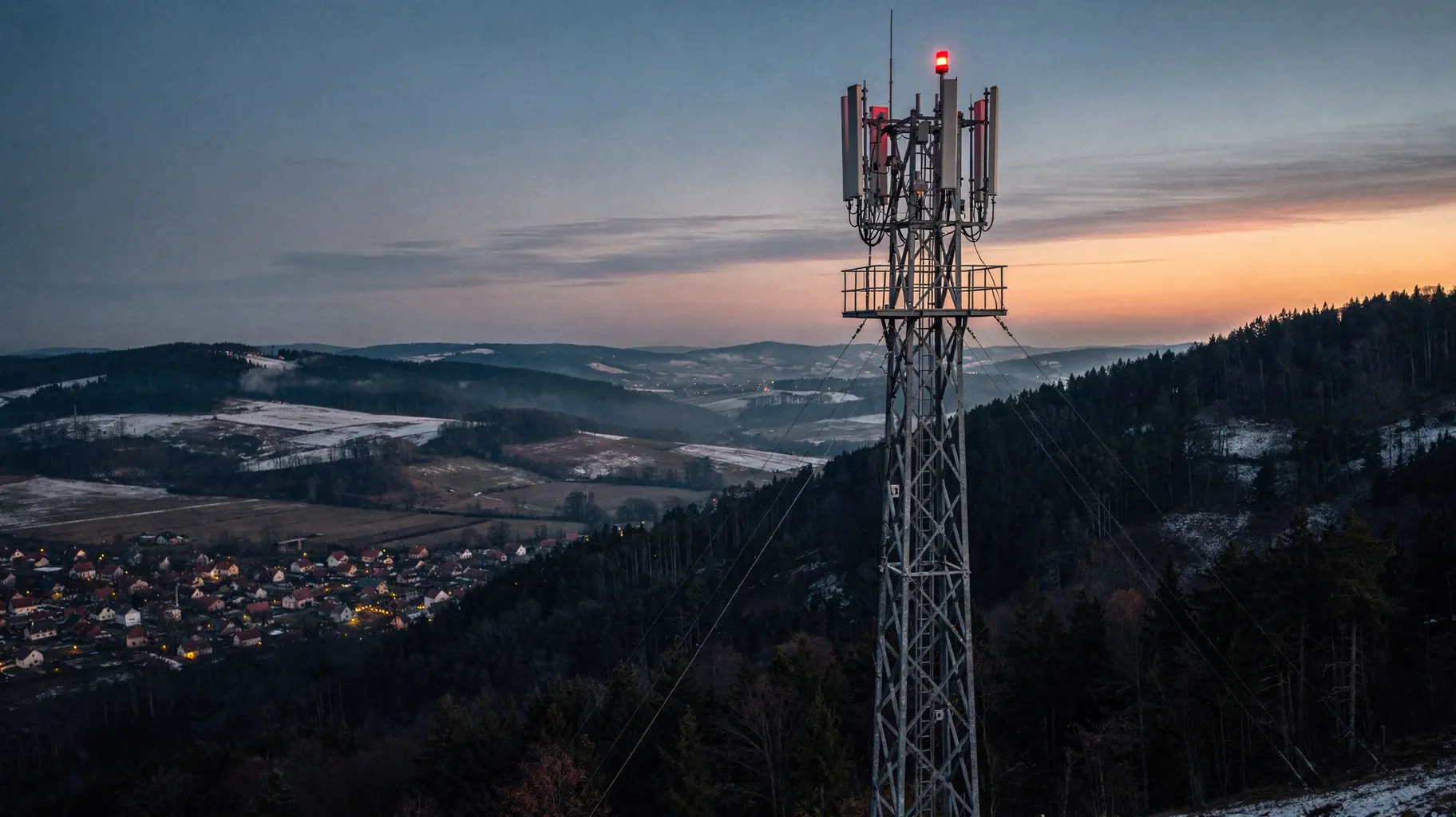
- The February 2025 Bantiger fact sheet lists both FM and DAB+ radio distribution at the site, alongside mobile, microwave, public-safety radio, shared infrastructure and low-power IoT. That is a coordination problem, not a utilisation report.
- RIPE NCC's RIPEstat shows AS215254 under the holder label SBC-NET-2 Swisscom Broadcast Ltd and reported the ASN as not announced at the checked time. That is a ledger entry and a routing-visibility observation — not a signal-strength reading.
Switzerland's FM switch-off is the easiest story in European broadcasting to get lazy about: one date, one replacement technology, one tidy arrow pointing from 2024 to DAB+. The Bantiger site, a hilltop installation in the canton of Bern, refuses the tidy version. The site did not become a museum piece when the national milestone passed, it does far more than radio, and the paperwork describing it answers four different questions that are very easy to blur into one. Continuity here is a handoff — a relay pass between responsibility, timing, site function and network identity — not a switch thrown on a single date.
The date is national. The handoff is local.
BAKOM gives the cleanest starting point. Its record says SRG SSR ceased nationwide FM broadcasting on 31 December 2024, and that local private broadcasters may choose individual FM shutdown timing within the final licence window, no later than the end of 2026. Two statements, two decision paths, one transition. Keep them together or you will misread both.
At Bantiger that difference has teeth. You can establish the SRG SSR milestone from the regulator's page; you cannot staple that date onto every FM function on the hill. Nothing in the record supplies a uniform Bantiger shutdown date, and nothing says every private broadcaster marches to the same schedule. A sound operating record therefore names the broadcaster whose clock is being read before it attaches a date to a site function.
This is not doubt about the transition. It is accuracy about it. A transition can be settled in direction and staggered in execution — that is what a handoff looks like when real hardware, real licences and real staff are involved. When the clocks differ, continuity work has to follow the responsibility being passed, not a date borrowed from another part of the file.
For decision-makers the implication is blunt: log 31 December 2024 as the nationwide SRG SSR event, log the end of 2026 as the outer edge of the final licence window for local private broadcasters, and leave Bantiger's local timing unresolved until evidence tied to the relevant function and broadcaster says otherwise.
Bantiger is not a radio label — it is an antenna farm with a payroll
The February 2025 fact sheet gives the site a concrete operational shape. It identifies FM and DAB+ radio distribution at Bantiger. It also lists mobile, microwave, public-safety radio, shared infrastructure and low-power IoT. The point is not that every listed function changes when FM does. The point is that a site-level handoff happens in a place where several functions share concrete, power, racks and access roads, and none of that collapses into a single transition label.
The fact sheet is valuable precisely because it is bounded. It tells you which functions Swisscom Broadcast lists at Bantiger. It does not report current traffic volumes or utilisation. It does not measure availability or performance. It does not name the owner of every asset used by every co-user. It does not hand you an exact end date for every FM function on the site.
Those limits are useful, not embarrassing. They tell you what to ask next. If a particular FM responsibility changes, which documented function is affected? Which DAB+ responsibility is expected to keep running? Which of the other listed functions sit outside the handoff and therefore should not be described as changing at all? The fact sheet scopes the inquiry; the answers must come from evidence appropriate to each function.
The same restraint applies to the language of continuity. A multi-function site creates coordination work. It does not prove an outage, an elevated risk event or a degraded service. The sources document a transition and a set of site functions — not a provider failure, not a measured interruption, not a performance dip. Operational care is justified by the structure of the handoff, not by an incident someone invented to make the story tidier.
Who says they run DAB+ — and why the sourcing matters
Swisscom Broadcast says it operates nationwide DAB+ radio networks for SRG SSR, SwissMediaCast and Romandie Médias. That statement establishes how the company describes its own role and names the broadcasters on the page. It sits directly on the responsibility side of the FM-to-DAB+ handoff.
Read it for what it is: first-party operator evidence. It does not independently quantify coverage, uptime, audience reach or quality. "Nationwide" belongs to the operator's description and should not be inflated into a promise that every location or every listener receives uninterrupted service. Nor does the existence of DAB+ distribution prove that every FM step at Bantiger is finished.
Explicit sourcing makes evidence stronger, not weaker. It tells the reader exactly whose operating description is on the page, and it stops an organisational statement from being dressed up as an independent measurement. Set beside BAKOM's chronology and the Bantiger fact sheet, it connects the stated DAB+ role to the wider transition without smuggling in a performance claim.
For continuity purposes the operator statement answers one question: who says it performs the DAB+ role for these named broadcasters. It does not answer when every FM function ends, how every site task is sequenced, or whether service outcomes clear a particular threshold. Those need their own records. Keeping them apart is what makes responsibility visible instead of merely asserted.
AS215254 is a ledger entry, not a signal meter
RIPEstat adds a different control layer. At the checked time, its public response displayed AS215254 with the holder label SBC-NET-2 Swisscom Broadcast Ltd and reported that the ASN was not announced. That is genuine network-resource evidence: an identity label and a routing-visibility observation for the ASN.
Do not convert it into a broadcast finding. The record does not say AS215254 carries DAB+ or FM traffic. An ASN shown as not announced does not establish that Bantiger is down, that a radio-distribution function is unavailable, or that a single listener lost a single second of audio. The source speaks to the registry and routing-visibility layer at the checked time, not to every operating system that shares a company name.
This is the cleanest illustration of why a registry is a ledger and not the operating system itself. The holder label is good for number-resource identity. The announced field is good for the observed routing state as RIPEstat represented it. Actual broadcast distribution, site availability and service quality need evidence from their own layers. Accurate records help you locate the subject; they do not replace proof of what is running.
The checked-time qualification carries equal weight. Routing visibility can only be reported here as RIPEstat displayed it when examined. No historical pattern, no future state, no cause is inferred. The observation stands with its boundary intact: reported as not announced, with no broadcast incident following from it.
Continuity is a relay race, not a switch
Put the four layers side by side and an evidence-led operating model falls out of them. Start with broadcaster timing: separate the SRG SSR milestone from the individual clocks available to local private broadcasters. Add the site layer: list the functions present at Bantiger without pretending they share one schedule or one owner. Add the operator layer: attribute Swisscom Broadcast's DAB+ role to Swisscom Broadcast. Add the registry layer: preserve the AS215254 holder label and the checked-time routing observation without drafting them into broadcast-performance evidence.
The model earns its keep when something is unclear, because it points to the right desk. A timing gap goes back to the relevant broadcaster transition record. A site-scope gap goes back to evidence about the named function at Bantiger. A DAB+ responsibility gap goes back to the operator record. A number-resource identity gap goes back to RIPEstat. Every source is used for the layer it can actually carry.
That is running-system discipline applied to continuity. Records matter because they fix identity, responsibility and stated timing. Operational reality matters because continuity ultimately rests on the functions that are actually available through the handoff. Neither side should impersonate the other. A complete record aligns the ledger with the operating evidence and leaves the uncertainty exactly where the sources stop — which is the only place it can honestly live.
Member Briefing
Read the full trend briefing
Members read the full briefing with the source notes behind every finding.
Strategic Circle
A daily briefing in your language, built from changes we have verified.
Join for USD 20/monthCancel anytime.
Members also get the full research library, a daily briefing on the networks they follow and the private forum.