Summary
- Towercom, a. s. reports issued bonds of zero in every maturity bucket, an approved €10,000,000 overdraft it had not drawn at 31 December 2024, and no pledge over property, plant, equipment, intangibles or receivables. Its only borrowing is a €74,323 thousand loan from its 100 per cent shareholder at 7 per cent, carried entirely as current and stated as repayable in 2025.
- The one customer contract filed in a state register — with the public broadcaster RTVS, concluded on 19 December 2022 — is recorded as valid until 31 December 2029 at €46,536,336. The lender's date arrives four years before the broadcaster's contract ends.
The directory record for Towercom, a. s. sits at https://btw.media/en/directory/towercom-a-s-sk, and every figure below comes from the documents linked beside it.
A balance sheet with one lender on it
The 2024 consolidated statements are blunt. The Group's only borrowings were shareholder loans: €74,309 thousand of principal plus €14 thousand of accrued interest, €74,323 thousand in total, against €87,955 thousand a year earlier. The rate is 7 per cent. The stated maturity is 2025. The entire balance is classified as current, with no long-term portion reported. The same statements record that no pledge had been created over property, plant and equipment, over intangible assets, or over trade and other receivables, and that trade and other payables are not secured by pledge or other security (consolidated financial statements, 31 December 2024).
The individual statutory statements shut the remaining doors. Issued bonds — Vydané dlhopisy — are reported as zero in every maturity bucket for both 2023 and 2024, and nothing appears in the one-to-five-year or over-five-year bands. The company does hold an approved overdraft with Československá obchodná banka, a.s. of €10,000,000. At 31 December 2024 it had drawn none of it (individual statements, 31 December 2024).
Set that against the standard picture of a tower operator — a site portfolio mortgaged to a banking syndicate, an indenture with a schedule, a covenant package watched by people who do not own the company — and Towercom is a different animal. There is no market creditor to negotiate with in 2025. There is no security interest anyone could enforce. The only party the company owes money to is the party that owns it.
The creditor is the owner, and a fund sits above the owner
The shareholder is ST Networks Holdings, S.a.r.l., Luxembourg, holding 100 per cent of the shares and voting rights. The Group is consolidated into Macquarie European Infrastructure Fund 4 L.P., Guernsey, and the Luxembourg parent does not itself prepare consolidated statements.
That chain decides what the 2025 date means. Repaying €74.3 million to an outside lender is a financing event with consequences; repaying it between a company and the fund that owns it is an allocation decision taken inside one economic interest. On 7 per cent the outstanding balance implies something in the region of €5.2 million of interest a year, with the €14 thousand accrued at the balance-sheet date carried apart from principal rather than added to it. Nor did the principal stand still: it fell by €13,429 thousand, from €87,738 thousand to €74,309 thousand, roughly 15 per cent.
For scale, the company earned €29,009 thousand of group EBITDA in 2024 on €43,604 thousand of net sales and closed the year with €52,281 thousand of equity and €157,813 thousand of assets (annual report 2024). Against that equity the loan is about 1.42 times. These are printed ratios, not a verdict on creditworthiness — and the filings themselves name no cause for concern.
What €43.6 million of revenue is made of
The revenue line tells you what the loan sits on top of. Consolidated revenue of €43,604 thousand in 2024 divided into €31,432 thousand from customer contracts and €12,172 thousand from operating leases. Inside the contract piece, television broadcasting contributed €18,154 thousand and radio broadcasting €8,996 thousand; network construction and operation added €1,256 thousand, the residential segment €1,081 thousand, satellite services €806 thousand, data transmission €593 thousand and other services €546 thousand. About 99 per cent of service revenue came from Slovakia.
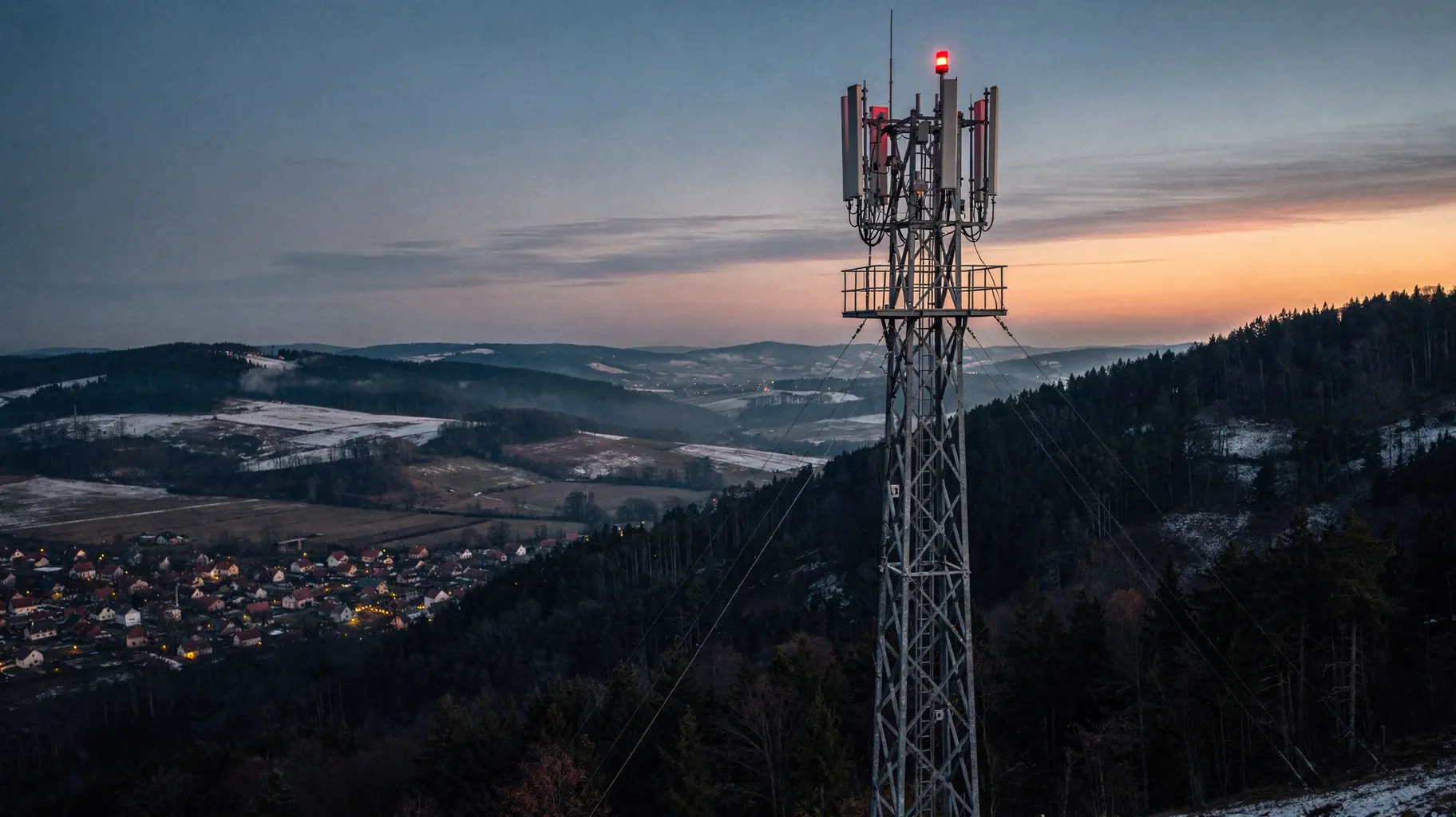
This is a business of transmission capacity sold to broadcasters, not a portfolio of tenancies sold to mobile operators. The company describes itself as the largest operator of a television and radio transmitter network in Slovakia and says it also rents tower space and datacentre capacity to other operators and public institutions. It runs four nationwide digital terrestrial multiplexes in DVB-T and DVB-T2 in standard and high definition, reporting household coverage around 96 per cent, analogue VHF radio coverage at 98 per cent and T-DAB+ coverage at 76 per cent of the population in 2024 (annual report 2024).
Revenue is recognised, in the company's own words, proportionally over the term of the service contracts (2023 consolidated statements). Which makes those contract terms the most important variable in the structure — and makes it worth asking how much of them a stranger can actually see.
Seven years, €46.5 million, and only the metadata is public
One customer contract is in the state contracts register: RTVS, the public broadcaster, IČO 47232480, and Towercom, a. s., IČO 36364568, for the provision of publicly available services — transmission of content service. Concluded on 19 December 2022, effective 1 January 2023, recorded as valid until 31 December 2029, registered total €46,536,336.00 (Centrálny register zmlúv).
Seven years and €46.5 million average roughly €6.6 million a year — about a third of the 2024 television broadcasting line, on the printed figures. The lender's stated date is 2025. The broadcaster's contract ends in 2029.
The register entry also shows its own boundary. Only the metadata was inspected: parties, dates, amount. The attached contract text, its termination clauses and its service scope were not obtained from the material read on 18 November 2026, so the arithmetic above is arithmetic and nothing more. Volume, indexation and exit rights are unknown here, and each of them moves the cash-flow picture materially.
The commercial side is thinner. A 2020 trade report described an RTVS DAB+ capacity contract valid only to the end of 2022, covering up to nine programme services at 696 kbit/s for €5,700 a month across six named transmitters — a term that has expired and says nothing about the present arrangement (SatelitnáTV.sk, 2020). In 2016, Markíza declined to renew its DVB-T transmission contract, in a report that cited contracted electronic communication services for programme-service transmission of €8,212,573 in Markíza's own 2015 statements and noted that RTVS had signed a fifteen-year terrestrial transmission contract with Towercom in 2010 (TREND / Mediálne.sk). That departure did not end the relationship: from 19 June 2017 Markíza stations were carried in Towercom's paid fourth multiplex, and Markíza Klasik joined it on 17 September 2024 for Plustelka subscribers, with no duration or value disclosed (SatelitnáTV.sk, 2024).
No contract with any commercial broadcaster was obtained in any register for this article. That is a boundary of this reading, not a finding that such contracts sit outside public records.
The date that moved once already
Comparing two years of filings is the most revealing move in the file. At 31 December 2023, current liabilities included a loan from the parent company of €87,955 thousand due 16 September 2024, alongside other parent-company liabilities of €217 thousand. The going-concern basis rested on a letter of financial support dated 15 March 2024 in which ST Networks Holdings S.a.r.l. agreed it would not demand repayment of the intra-group loan at its maturity date.
A year later the same balance reads as repayable in 2025, with €13,429 thousand of principal gone and the whole amount still current. Nobody outside the group had to agree to anything, because nobody outside the group was owed anything.
That is the mechanism worth carrying away. Where a tower company is financed by bonds, a maturity date is a cliff: the refinancing market reprices the whole business the moment the instrument rolls. At Towercom the cliff is indoors. The parent can extend, forgive, convert or call, and the next annual report records which one happened. The risk does not vanish; it changes character. It stops being a market event with a public schedule and becomes a decision taken by an infrastructure fund, evidenced by a support letter rather than a prospectus.
What the filings do not settle
No financial statements for a period later than 31 December 2024 were obtained from the material read on 18 November 2026. Whether the loan was repaid, extended again or replaced after that date is not established here, and the 2025 date is a stated maturity, not evidence of a default or a missed payment.
No count of towers or sites for 2024 was obtained either. The company's website states that it operates 800+ vysielačov across all districts of Slovakia, reaches 5.5 million people daily, covers 99 per cent of the servable territory and traces its role to 1926 (towercom.sk); the 2024 annual report describes an extensive transmitter-tower infrastructure but prints no site count. A transmitter is not a mast, and neither figure is a cash-flow number.
The legal identity is confirmed, which matters for anyone checking the chain: a Slovak joint-stock company entered in the Business Register kept by Mestský súd Bratislava III, oddiel Sa, vložka 3885/B, registered office Cesta na Kamzík 14, 831 01 Bratislava from 13 November 2007, IČO 36 364 568, registered 31 May 2006 and renamed from TRI R, a.s. with effect from 28 May 2008 (Obchodný register SR). The Register of Financial Statements carries the same IČO and DIČ 2022201709 and shows the 2024 individual ordinary statements submitted on 31 March 2025 with auditor reports filed alongside (Register účtovných závierok).
The point of the exercise
A tower operator's economics are usually read off the tenancy count. Towercom does not publish one, and on this evidence it is the wrong number to want. What the filings put on the table is a transmission business whose revenue is recognised over contract terms, financed by a loan from its own owner with no security to anyone, and anchored by one registered customer contract that outlasts the debt by four years.
That flips the question an analyst would normally ask. It is not whether the company can refinance in 2025 — there is nothing to refinance with a stranger. It is whether the fund above it wants its money back in 2025, and what the next set of statements records. The broadcaster, meanwhile, holds a contract priced, signed and registered through the end of the decade, on terms nobody outside the two counterparties has read.
Member Briefing
Read the full trend briefing
Members read the full briefing with the source notes behind every finding.
Strategic Circle
A daily briefing in your language, built from changes we have verified.
Join for USD 20/monthCancel anytime.
Members also get the full research library, a daily briefing on the networks they follow and the private forum.