Summary
- A Canary Islands regulator's note exempts the Tenerife–Gran Canaria corridor from price regulation because an alternative cable of Cable Submarino de Canarias exists, and the company behind that cable publishes a single employee's salary as its only operating number.
- The one regulated price the CNMC prints for Canary capacity, €162,018 a month for 2.5 Gbit/s in 2011, belongs to the Península–Canarias route, where these two cables do not run; the competing Canalink figure on the same page is struck out as confidential.
Note 6 of a CNMC case file settles a question nobody had asked out loud. It lists the only three unregulated submarine routes in Spain — Península–Mallorca, Mallorca–Ibiza, and Tenerife–Gran Canaria — and gives the reason for each in a parenthesis: «existe un cable alternativo de Cable Submarino de Canarias». Read the sentence as a technical claim and it is a compliment: the corridor has competition, so it needs no regulated price. Read it as a measurement and it asks a company to be an alternative without asking it to be counted.
The exclusion itself appears in a different document. The CNMC's 18 January 2018 resolution on trunk leased lines lists nine regulated submarine routes — Mallorca–Menorca, Ibiza–Formentera, Tenerife–Gomera, Tenerife–La Palma, Gomera–Hierro, Gran Canaria–Fuerteventura, Gran Canaria–Lanzarote, Península–Ceuta, Península–Melilla — and Tenerife–Gran Canaria is not among them. The resolution does not carry the explanation; the note in case C/0606/14 does. Two files, one exemption, and the reason sits in the file that is not about the exemption.
What the corridor contains is stated plainly. The CNMC's connectivity report of 24 July 2025 counts, on page 21, six submarine cables between Tenerife and Gran Canaria, owned by three operators: Telefónica, Canalink and CSC. Table 2 lists SUBCAN–1 and SUBCAN–2, owner CSC, entry into operation 2002, status operative. Six cables, three owners, and not one capacity in Gbit/s or Tbit/s for any of them, not one tariff, not one fibre-pair count assigned to a named system — only a general remark that a submarine cable carries anywhere from 6 to 48 fibre pairs depending on its age. CSC is the report's own abbreviation for the owner of those two rows; the report's legend for it is not quoted here.
The one price in the file is printed where Subcan is absent. Page 43 of the 2018 resolution reads: «Así, el precio regulado de Telefónica para un circuito de 2,5 Gbit/s Península – Canarias era en 2011 de 162.018 €/mes, y Canalink ofrecía ya este servicio por [CONFIDENCIAL: ]». Telefónica's regulated price, a euro figure, a unit, a date. Canalink's competing offer on the same circuit, blanked out. That is €64,807.20 a month per Gbit/s, my division of a 2011 monthly price, not a current rate and not a Subcan rate. On the route where the alternative cable runs, no price at all was located.
Cable Submarino de Canarias, S.A. describes itself on its transparency page, updated 26 May 2026, as a company whose capital is 42.71 per cent held by the Cabildo Insular de Tenerife through Canarias Submarine Link, S.L.U. (Canalink) and 21.36 per cent by the Gobierno de Canarias through SODECAN. That is 64.07 per cent public through the vehicles the page names, and 35.93 per cent neither named nor attributed — my subtraction from two printed holdings, not a disclosure by the company. The same page says the company is part of the public sector under article 3.1 of the public-contracting law and yet «no se considera poder adjudicador».
And then the number it chooses to print. «La Sociedad cuenta con un único empleado con contrato de carácter laboral indefinido con una retribución anual de 51.986,38€ (2025). Las cargas sociales ascienden a 15.264,27€ (2025).» One employee, indefinite contract, an annual salary, the social charges — €67,250.65 of printed staff cost, my addition. The employment section adds that the single employee is full time and classified as Ingeniero Superior.
The economic-financial section of the same page contains two links to the 2024 annual accounts and nothing else: no revenue, no turnover, no result, no traffic, no capacity, no fibre pairs, no customer.
So a company operating two submarine cables for twenty-four years publishes the pay of the one person on its payroll and no figure for the thing it sells. An absence here is a count, not an accusation: it is what the ten documents read on 24 November 2026 print and do not print, and the 2024 accounts behind those links were not opened.
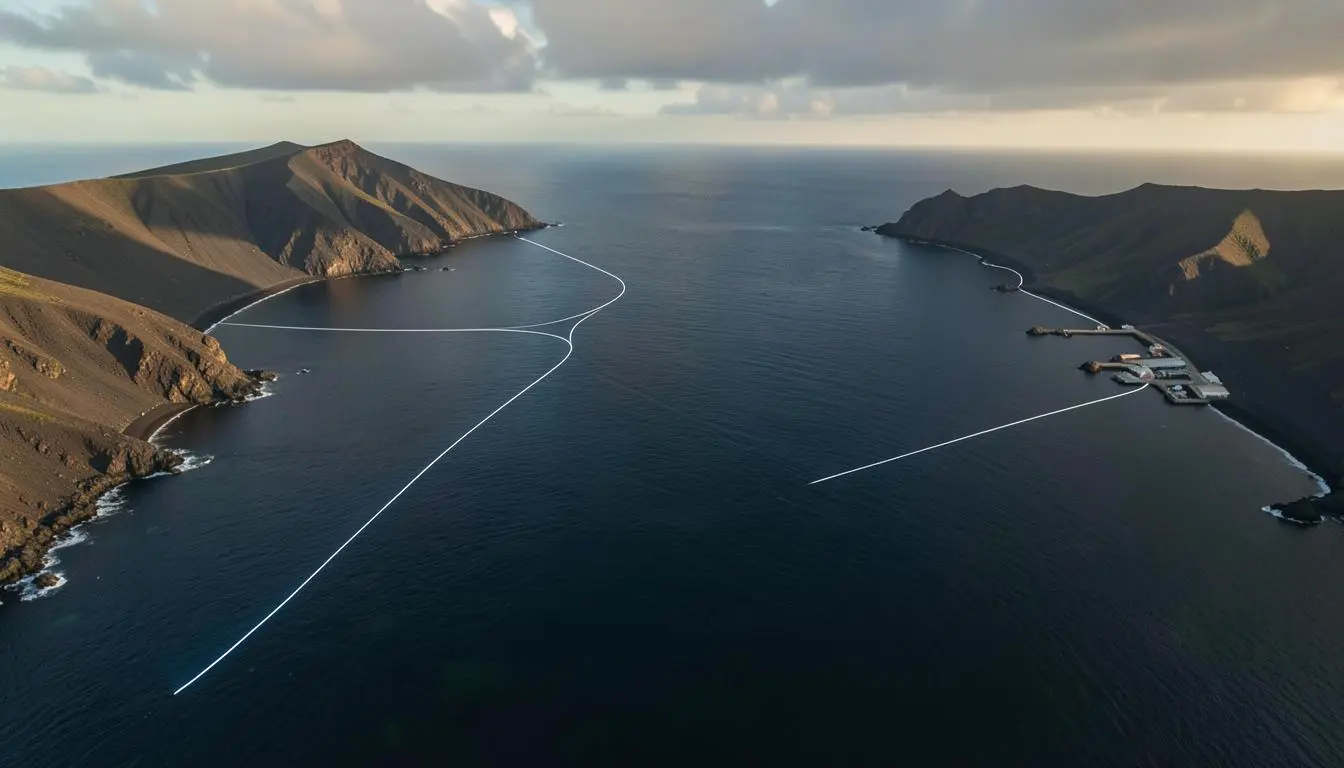
The company's own account of its assets is asset-first and quantity-free: two fibre-optic submarine cables on disjoint routes for redundancy between Tenerife and Gran Canaria, in service since 2002, the first competitor to the incumbent in the wholesale trunk-line market between the two capital islands. No length, no capacity, no pair count, no tariff, no customer. The public money that built the system is printed to the euro. A 2002 decree authorised a Treasury guarantee of up to €3,000,000 for circulating capital «con ocasión de las inversiones realizadas de instalación de dos cables submarinos entre las islas capitalinas». A 2005 decree authorised a second guarantee of up to €2,000,000 for «la inversión ya realizada», stated that the cables «se encuentran ya operativos», and made the instrument conditional on cancelling the first. Do not add them. The printed ceilings are €3,000,000 and €2,000,000, they overlap by design, and no reviewed page says whether either was ever drawn.
Capacity exists in this record in one form only. A 2020 study in the Anuario de Estudios Atlánticos states that each of these cables carries 12 fibre pairs with SDH, giving a capacity equivalent to 30,720 telephone circuits per fibre pair — and prints no system total, no wavelength count, no bit rate. Twelve pairs on each of two cables is twenty-four pairs, my multiplication. The same article uses 30,720 circuits as the total of another cable's four pairs, so the number is a per-pair unit in one sentence and a four-pair total in another; per pair and per system are not the same claim, and neither is a bit per second.
Meanwhile the 42.71 per cent shareholder sells capacity from the same beach. Canalink advertises links scalable from 1 Gb to 100 Gb with protection options, IP transit and presence at European nodes, and prints no unit price, no tariff, no IRU term — and no mention of Subcan. Its Teide project is a new 225 km cable from Caletillas on Tenerife to Tamaduste on El Hierro, total cost €18,995,966.67, of which €13,245,176.67 is funded under the CEF Digital second 2022 call, for execution between 1 January 2024 and 31 December 2026. The page prints no capacity in bits per second either. Same shareholder, same landing beach, a different island, and the same silence on quantity.
That is the seam. The regulator justifies an unpriced corridor with a cable; the cable's owner counts one employee and no traffic; its largest shareholder sells a capacity product next door and builds another cable; and the single price the regulator prints belongs to the route where none of this is true. The lever is not the size of the cable. It is note 6, the sentence that names it. If any reviewed page ever printed Subcan's traffic, its revenue or its capacity, that sentence would have something to test it against. Until then, the corridor is unregulated because a company exists, and the company prints one salary.
Member Briefing
Read the full trend briefing
Members read the full briefing with the source notes behind every finding.
Strategic Circle
A daily briefing in your language, built from changes we have verified.
Join for USD 20/monthCancel anytime.
Members also get the full research library, a daily briefing on the networks they follow and the private forum.