Summary
- 1&1 AG's 2025 reports put cash capex at €409.2 million including 1&1 Versatel and €389.3 million excluding it, against €290.6 million a year earlier, while material expense in the 1&1 Mobilfunknetz segment rose from €275.4 million to €710.0 million — a line the report itself says carries the cost of interconnecting the mobile networks in national roaming.
- 1&1 says its network reached 27 per cent of German households in December 2025 and treats a 25 per cent requirement as the one that applied; clause 12 of the Bundesnetzagentur decision of 26 November 2018 sets 50 per cent by the same date for newcomers generally and reserves 25 per cent for a newcomer that bought only 3.6 GHz spectrum.
Two numbers in 1&1 AG's 2025 report describe the same network from opposite ends, and only one of them belongs to 1&1. Cash capex came to €389.3 million excluding 1&1 Versatel and €409.2 million including it, against €290.6 million the year before, with €19.9 million of the 2025 figure arriving from 1&1 Versatel in December alone (https://imagepool.1und1.ag/v2/download/berichte/GB_1u1_2025_DEU.pdf). The other number is not called capex. Material expense in the 1&1 Mobilfunknetz segment rose from €275.4 million to €710.0 million, and the report says what sits inside it: the costs of interconnecting the mobile networks in national roaming, non-capitalisable network infrastructure costs, and the operating costs of the 1&1 mobile network (https://imagepool.1und1.ag/v2/download/berichte/JA_1u1_2025_DEU.pdf).
That sentence is the most useful thing in the report and also a wall. National roaming is named first among three components of a €710.0 million expense, and it carries no euro figure of its own in the material I read on 19 November 2026. An outside reader can measure what 1&1 builds, down to the antenna. Measuring what it buys is a different exercise, and the composite line that carries the roaming charge is now the larger of the two numbers — larger than capex, while remaining something other than a roaming invoice.
A price set on a competitor's balance sheet
The report also explains how the Vodafone bill is calculated. 1&1 pays a share of the mobile network's total costs corresponding to the share of total data volume in Vodafone's network attributable to its own customers, and the report adds that slower capacity growth at Vodafone pushed 1&1's cost up (https://imagepool.1und1.ag/v2/download/berichte/JA_1u1_2025_DEU.pdf). Read plainly, the unit price is not a figure 1&1 negotiates on its own cost base. It is a derivative of a competitor's cost base and a competitor's build pace. The contract text was not obtained, and that description is the company's own; it should be read as the company's own.
The asymmetry is worth naming precisely, because it runs against the usual direction of wholesale deals. When the network owner invests and its capacity grows, the share 1&1 pays is computed over a larger base. When the owner invests more slowly, 1&1 pays more for the same traffic. Efficiency at Vodafone and thrift at Vodafone therefore arrive at 1&1 as opposite signs, and 1&1 controls neither.
What 1&1 actually controls is countable
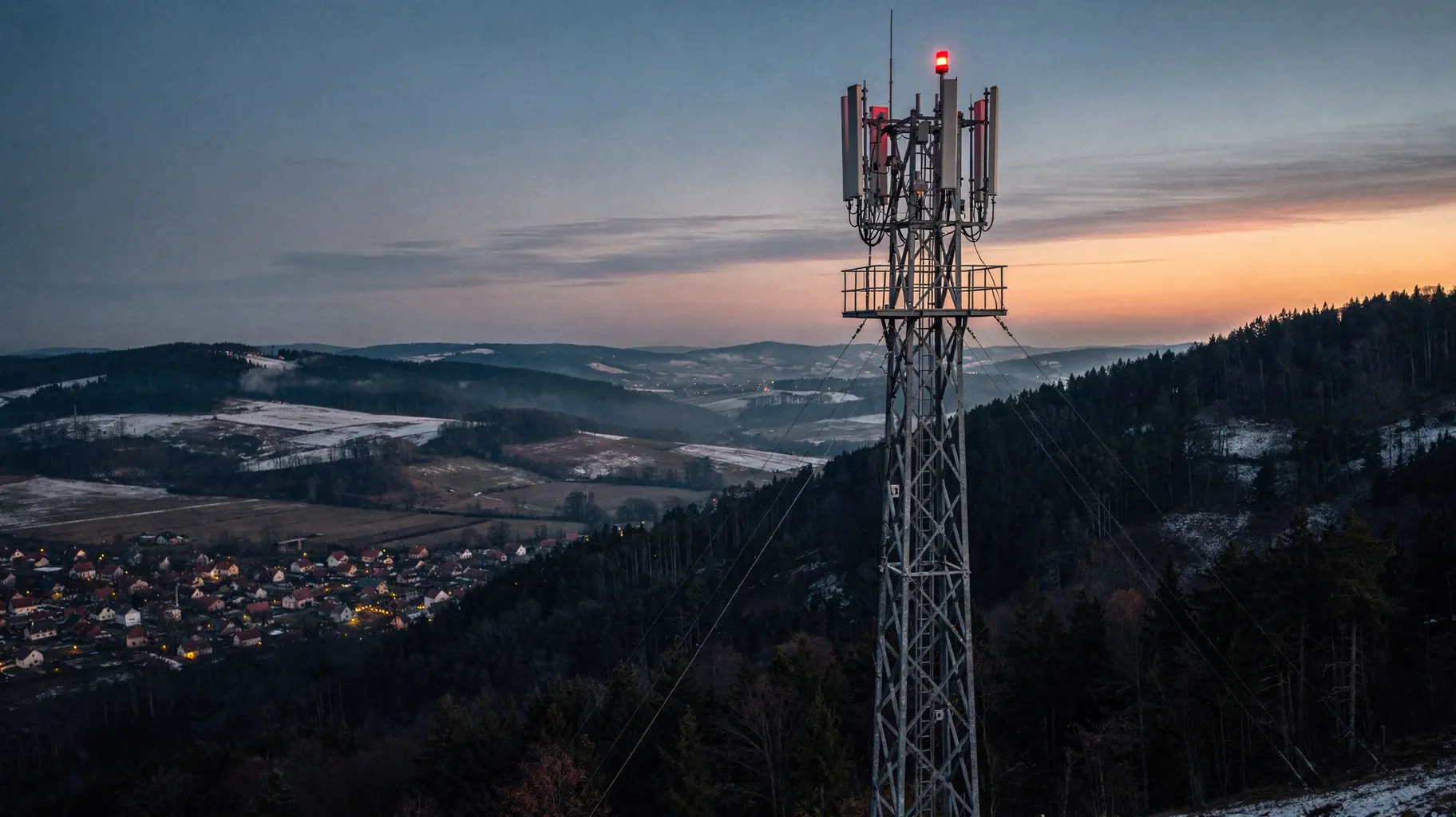
Its own build is visible. 1&1 commissioned more than 300 antenna sites per quarter on average in 2025 (https://imagepool.1und1.ag/v2/download/berichte/GB_1u1_2025_DEU.pdf), and reports 27 per cent of German households covered in December 2025 on a network running on 2 GHz and 3.6 GHz frequencies acquired in 2019 (https://imagepool.1und1.ag/v2/download/berichte/GB_1u1_2025_ENG.pdf). The report dates completion of the migration of existing customers onto its own network plus the roaming arrangement to November 2025 (https://imagepool.1und1.ag/v2/download/berichte/JA_1u1_2025_DEU.pdf). It does not print the share of traffic carried on its own antennas at any point, and I did not obtain that share.
Clause 12 does not say 25 per cent
Here the documents part company, and the split matters more than either figure on its own. 1&1 states that the 27 per cent exceeds the requirement to cover one quarter of German households by the end of 2025 (https://imagepool.1und1.ag/v2/download/berichte/GB_1u1_2025_ENG.pdf). Clause 12 of the Bundesnetzagentur's Präsidentenkammer decision of 26 November 2018 reads, in the German the auction rules print (https://www.bundesnetzagentur.de/SharedDocs/Downloads/DE/Sachgebiete/Telekommunikation/Unternehmen_Institutionen/Frequenzen/OffentlicheNetze/Mobilfunk/DrahtloserNetzzugang/Projekt2018/20181126_Auktion2019Entscheidungen_III_IV.pdf?__blob=publicationFile&v=3):
Neueinsteiger haben einen Versorgungsgrad der Haushalte von mindestens 25 % bis zum 31. Dezember 2023 und mindestens 50 % bis zum 31. Dezember 2025 zu erreichen. Sofern ein Neueinsteiger ausschließlich Frequenzen bei 3,6 GHz ersteigert, ist abweichend ein Versorgungsgrad der Haushalte von mindestens 25 % bis zum 31. Dezember 2025 zu erreichen.
In translation: a newcomer must reach at least 25 per cent of households by 31 December 2023 and at least 50 per cent by 31 December 2025; a newcomer that acquires exclusively 3.6 GHz frequencies must instead reach 25 per cent by 31 December 2025. The lower figure is drafted as an exception for a 3.6-GHz-only entrant, and 1&1 states that its network runs on 2 GHz and 3.6 GHz spectrum. No amendment, waiver or extension of the 2025 milestone turned up in the material I read on 19 November 2026. Both statements sit on the page here as they stand, because the reconciliation is not in the documents I held.
The obligation a percentage cannot express
The same clause carries the duty that a coverage percentage cannot represent. A newcomer acquiring 3.6 GHz frequencies had to put 1,000 base stations into operation by 31 December 2022 and make them available for 5G applications, distributed across each federal state according to its share of the federal territory (https://www.bundesnetzagentur.de/SharedDocs/Downloads/DE/Sachgebiete/Telekommunikation/Unternehmen_Institutionen/Frequenzen/OffentlicheNetze/Mobilfunk/DrahtloserNetzzugang/Projekt2018/20181126_Auktion2019Entscheidungen_III_IV.pdf?__blob=publicationFile&v=3). The instrument is equally plain about the incumbents, which faced 98 per cent of households in each federal state at 100 Mbit/s by the end of 2022, 1,000 5G base stations and 500 base stations in white spots by the same date, and the remaining state and federal roads at 50 Mbit/s by the end of 2024 (https://www.bundesnetzagentur.de/SharedDocs/Downloads/DE/Sachgebiete/Telekommunikation/Unternehmen_Institutionen/Frequenzen/OffentlicheNetze/Mobilfunk/DrahtloserNetzzugang/Projekt2018/20181126_Auktion2019Entscheidungen_III_IV.pdf?__blob=publicationFile&v=3). An obligation counted in households measures reach. An obligation counted in base stations measures density, and only the second forces a network into places where few people live.
On 13 January 2023 the Bundesnetzagentur recorded the state of play: the obligation to commission 1,000 5G base stations had not been met by the deadline, delay reasons had been submitted, 1&1 intended to reach the target that year, and separate coverage obligations apply to 1&1 (https://www.bundesnetzagentur.de/SharedDocs/Pressemitteilungen/DE/2023/20230113_Versorgungsauflage.html).
Der Spiegel reported on 27 November 2025 that five sites were in operation at the 31 December 2022 deadline, that the Bundesnetzagentur opened fine proceedings in spring 2023, and that those proceedings were not pursued after a 2024 ruling of the Cologne Administrative Court became final (https://www.spiegel.de/netzwelt/5g-mobilfunk-1-1-entgeht-millionenstrafe-wegen-pannenstart-a-e70cfbd9-7e07-4450-98a8-ffa83cde4899). That is a news organisation's account, not a regulator's. The official disposition of the proceedings and the court file were not obtained from the material read on 19 November 2026, and no penalty figure is asserted here, imposed or forgone.
The instalment plan
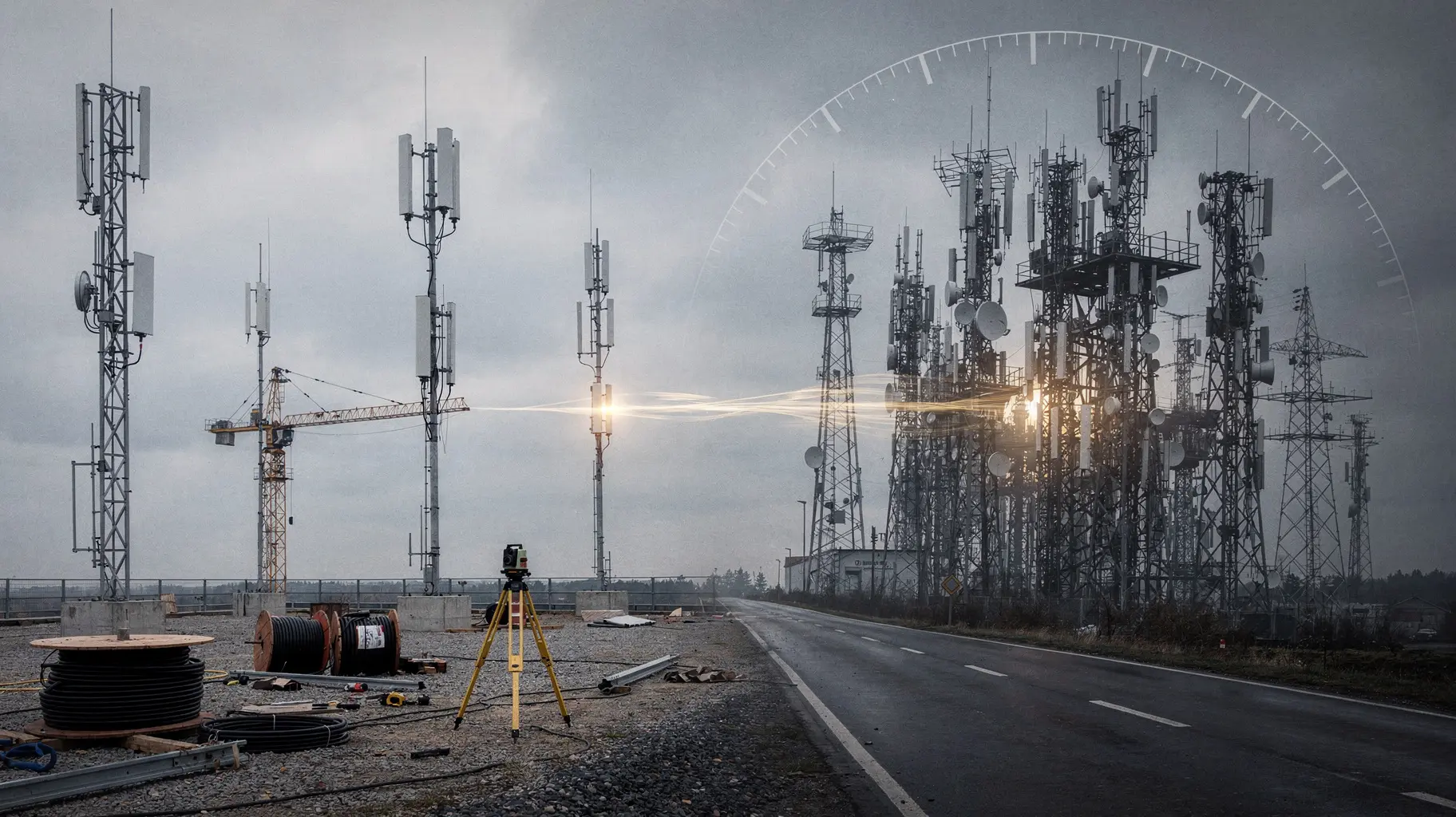
Set the pieces in one row and the shape of the business changes. 1&1 owns spectrum, antennas and a build rate it publishes. It buys the rest of its coverage under a formula tied to the cost base of a company it competes against, and the price of that purchase is legible only as a component of a composite line. The one lever 1&1 controls is the one that reduces the exposure, which is why the climb from €290.6 million to €409.2 million of cash capex is better read as a purchase of independence paid in instalments of more than 300 sites a quarter than as ordinary network spending (https://imagepool.1und1.ag/v2/download/berichte/GB_1u1_2025_DEU.pdf).
Whether the instalments win is a question these filings answer only at the margin. A future report that prints the traffic share carried on 1&1's own antennas, or a regulator publishing roaming terms a stranger can price, would replace this reading in a sentence. Until one of those appears, "fourth network operator" describes a spectrum licence and a construction programme. On the cost side, the 2025 report describes a wholesale customer with an unusually expensive building habit.
None of this restates what BTW has already published on 1&1. The August 2026 pieces on the German tower-access row and on the intra-group 1&1 Versatel transaction worked at the corporate and transaction layer. Neither set a reported capex figure against the composite line that carries the roaming charge and against a licence milestone printed in the same instrument. That comparison is the claim here.
One boundary belongs beside every figure above. 1&1 AG is the listed group whose report carries them. 1&1 Mobilfunknetz is a reporting segment of that group, so the €710.0 million is a segment material expense rather than a roaming invoice. 1&1 Versatel is a separate company whose December 2025 capex sits inside the group total, which is why the group also prints €389.3 million without it. Vodafone is the counterparty named in the group's own description of the cost share, and the Bundesnetzagentur is the issuer of the auction decision and the 2023 status statement. The directory entry for the listed group is here: https://btw.media/en/directory/1and1-ag
Member Briefing
Read the full trend briefing
Members read the full briefing with the source notes behind every finding.
Strategic Circle
A daily briefing in your language, built from changes we have verified.
Join for USD 20/monthCancel anytime.
Members also get the full research library, a daily briefing on the networks they follow and the private forum.