
Summary
- RFC 1434 terminated LLC Type 2 at each Data Link Switch, so the two end stations had independent local connections rather than one data-link session stretched across the WAN.
- The switches discovered a path, exchanged locally meaningful Circuit IDs and contacted the remote station through SSP; a working TCP connection alone proved none of those later states.
- Multiplexing saved wide-area acknowledgement traffic and insulated LAN timers from WAN delay, but one failed transport connection forced every circuit riding it to disconnect locally.
The acknowledgement stopped at the first switch
The useful fiction of a network diagram is the uninterrupted line. Put a terminal on each side, draw a wide-area link between two routers, and the eye completes an end-to-end conversation. IEEE 802.2 LLC Type 2 made that picture hazardous when its local-area assumptions met a slow or congested WAN. Its fixed timer expected transit delay to be small and predictable. A delayed frame could look lost, trigger retransmission, confuse the link procedure and eventually bring the connection down.
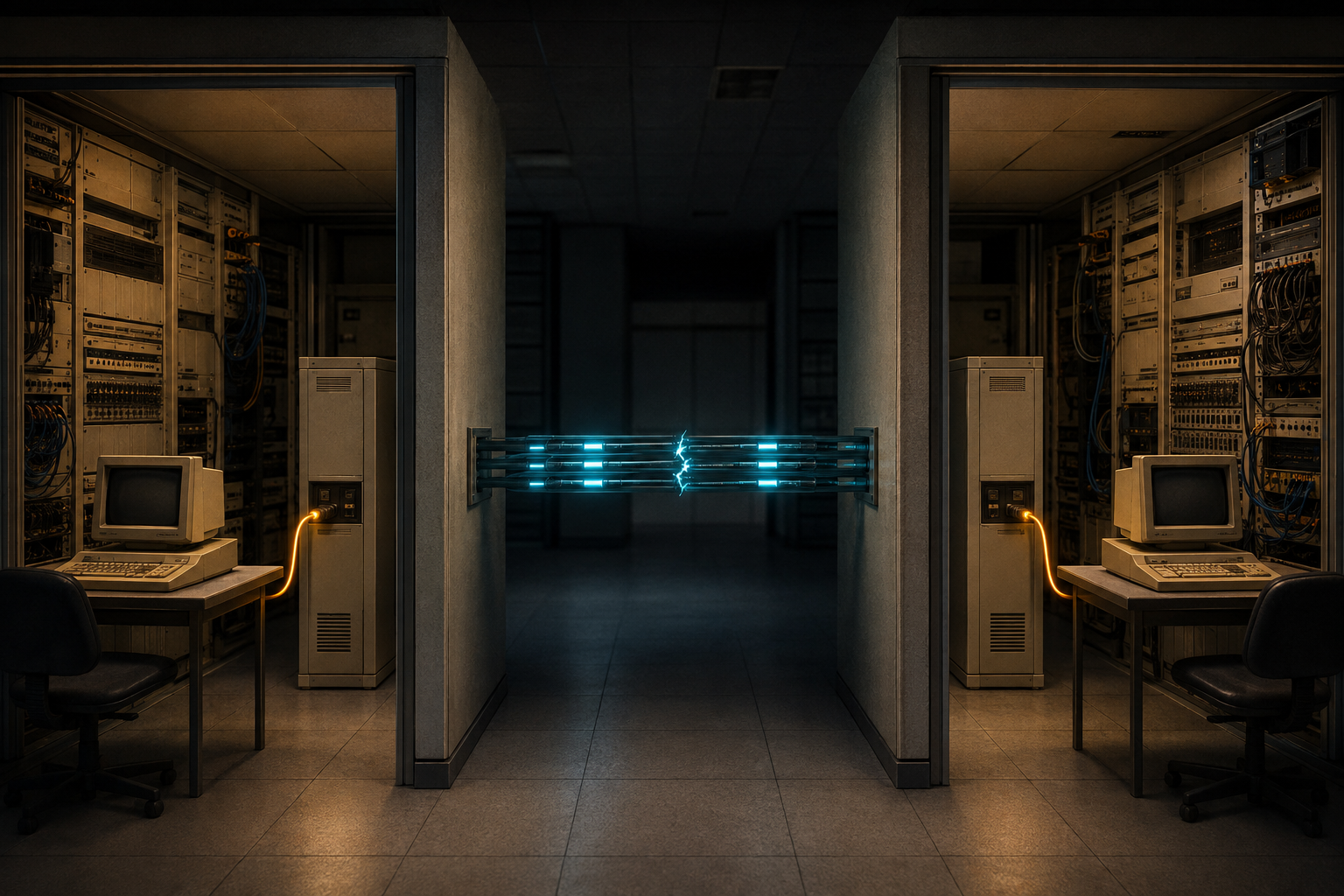
RFC 1434's answer was not to tune one very long timer and hope every path behaved alike. Data Link Switching ended the local link-control relationship at the edge. The terminal on the left exchanged LLC frames and acknowledgements with its nearby switch. The terminal on the right did the same with its own nearby switch. Between those switches, a Switch-to-Switch Protocol relayed the information over reliable transport.
That arrangement changed the meaning of an acknowledgement. A receiver-ready response seen by a terminal meant that the adjacent switch had accepted responsibility. It did not mean that the remote terminal had received the frame, that the remote local link was up, or that the application had processed anything. RFC 1434 explicitly called the two LLC connections totally independent. The apparent conversation rested on a chain of distinct promises.
The benefit was concrete. LLC timeouts and acknowledgements no longer crossed the WAN. SDLC polling and responses could also remain local. Retries could be absorbed at the switch closest to the affected link. Variable wide-area delay stopped interfering directly with a procedure designed for a LAN.
A socket was infrastructure, not a circuit
Two Data Link Switches first needed a transport connection. The initial SSP implementation used TCP, though the RFC left room for another reliable transport. Once the connection existed, the switches could use SSP to establish end-to-end DLS circuits over it. Several circuits could share the same transport.
The order matters because “TCP connected” was only a statement about the two switches. It did not say that either switch knew where a requested end station was, that the remote station had answered a link-control exchange, or that a DLS circuit had reached connected state. A transport monitor could be green while the intended terminal session remained only an unresolved question.
RFC 1434 gave the circuit its own identity. A Data Link ID described the two station attachment points as paired MAC and SAP addresses. Each switch also allocated a 64-bit Circuit ID with only local significance. The end-to-end circuit was identified by the pair, and each switch had to retain the mapping between its local identifier and the remote one.
This was more than compact addressing. It created an auditable boundary between a station description and a live circuit instance. Before the pair existed, messages needed the fuller Data Link ID. After establishment, an INFOFRAME could use a shorter header carrying the remote Circuit ID. If an operator preserved only the TCP peer address, every multiplexed session would collapse into an indistinguishable stream.
Reachability, recognition and contact were separate verbs
The names of the control messages read almost like a cautious conversation. CANUREACH asked peers whether a station could be reached. ICANREACH returned a positive answer and the target switch's Circuit ID. REACH_ACK completed the identifier exchange by supplying the origin Circuit ID. Only then did later messages such as CONTACT and CONTACTED advance the relationship toward connected state.
The sequence prevented one observation from standing in for another. A peer could be alive without knowing the station. A station could be discovered without a complete Circuit-ID pair. A pair could exist without the remote local link having completed contact. INFOFRAME traffic belonged after those transitions, not merely after the TCP handshake.
Multiple positive reachability answers created another decision. RFC 1434 said the origin selected the first ICANREACH and sent REACH_ACK to that switch. Discovery was therefore not an eternal truth about a unique location. It was an observed answer followed by a choice, and the resulting circuit state belonged to the selected pair of switches.
Search had cost. A switch could cache a discovered station location, but when it had no entry it sent the question to all known DLS peers. Caching reduced broadcast-like exploration; stale knowledge could point later attempts toward a location that no longer held. Search scope, cache age and the particular answer chosen were operational evidence, not background detail.
Local politeness could precede remote success
The sharpest illustration of the split appeared during connection setup. A local station could send SABME to open its LLC connection. The origin switch could respond locally with UA before the far station had been contacted. To stop the local sender from racing ahead, the switch used receiver-not-ready. After CONTACTED arrived from the remote switch, receiver-ready allowed information to flow.
Nothing fraudulent occurred. The local acknowledgement represented the switch's assumption of link responsibility, while the temporary stop represented uncertainty farther along the chain. Trouble begins only when monitoring or application logic reads the local UA as proof of remote acceptance.
This is why circuit state and flow permission deserve separate records. “Circuit established” named an SSP relationship with identifiers. “Connected” followed station contact. Receiver-ready permitted the adjacent station to send. None of those states proved that a business transaction, terminal screen update or remote program action completed.
RFC 1795 later made the flow boundary more explicit. Its successor protocol added per-direction, per-circuit adaptive pacing. A sender began with no granted units and needed an FCIND grant from the receiver before sending data units. The initial window came from capabilities exchange. Those details belong to the 1995 revision, not the original RFC 1434, but they reveal the same design pressure: reliable transport still needed an independent rule for how much one logical circuit could inject.
Efficiency concentrated the failure domain
Local termination removed repeated LLC acknowledgement traffic from the WAN and protected local timers from WAN variability. Multiplexing also avoided a dedicated transport connection for every terminal pair. The economy carried a precise price.
RFC 1434 said that if the TCP connection between two switches failed, all connections multiplexed on it were taken down. Both switches sent DISC commands to every affected local system. A terminal whose own cable, local switch port and local LLC procedure were healthy still lost its session because the shared middle layer disappeared.
That fan-out is not an implementation anecdote; it follows directly from the aggregation boundary. Ten local sessions could have separate Circuit IDs, separate station states and unrelated application purposes while sharing one transport dependency. Counting ten disconnects without linking them to the one peer connection would exaggerate the number of root causes. Counting one TCP failure without enumerating the ten affected circuits would hide impact.
Normal teardown also had its own evidence. HALT_DL requested that the remote side halt a data link; DL_HALTED acknowledged the action. A local DLC error could move a circuit toward disconnection without a transport failure. The same visible terminal symptom—session gone—could therefore originate in local link state, remote link state, circuit control or the common transport.
The successors exposed what operators needed to see
RFC 1795 was not a cosmetic republication. The APPN Implementers Workshop's DLSw group sought one multivendor SSP, corrected documentation problems and made significant changes, thereby obsoleting RFC 1434. It added capabilities exchange after transport establishment and before ordinary circuit control. It also specified adaptive pacing and transport-connection negotiation.
RFC 2024 turned several of these boundaries into managed objects. A transport could be connecting, in initial capability exchange, connected, quiescing, disconnecting or disconnected. Counters distinguished circuit creation and exploration activity; circuit tables could retain disconnect reasons. Operations had caught up with architecture: one green socket field could no longer carry all relevant truth.
RFC 2166 then documented scaling pressure. Maintaining peer definitions, propagating search and NetBIOS traffic across many point-to-point connections, holding transport sessions and terminating large numbers of LLC2 sessions all imposed cost. Its DLSw v2.0 enhancements added halt reasons, multicast-assisted discovery, connections on demand and a preference for a single bidirectional TCP connection where peers supported it.
These later RFCs should not be back-projected into 1993. They show that the original boundary created new control surfaces that needed negotiation, observability and scaling work. Removing WAN delay from an old link procedure did not remove state. It relocated state into switches and made its dependencies more explicit.
Evidence ends before the application
The minimum honest record follows the chain. Capture the transport peer and its state; the station addresses searched; every reachability reply and which one won; the local and remote Circuit IDs; CONTACT and CONTACTED transitions; both adjacent DLC states; flow permission; data counters; and the exact teardown cause. Then retain application-side evidence separately.
RFC 1434 and RFC 1795 both said security issues were not discussed. The control exchange therefore cannot be treated, from these documents alone, as proof of peer authentication, station authorization, confidentiality or integrity against an adversary. Reliable delivery is a transport property within the stated model, not a security verdict.
Nor do the RFCs prove deployment, present use or the success of any named network. Their historical value is sharper. They show an Internet carrying an older data-link world by refusing to pretend the two systems had identical timing and state. The bridge between them worked because it admitted several boundaries: local acknowledgement versus remote contact, transport versus circuit, permission versus delivery, and efficiency versus shared fate.
Sources
Member Briefing
Deeper Profile Context
Sign in with the right membership level to unlock the full briefing and source notes.
Only for Strategic Circle
Strategic Circle
Open to all readers. Unlock profile briefings after joining and signing in.
Join Strategic CircleOnly for Leadership Alliance
Leadership Alliance
For qualified IP-asset owners and management; sign in to unlock alliance briefings.
Join Leadership Alliance