Summary
- A 1990 US–European working group set a one-year target: routine, proper campus-to-campus email delivery in less than one hour. RFC 1210 recorded the target, not a measured result.
- The group traced delay and failure through incompatible mail protocols, unreliable relays, missing operations procedures and weak user and directory support. It proposed an intercontinental operations forum to make the route answerable to its users.
Nine people managed the minutes. A service needed a method
The participants had a working demonstration of transatlantic email. Nine people on both sides of the Atlantic contributed to the meeting minutes over five days using mail alone, RFC 1210 says. The same report wanted a routine expectation that a message would travel from one campus to another properly and in less than an hour. One successful working group could coordinate around problems; a service for everyone needed to make that coordination ordinary.
The report was edited by Vint Cerf, Peter Kirstein and Brian Randell and published in March 1991. It came from meetings in Brussels and Washington in July 1990 for planned US–European research collaboration. Its headline target was a deadline, but the body reads like a list of people who would have to own the clock. Researchers cared whether their correspondent received a useful message. They did not care which campus gateway, national network, protocol converter or transatlantic link had missed its turn.
The document was blunt about the current mail service. Across the US and Europe, it found gaps in connectivity, weak reliability and poor responsiveness. Some problems came from the mix of mail protocols and the translation between them; others came from inadequate operations and maintenance. User assistance and directories were thin. The group did not propose that a faster ocean cable alone would fix a queue in a relay or an address that nobody could find.
A deadline with six dialects
A campus message could encounter X.400, UUCP, SMTP, EARN, EUROKOM and BITNET environments. RFC 1210 recommended a collaborative working group to analyze their interoperability and propose concrete developments. It also wanted functional and performance specifications for mail gateways. That is a different demand from simply declaring a protocol winner. The mail had to pass through systems already in use, and the relay had to behave in a way that another operator could test and support.
The one-year objective came in two parts. First, establish management capable of helping users and running relays reliably. Second, make proper delivery in under an hour campus-to-campus a routine expectation. Three-year targets added global email directories, a return or receipt facility and support for privacy and authenticity. Those later features mattered because delivery is more than a packet crossing water: someone must address the right person, know when a message returned, and decide what evidence of origin to trust. The report presented these as work to be done. It did not publish an achieved one-hour measurement.
Its recommended machinery had names. An intercontinental operations forum would involve mail service providers in both regions, define procedures for reliable operation and specify the behavior of gateways. An international user support group would handle the people who could not solve a failed delivery by reading a protocol document. The interoperability group would face the six systems rather than assuming they would merge. Each proposal put responsibility beside the technology.
A wide ocean was not the whole route
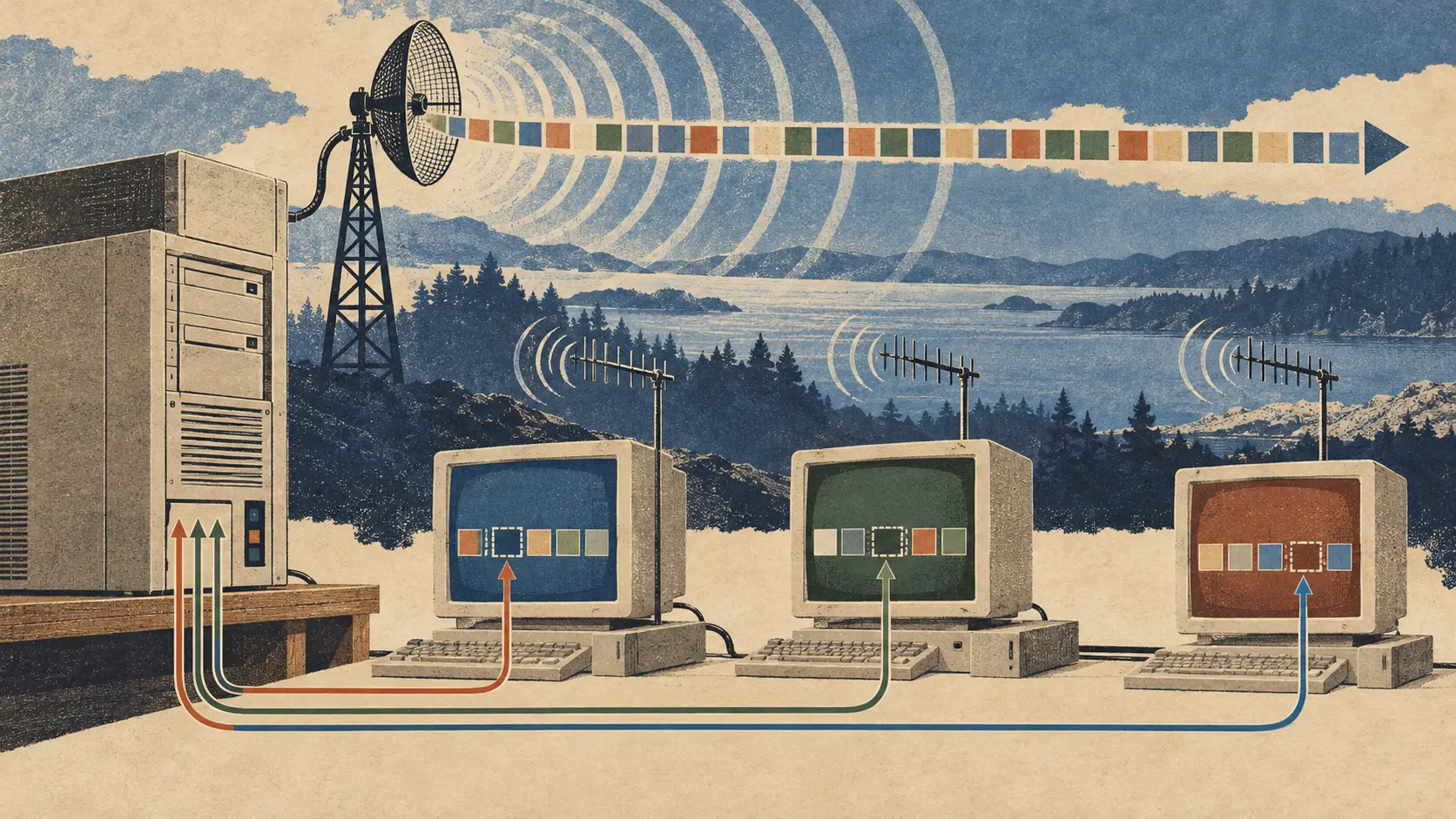
The report called the end-to-end user service a chain of management domains: inside campuses, at campus gateways, in national distribution, at intercontinental gateways and over the transatlantic facility. A shortage of bandwidth, a protocol mismatch or an administrative failure anywhere in that chain appeared to the correspondent as one broken service. This is a sharper way to read the one-hour goal. It was not a speed promise made by a single cable operator. It was a demand that multiple institutions make their handoffs work together.
The physical asymmetry was real. The report described many US backbones using 1.5 Mb/s facilities, while European national wide-area networks commonly ran X.25 access at up to 64 Kb/s. A new European international backbone, IXI, had begun operation at 64 Kb/s, and longer-term funding and upgrades were unsettled. The group separately proposed 2 Mb/s European distribution and at least 1.5 Mb/s across the Atlantic within a year. These figures locate the capacity problem; they are not a formula that converts link speed into a guaranteed mail arrival time. Queues, gateways and operations still occupied the rest of the path.
Other working groups asked for reliable, timely mail, easier access, guidance and information about services. Some reported that fax was easier to use and more widespread in their communities. That comparison had a practical sting. A network that could move research data was still losing a usability contest for ordinary collaboration if the user had to guess whether an address existed or a relay had quietly stalled.
The clock started at the sender and stopped at the recipient
RFC 1210 left a precise historical record of ambition and missing ownership. It specified the less-than-one-hour campus target, separated near-term reliability from later directory and receipt work, and asked US and European providers to coordinate operations. It did not establish which messages met the deadline afterward. A dated cross-campus mail trace, relay log and operational agreement would show what happened beyond the workshop.
The lesson of the document sits in its own minutes. People could make email work across an ocean by cooperating for five days. The proposed service had to make that effort available on an ordinary day, to a researcher who did not know the relay operators. That meant a route, a gateway specification and someone responsible when the clock ran out.
Source
- RFC 1210, Network and Infrastructure User Requirements for Transatlantic Research Collaboration (March 1991) — original 1990 workshop report and the sole historical source for the targets and conditions in this article.
Member Briefing
Deeper Profile Context
Sign in with the right membership level to unlock the full briefing and source notes.
Only for Strategic Circle
Strategic Circle
Open to all readers. Unlock profile briefings after joining and signing in.
Join Strategic CircleOnly for Leadership Alliance
Leadership Alliance
For qualified IP-asset owners and management; sign in to unlock alliance briefings.
Join Leadership Alliance