Summary
- RFC 1192 called the NSFNET backbone free to authorized connecting networks. Its 1990 cost account still put money and contributed services behind that route.
- Moving the subsidy toward users promised more provider choice, but each proposed destination shifted bills and power. Sparse regional networks had a longer line to pay for than the metropolitan customers commercial providers preferred.
The zero on one invoice
A regional network connected to the NSFNET backbone could see a zero at the backbone boundary. Its remote member college could see an entirely different number on the leased-line bill. That mismatch is the useful starting point for Brian Kahin’s November 1990 RFC 1192, a synthesis of a March Harvard workshop on commercializing the Internet. The report’s question was less romantic than “public or private?” It was who received a subsidized route, who supplied the missing money, and who chose the next provider.
The workshop’s account separates two words that often get thrown into the same box. Stephen Wolff, then directing networking work at the National Science Foundation, used commercialization for admitting commercial users and suppliers to Internet facilities. Privatization meant ending federal provision or subsidy. A network could have private contractors, paid users and commercial traffic while federal money still shaped its route. The distinction mattered because changing the accepted use of a connection was easier to describe than relocating the subsidy that made the connection attractive.
RFC 1192 gave the free backbone a price tag. It reported NSF contributing less than $3 million toward roughly $10 million in annual backbone costs. Michigan’s Strategic Fund provided $1 million; IBM and MCI supplied the balance as contributed services under Merit’s cooperative arrangement. These are the report’s contemporary accounting categories, not an estimate of every campus cable and router in the country. The same report put NSF’s share at roughly 40 percent of operating costs for the mid-level networks it funded. Regional fees, states and other contributions paid the rest.
The backbone looked free precisely because its bill was being settled elsewhere.
Hand the money to whom?
Kahin laid out a chain of possible payees. Charge regional networks for backbone service, then redirect the federal subsidy to the networks, campuses or researchers who buy connectivity. In theory, money in a purchaser’s hands gives a supplier a reason to compete for that purchaser. In practice, each rung of the chain had its own accountant, gatekeeper and blind spot.
Give researchers network money through grants, and universities might put it in overhead accounts because ordinary Internet access was rarely costed per researcher. Vouchers could tie it more tightly to eligible wide-area service, but the report anticipated new accounting disputes. Grant-linked aid could also split a campus: federally funded scientists would bring a network allowance while teachers and scholars outside those grants used the same institutional connection without one. The convenient unit of federal administration was a poor map of who actually used the wire.
Give institutions recurring aid instead, and campuses could decide which external service met their needs. The bill would move closer to a place that could compare suppliers. Then NSF would have to decide how to allocate the money and what counted as an eligible purchase: a regional-network fee, another network’s bill, a modem, an information service? A subsidy designed to avoid picking a backbone could turn the funding agency into a referee for campus purchases.
Give the money to regionals, and the paperwork looked simpler: a few dozen recipients rather than hundreds of campuses or thousands of researchers. Yet some regionals competed for members. A large grant to one could make its prices look better than a rival’s for reasons unrelated to operating skill. RFC 1192 did not find a magic level at which public money stopped shaping the market. It traced how the shape changed as the payment moved.
The cheap customer and the long wire
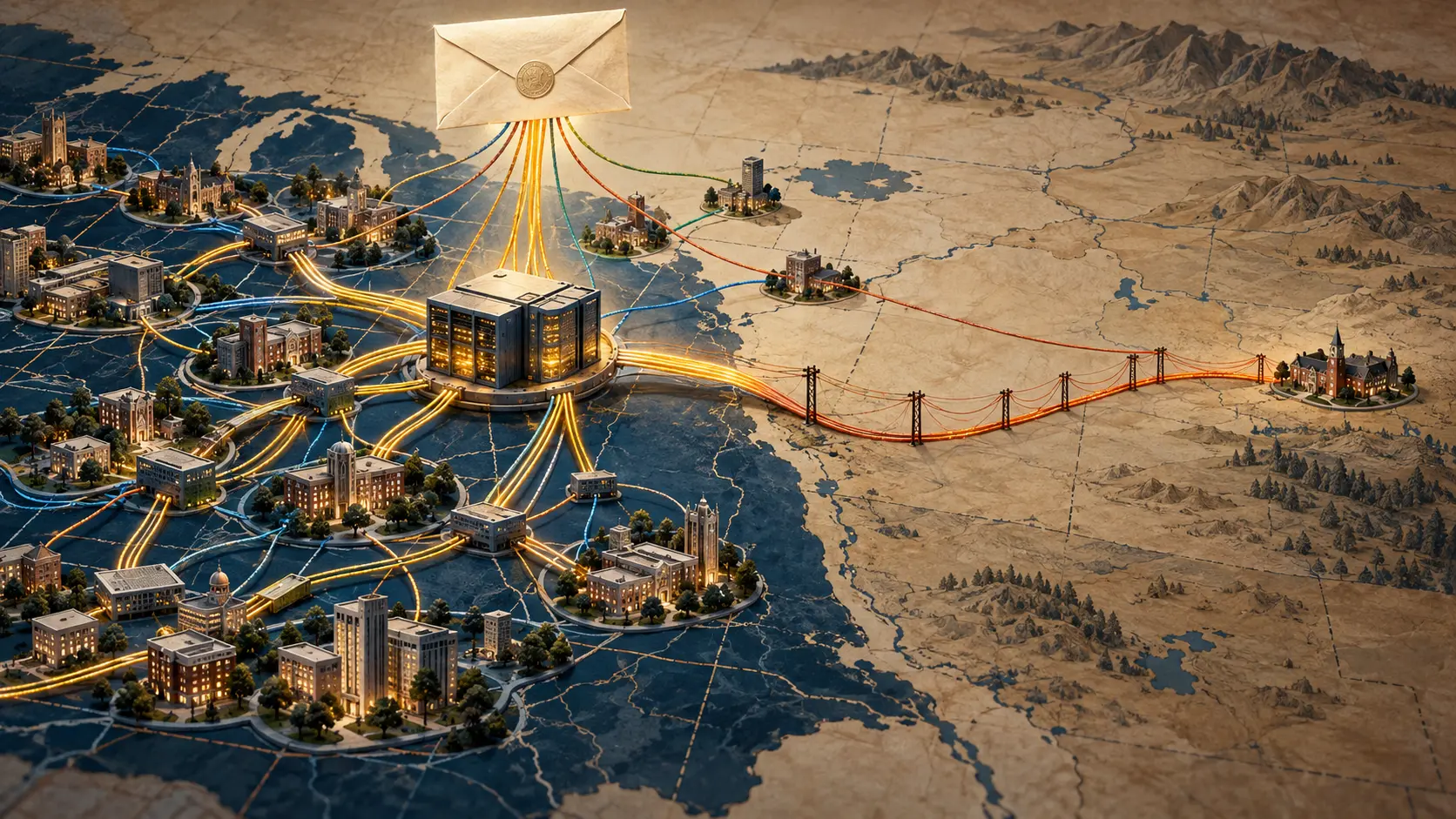
The geographic argument is the sharpest part of the report. Commercial suppliers naturally pursued dense places with research and development customers—Boston, the San Francisco area and Washington were its examples. A regional network expected to serve a broad territory could not collect only the easy addresses. A remote institution needed a leased circuit to the nearest network point. Either the institution paid that long line directly or the regional pooled it into common costs. The latter made the regional look expensive beside a compact provider that could choose its neighborhoods.
That is why the report floated a density-based subsidy for regionals, measured, for example, by circuit miles per member institution. It even contemplated eligibility for both for-profit and nonprofit networks. This was an allocation proposal in a 1990 workshop report, not a record of a program being implemented. Its force lies in the pricing problem it exposed: a national backbone can be equally free at its own interface while the cost of reaching that interface is radically unequal.
The report also warned against rushing a new invoice into existence. It said no regional had yet folded and no institution had permanently disconnected because of higher prices, while describing concern for marginal networks if backbone support were withdrawn. A fee imposed upstream would travel downstream through regional membership and connection charges. The most fragile route could be the one with the least room to absorb it.
What the workshop actually left behind
RFC 1192 did not select one of its funding locations. It assembled a live argument: the free backbone brought networks together and made each connection more valuable, but it also subsidized an established traffic path and could deter alternative backbone investment. Move the money to buyers and competition gains a lever; move it without regard to distance and the remote campus receives a sharper bill. The same federal dollar could buy a shared trunk, a regional circuit, a university choice or a researcher’s voucher. It could not be in all four ledgers at once.
The document is valuable because it names the physical and institutional joints. There was a backbone operator, a federal funder, regional networks, campus networks, private suppliers and individual users. A change in one funding rule altered the incentives of the others. The Internet’s early commercial story was not just a procession of new companies. It was a dispute over which part of a real route should appear free, and to whom.
Source
- RFC 1192, Commercialization of the Internet: Summary Report (November 1990) — primary workshop synthesis and all historical figures and proposals in this article.
Member Briefing
Deeper Profile Context
Sign in with the right membership level to unlock the full briefing and source notes.
Only for Strategic Circle
Strategic Circle
Open to all readers. Unlock profile briefings after joining and signing in.
Join Strategic CircleOnly for Leadership Alliance
Leadership Alliance
For qualified IP-asset owners and management; sign in to unlock alliance briefings.
Join Leadership Alliance