
Summary
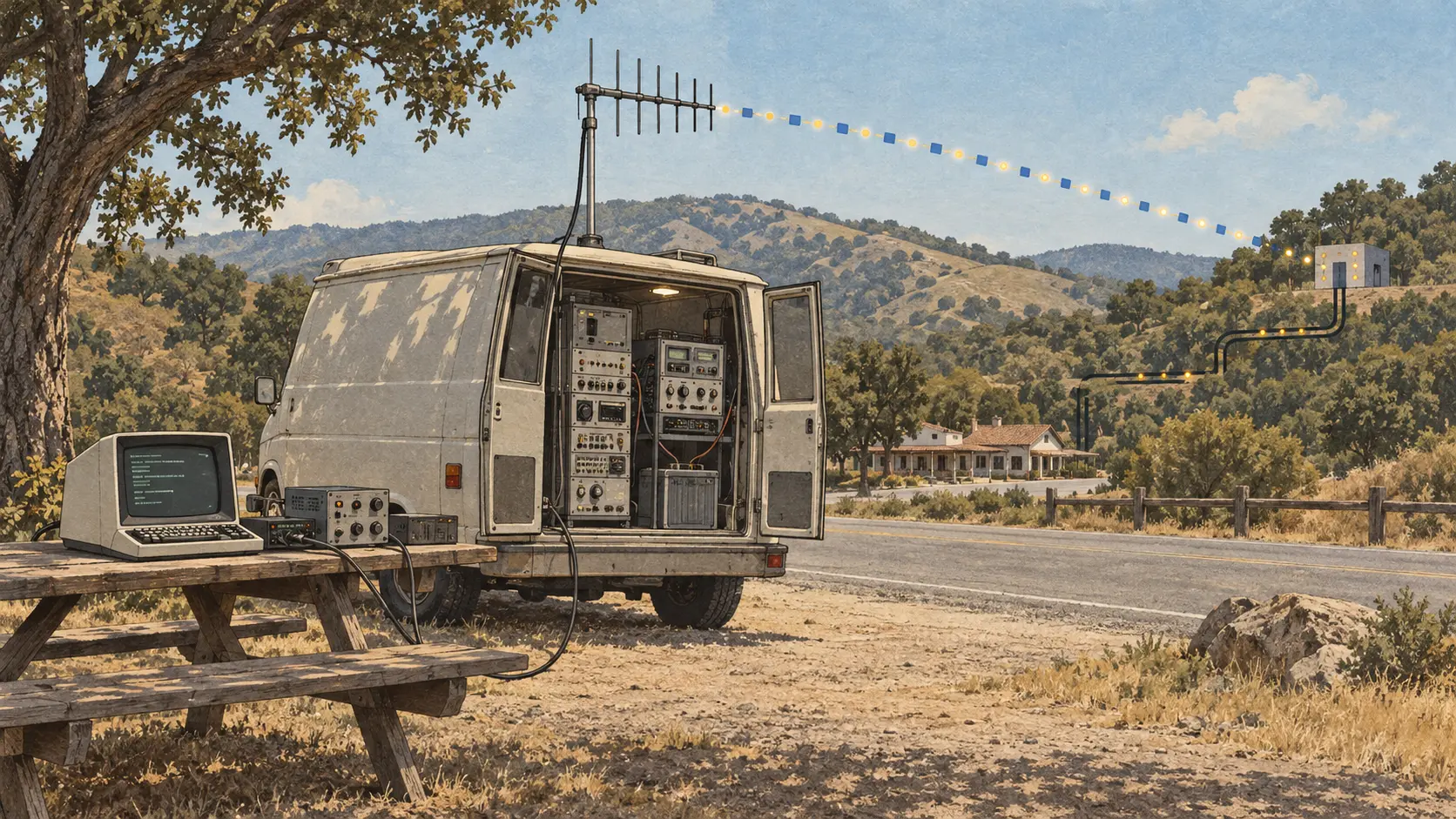
- SRI’s retrospective places a packet-radio van beside Portola Valley’s Alpine Inn in August 1976 and describes traffic passing by radio through SRI into ARPANET.
- That two-network test was not the same event as the better-known 1977 demonstrations involving ARPANET, packet radio and satellite links; neither alone marked public adoption of an Internet service.
What the van had to prove
A terminal at the Alpine Inn sent characters over a short cable to equipment in the SRI research van. The van’s node converted them into packets, sent them over the Packet Radio Network (PRNET) through a nearby repeater to SRI, and from there into the wired ARPANET. SRI’s institutional history dates this field test to August 1976 and describes it as a connection between PRNET and ARPANET through SRI. The point was not that a vehicle had become the Internet. It was that traffic could cross a boundary between networks built with different transmission media and operating assumptions.
That boundary mattered because a network-to-network design had to preserve communication while each underlying network handled its own packets. A successful exchange showed that a gateway and protocol implementation could make unlike networks cooperate in a particular test configuration. It did not, by itself, measure how the arrangement would behave at scale, establish a continuously available service, or say who could use it.
A sequence, not one birth scene
The project’s own chronology is iterative. In his 1980 final report, Vint Cerf describes TCP work beginning in 1973–76 at Stanford, BBN and University College London, then continuing at other research centers through 1980. The specification and implementations changed along the way. SRI’s later technical history also describes a May 1977 TCP demonstration spanning PRNET and ARPANET before the widely commemorated three-network transmission.
The 1977 milestone has its own date problem. The 1997 Internet timeline in RFC 2235 dates a first demonstration to July and marks that entry as attributed to Vint Cerf. The Computer History Museum’s 2007 anniversary record calls November 22 the first known three-network transmission. In a 2007 oral-history session, Cerf said reports pointed to five or six network tests; participants also questioned which gateways carried the traffic. These sources do not reconcile July with November or establish whether the dates refer to different tests.
They do agree on the larger distinction: by 1977, packet radio, ARPANET and satellite networking were being joined in demonstrations that extended beyond the earlier two-network field test.
What the record supports
The evidence supports a chronology of experiments: a 1976 PRNET-to-ARPANET field connection; further TCP testing; and 1977 demonstrations that brought satellite networking into the picture. It does not support compressing these into a single instant when a public Internet appeared. Nor does a successful technical test prove universal participation, public authorization or widespread deployment. Later operational milestones, including the 1983 TCP/IP transition on ARPANET, answer a different question from whether two research networks exchanged traffic in 1976.
The distinction matters because origin stories often turn a test result into a launch date. The more useful historical question is what each demonstration established, which network boundary it crossed, and what remained untested.
Sources
- SRI, “75 Years of Innovation: Internetworking”
- SRI, “Advances in Communications,” chapter 3
- Vint Cerf, IEN 151, Final Report of the Stanford University TCP Project
- Vint Cerf, RFC 2235, “Hobbes’ Internet Timeline”
- Computer History Museum, 30th-anniversary event record
- Computer History Museum, 2007 oral-history transcript
Member Briefing
Deeper Profile Context
Sign in with the right membership level to unlock the full briefing and source notes.
Only for Strategic Circle
Strategic Circle
Open to all readers. Unlock profile briefings after joining and signing in.
Join Strategic CircleOnly for Leadership Alliance
Leadership Alliance
For qualified IP-asset owners and management; sign in to unlock alliance briefings.
Join Leadership Alliance