Summary
- The Solomon Islands Submarine Cable Company, incorporated in August 2016 and held 51% by the Investment Corporation of the Solomon Islands and 49% by the Solomon Islands National Provident Fund, owns and operates the country's international and domestic submarine cable systems — and says it sells capacity only to licensed operators in Solomon Islands.
- The Australian grant paid for the asset, and a US$29.7M share purchase covered the government's co-contribution in 2018, but the durable leverage is the wholesale-only rule. In a country whose international capacity arrives through one company, an aspiring ISP's entry cost is a licence and a contract, not a cable.
The asset
Solomon Islands does not have a cable market. It has a cable company, and that company's own first page is unusually candid about the arrangement.
Solomon Islands Submarine Cable Company Limited states that it was incorporated in the country in August 2016 and that "The Coral Sea Cable System and the Solomon Islands Domestic Network were completed by a majority grant funded project by the Commonwealth of Australia in late 2019" (SISCC's company description).
Two systems, one grant, one owner. The international leg and the domestic network appear in the same sentence because, as far as the commercial record goes, they are the same business.
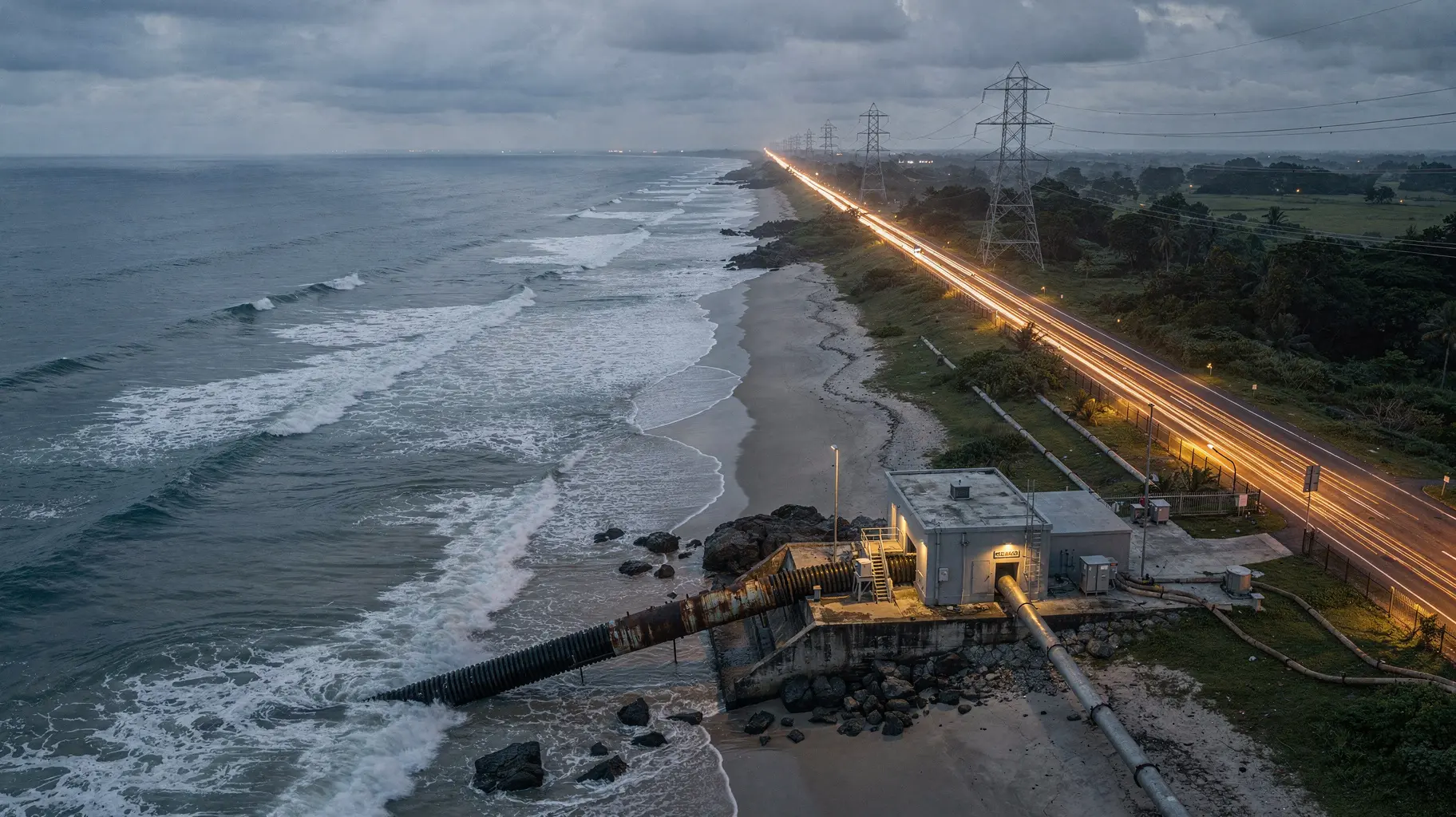
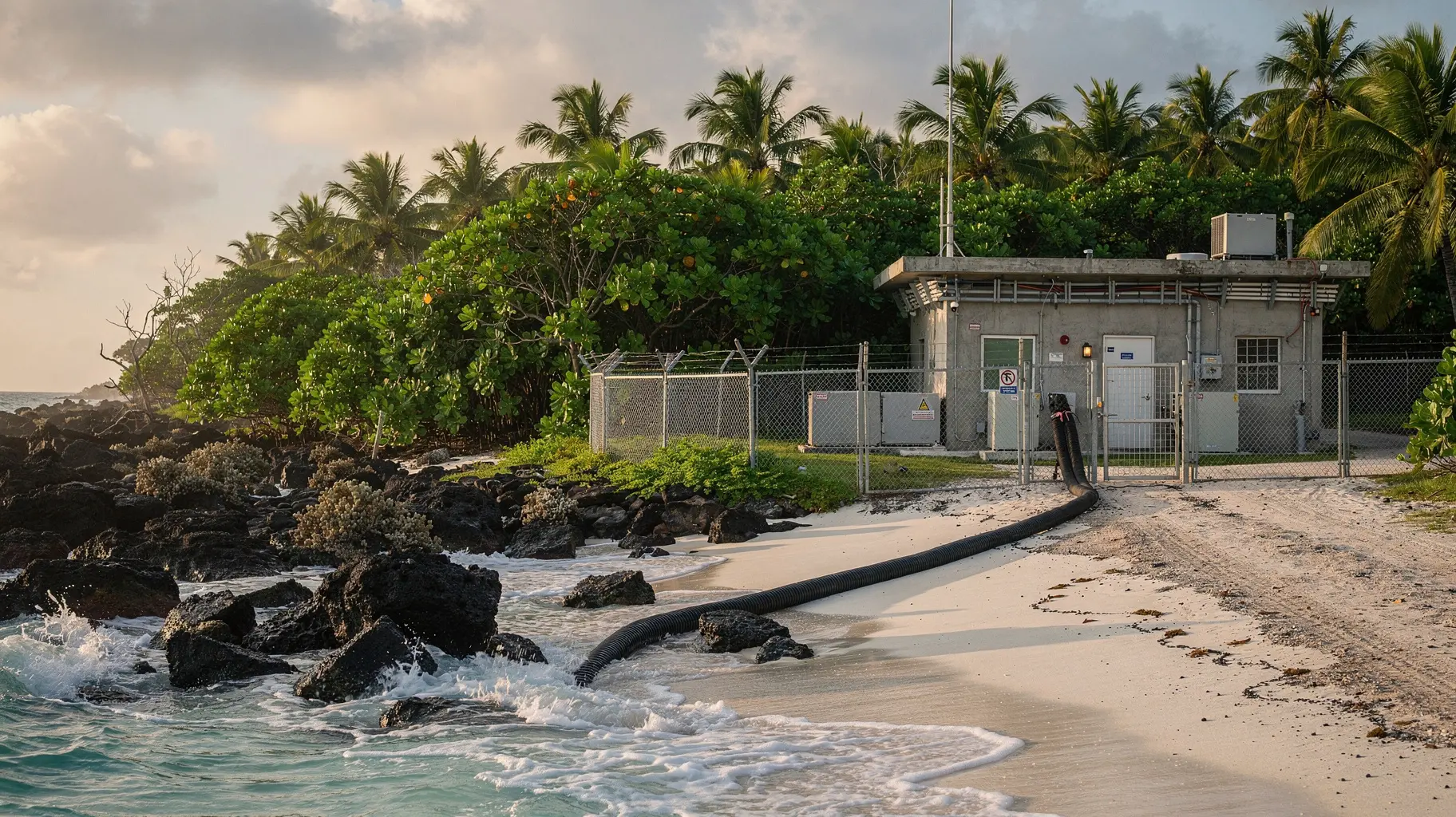
The build did not stop when the cables landed. Trade title Data Center Dynamics reported that Australian data-centre firm DXN had been contracted by SISCC "to design, manufacture, deliver, and install a cable landing station (CLS)" (Data Center Dynamics), with the headline putting the contract at AU$12m. The retained passage breaks off mid-sentence, so which site that station serves is not in the record held here. What the report does establish is that SISCC was commissioning civil infrastructure for a system it already owned.
The capital
Ownership is stated plainly: the Investment Corporation of the Solomon Islands holds 51% of the share capital and the Solomon Islands National Provident Fund 49%, and SISCC describes itself as "a 100% Government backed company who own and operate Submarine Cable services in the Solomon Islands territory" (SISCC's company description).
The money has an unusual shape. Following a shareholders agreement completed on 20 July 2018, the two shareholders "purchased their shares for a combined value of $29.7M USD, sufficient to fully fund the co-contribution required from Solomon Islands Government" under the tripartite memorandum signed by Australia, Papua New Guinea and Solomon Islands in Brisbane on 11 July 2018 (SISCC's company description).
Read that twice. The state's share of a three-country cable project was met not by a treasury appropriation but by two state-linked institutions buying equity in the company that would hold the asset, in an amount the company ties directly to the obligation. That is a capital-layer solution to a diplomatic-layer requirement, and it produced a balance sheet with two domestic institutional owners and one very long-lived asset.
No incorporation filing or audited share register was retrieved for this article. The 51/49 split and the US$29.7M figure are the company's account of itself, and are presented as such.
The access rule
Then the sentence that matters.
"Solomon Submarine Cable is a Wholesale Operator, selling international and domestic capacity to any licensed operators in the Solomon Islands" (SISCC's company description).
SISCC began commercial operations in February 2020 and trades under the business name Solomon Submarine Cable (SISCC's company description). The wording is careful; the effect is structural. Capacity is not sold to end users. It is sold to licensed operators, which means any retail ISP serving Solomon Islands customers buys its international bandwidth, and its inter-island bandwidth, from a counterparty owned entirely by state-linked institutions.
A grant builds an asset. A wholesale-only mandate decides who may buy from it. The first is a capital event with a completion date. The second is a market rule with none. Australia's money is in the ground; the access rule stays in force for as long as the terms say so.
That is the difference between "the Solomon Islands got a cable" and "the Solomon Islands got a gate." Both are true, in the same company, on the same page.
What the record does not show
The Coral Sea Cable System's design capacity does not appear here in verified form. Figures circulate — commonly 40 Tbps, sometimes 20 Tbps for what descriptions call initial or activated capacity — but no publisher passage was inspected to settle which is design, lit or contracted. The same restraint applies to the system's route and to the domestic network's landing list: Honiara plus Auki, Noro, Taro and Kirakira appear as project candidates, not as confirmed completions.
The registry question is also open, and its openness matters to the argument. Our own record of SISCC, last updated 18 June 2026, holds one technical fact: the company appears in the APNIC public member directory as a "very small" member with country code SB (APNIC member directory), and the same record warns against classifying it as an ISP, transit provider or managed-network operator without explicit public support. Whether SISCC holds its own autonomous system number and address allocations was not determined here. A record that could not be read is not evidence that it does not exist.
The distinction deserves naming because it is routinely blurred. An APNIC membership tier describes an address-space account. It says nothing about how much traffic crosses a landing station, and a "very small" registry footprint is entirely compatible with being the sole wholesale seller of international capacity in a country. Registry presence and market control are different measurements; only one of them describes this market.
Also not established: how many licensed operators currently buy capacity from SISCC.
The test that would settle it
Two observables would decide whether the gate framing is right or overwrought.
If SISCC's published terms, or a regulator's record, showed open and non-discriminatory resale of capacity to unlicensed downstream providers, the framing fails, and the correct story is a straightforward state wholesaler in a very small market — an unremarkable thing, and a good one.
If SISCC turned out to hold substantial allocations and to announce its own prefixes, the "registry row behind an operating gate" contrast collapses: it would be a network operator in the ordinary sense, visible in routing tables rather than only in a member directory.
Neither test is settled by the records retrieved here. Both stay open, and either would change the conclusion.
What needs no settling is the arithmetic of entry. An ISP wanting to serve Solomon Islands customers cannot build a second Coral Sea Cable. It can obtain a licence and negotiate with the single wholesale operator that owns both the international and the domestic systems. There is no evidence of misconduct in that arrangement, and this article alleges none. It is a description of the market's shape — and shapes have consequences. For an operator weighing entry, the cost of a licence and a wholesale contract sits where the cost of capital used to be.
For a buyer of Pacific capacity, the negotiating counterparty is a company, not a market: one price, one restoration schedule, one set of terms.
The cable was a gift. The gate is a standing decision, written into a wholesale mandate, and in a country whose international capacity arrives through one company, that decision is what every future operator has to argue with.
Member Briefing
Deeper Profile Context
Sign in with the right membership level to unlock the full briefing and source notes.
Only for Strategic Circle
Strategic Circle
Open to all readers. Unlock profile briefings after joining and signing in.
Join Strategic CircleOnly for Leadership Alliance
Leadership Alliance
For qualified IP-asset owners and management; sign in to unlock alliance briefings.
Join Leadership Alliance