
Summary
- One trade report names the Solomon Islands Submarine Cable Company as owner and operator of the Coral Sea Cable System and of the newer ACS-1; the same report was returned by two differently aimed searches, so the attribution rests on one publisher rather than two.
- The single registry record cited as evidence on the company's directory entry returned an access error on 18 October 2026, which is a retrieval failure and not a finding about who holds the network.
- No tariff, capacity unit, reference offer, supply agreement or national regulator determination covering wholesale access to the landing was retrieved in that window. That is a statement about five searches, and it is not a statement that such instruments do not exist.
What five searches actually returned
Between 22:08:55 and 22:12:25 UTC on 18 October 2026 I ran five separate searches against one question: which published instrument decides who may use the Coral Sea landing, and on what terms. Five public documents came back, and the shape of that set is the story.
Two of the five searches — one aimed at access instruments, one aimed at the national regulator — returned the same trade report. One returned a registry endpoint that answered with an error. One returned an Australian government project page that would not load, alongside a financing portal that loaded but carried no project papers. One returned a construction-contract report.
The one sentence that attributes ownership
The retained excerpt reads: "It is the Solomon Islands' second international submarine telecommunications cable, the first being the Coral Sea Cable System (CS²). ACS-1 is owned and operated by the Solomon Islands Submarine Cable Company." That is the whole of the attribution, and it comes from a trade report on the second cable's landing station.
It is a news sentence. It is not a share register, a joint-venture agreement, a licence, a filing or an annual report. And because two differently aimed searches resolved to that one publication, counting the captures would manufacture a second source that does not exist. One narrator, counted twice, is still one narrator.
The link the record rests on did not answer
The company's directory entry cites exactly one piece of registry evidence, an entry for the autonomous system AS139609, and labels it a public registry record. I asked for that exact record. The RDAP endpoint for AS139609 returned an access error, as did the alternative registry and looking-glass routes tried in the same pass.
That result has to be read exactly as it is. It does not show that the ASN belongs to another party. It does not show that it belongs to this company. It shows that on 18 October 2026 the record could not be read, which means the network-identity layer of this file is undated evidence at best and, in this window, unsupported either way.
The page that would have carried the project structure did not load
The Australian government publication on the Coral Sea Cable System is the document class that normally carries a project's ownership and financing structure. That page returned an access failure and no text at all.
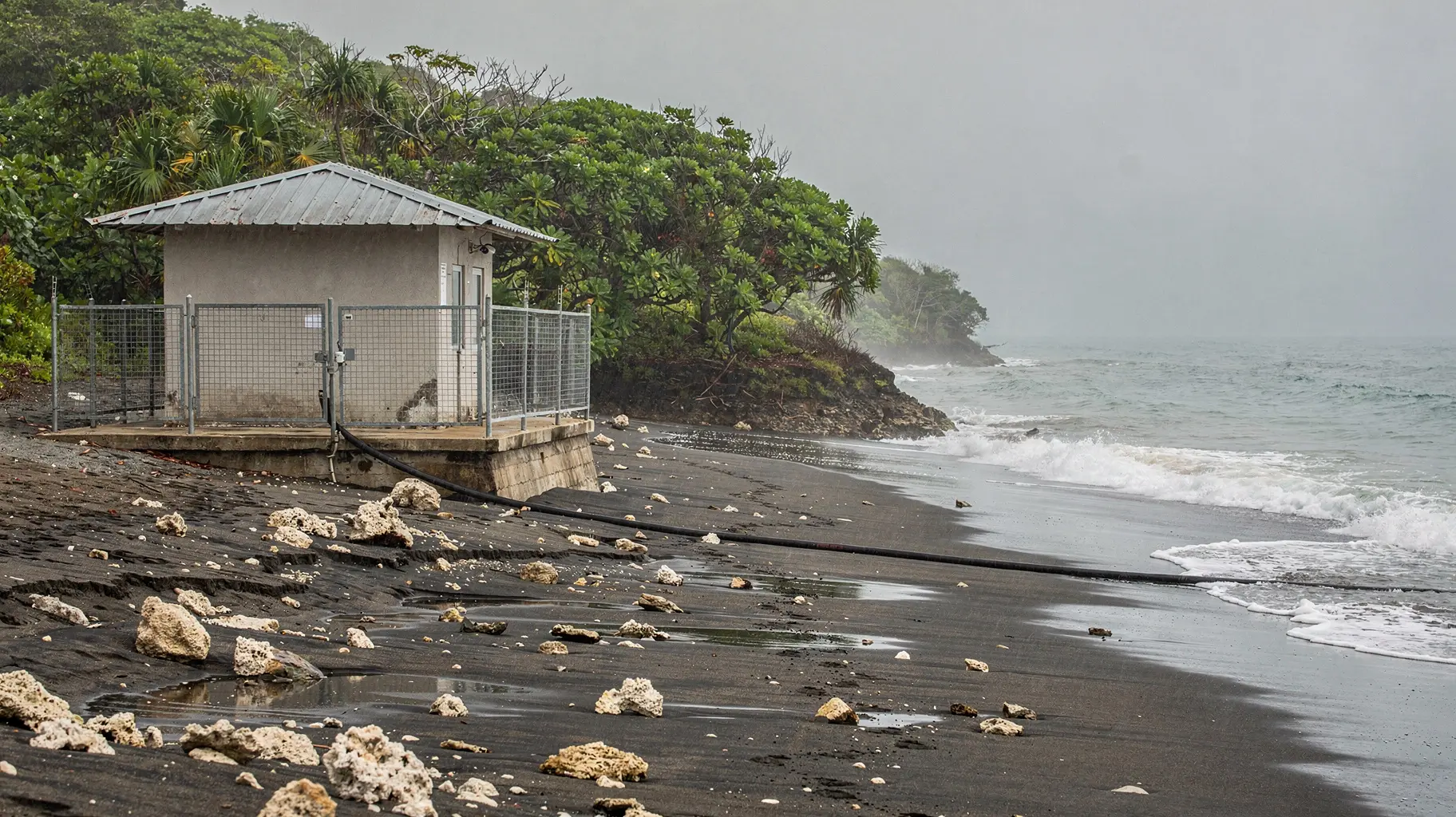
A second request in the same pass did load: the Australian Infrastructure Financing Facility for the Pacific portal. It references the project and even credits an image of the Honiara landing. It does not carry the historical project documents that would name the shareholders or describe the operating arrangement. An image credit is a caption, not a shareholding.
A build contract is not an access instrument
The fifth search returned a report recording that "The Vocus Group has signed a contract with Alcatel Submarine Networks to build a 4000-kilometre subsea cable linking the Solomon Islands, Papua New Guinea and Australia" — the construction report is here.
Four thousand kilometres across three countries is a real, checkable fact about a build. It tells you who was contracted to lay the system. It says nothing about who holds the asset after acceptance, who runs the landing, or on what terms capacity is sold. A construction contract is the wrong instrument for the question, and treating it as evidence of ownership is the most common way this question gets answered wrongly.
Four layers, two of them undocumented
Separate the question into four layers and the asymmetry becomes visible.
Ownership and asset holding. Settled by a share register, a shareholder or joint-venture agreement, or a filed company record naming the holder. Retrieved: none. Nearest retained text: the news sentence above.
Operating arrangement and legal form. Settled by a management or operating agreement, a licence naming the operating entity, or the operator's own published report. Retrieved: none. Nearest retained text: the same news sentence.
Access terms. Settled by a published tariff, a reference offer stating capacity units and term, or an executed supply agreement. Retrieved: none.
National regulatory obligation. Settled by a licence condition, an access determination, a price-control decision or a universal-service instrument issued by the national regulator. Retrieved: none.
Two layers have a sentence behind them. Two layers have nothing behind them in this window at all. That gap — not the cable, not the financing — is the finding.
What would overturn this
Stated before the conclusion, so it can be checked. A published reference offer or tariff naming capacity units, term and price would settle the access layer and retire that part of this finding. An executed capacity or landing agreement would show terms exist in contract rather than in marketing. A regulator determination or licence condition would settle the regulatory layer. A share register or filed accounts would settle ownership and legal form. Any one of these, read as text, would make the corresponding part of this briefing wrong, and should be reported as such.
What the directory record itself shows
The company's directory entry is thinner than its confidence score suggests. Its stored legal name is visibly truncated mid-word, ending in "administra" — a defect in the field, not the company's registered name, and one I will not guess at. The entry asserts a private-company legal type, a Solomon Islands headquarters and jurisdiction, and records no website, no domain, no leadership contacts and no parent or subsidiary relationships. It carries an explicit note asking for verification of exactly those things: legal-entity country, current services, visible assets, ownership links and contacts.
Because the private-company assertion rests on the registry link that did not resolve, this briefing does not present the company's legal form as established. It reports that the record asserts a type and that the cited support for it was unreadable on 18 October 2026.
The asymmetry, and why it matters
An earlier BTW briefing covered the second cable as a financing and redundancy question. This one asks a narrower and less comfortable question: what document would let a reader say who may use the existing landing, and does the record contain it?
It does not, in this window. That is a modest claim, and it is deliberately modest. But it is enough to change how the next argument should be run. Anyone asserting that this landing is closed, open, monopolised or competitive is asserting something about an instrument — a tariff, a reference offer, a licence condition, a determination — and should be asked to produce it, name its layer and date it. Where that instrument cannot be produced, the honest description is neither "closed" nor "open". It is undocumented, which is a different problem and calls for a different remedy.
Member Briefing
Deeper Profile Context
Sign in with the right membership level to unlock the full briefing and source notes.
Only for Strategic Circle
Strategic Circle
Open to all readers. Unlock profile briefings after joining and signing in.
Join Strategic CircleOnly for Leadership Alliance
Leadership Alliance
For qualified IP-asset owners and management; sign in to unlock alliance briefings.
Join Leadership Alliance