
Summary
- Siemens is combining a strategic investment in Skeleton Technologies with exclusive global rights to sell Skeleton products in the data-centre market. That is a route-to-market position, not a disclosed acquisition of the company.
- The commercial case rests on whether short-duration power buffering improves measured site economics. Public materials do not disclose the final ownership percentage, exclusivity term, a named customer deployment or independently validated performance.
The most consequential part of Siemens’ Skeleton announcement is not the valuation headline. It is the pairing of capital with distribution. Siemens says it is investing strategically in the Estonian energy-storage company and will have exclusive global rights to sell Skeleton products to data-centre customers. The rights add a new channel to a relationship that Siemens says began in technology work in 2022 and investment in 2023.
That structure gives each side something the other lacks. Skeleton brings high-power supercapacitor systems and a planned expansion of US manufacturing and research. Siemens brings a broad electrical-infrastructure portfolio and customer access across data-centre projects. The combination could shorten the path from product development to specification in a market where electrical equipment, grid capacity and construction schedules increasingly constrain AI deployments.
But an exclusive channel is not the same as proven demand. Siemens says it serves nine of the ten largest data-centre providers; that is Siemens’ description of its existing customer relationships, not evidence that any of them has ordered Skeleton systems. The announcement does not name a customer installation, show contract volumes or disclose the duration and conditions of exclusivity. It does not establish how much of the new investment Siemens owns or what governance rights accompany it.
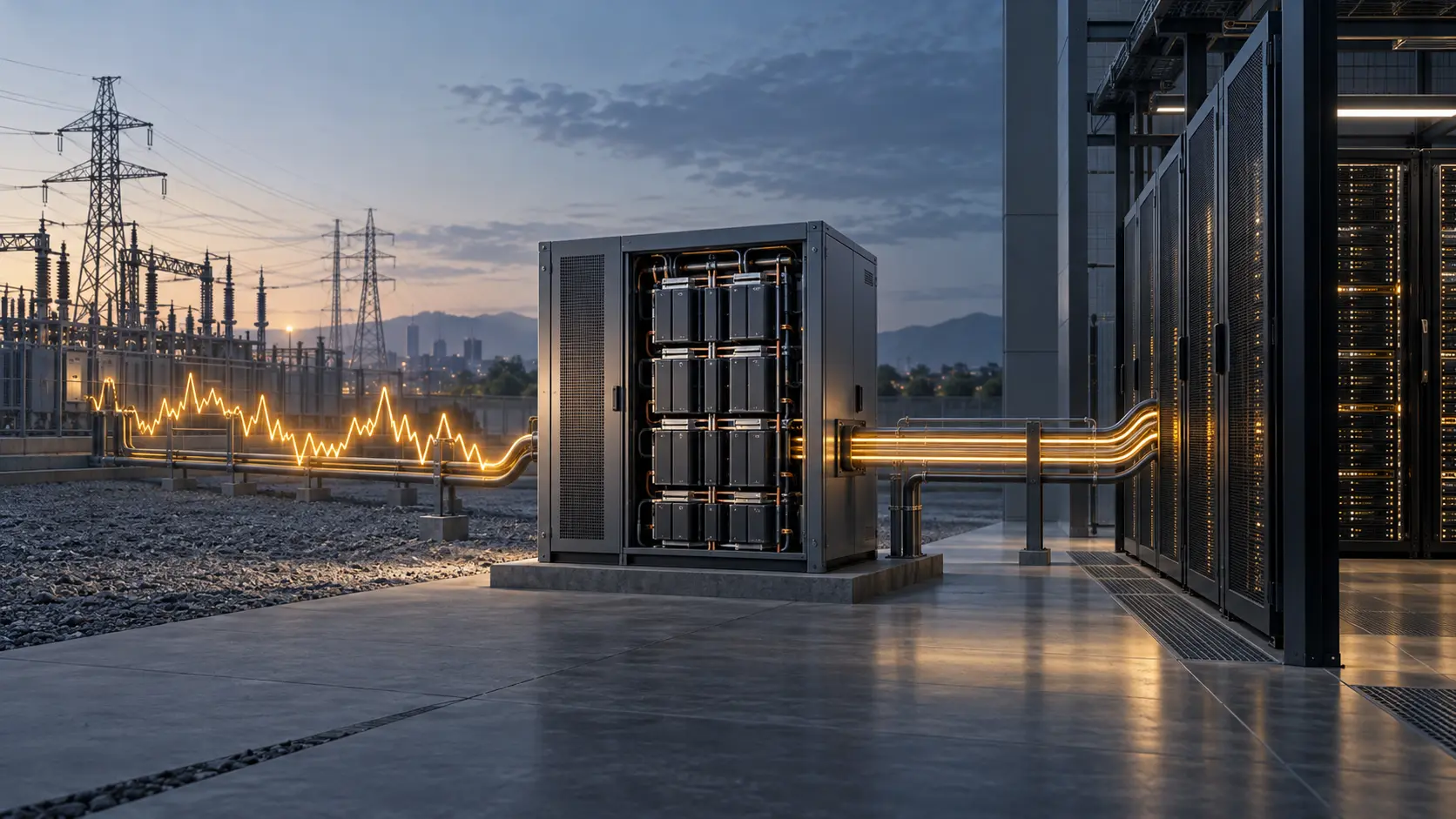
The distinction matters because Skeleton describes a fast-response power product, not a new source of electricity. Siemens presents the systems as an electrical “shock absorber” for rapid load swings from AI workloads. Buffering can, in principle, soften a short-duration demand profile and reduce some peak stresses. It cannot by itself generate the energy consumed over hours, secure a grid connection or remove the need for upstream capacity. That boundary is an analytical one; neither company has published independent site data that quantifies the effect.
The International Energy Agency’s 2026 outlook helps explain why the channel is attractive. It projects data-centre electricity use rising from 485 terawatt-hours in 2025 to 950 TWh in 2030, with AI-focused facilities accounting for the faster growth. The IEA also describes large and rapid power swings from AI training and use. Those trends create a market for flexibility equipment, but they do not validate one supplier’s savings claim. The IEA says data-centre load can also be uncertain as facilities fill progressively, and that grid connections and new generation remain system-level constraints.
Skeleton says the financing is a nine-figure round led by Siemens, values the company above $1 billion and supports more than $200 million of planned US operating scale-up and Silicon Valley research. Bloomberg Law reports that the investment exceeded $100 million and had closed in October, attributing the amount to Skeleton. Siemens’ own release says the transactions will complete after customary formalities. The public record does not explain whether the statements refer to different closing steps, so the discrepancy should remain open rather than be reconciled by assumption.
A same-day disclosure from existing shareholder AS Harju Elekter adds a separate transaction to the picture. Harju said it accepted Siemens International Holding B.V.’s offer to buy part of its Skeleton holding for €5.7 million, with completion expected during 2026. Harju described this as a partial sale and said it would remain a shareholder. The notice does not say that the €5.7 million is part of the primary financing, and it should not be combined with the reported round size.
The market question is therefore narrower and more testable than whether AI data centres need more power. It is whether Siemens can use its customer relationships and equipment portfolio to convert Skeleton’s technology into repeat deployments, while Skeleton scales manufacturing without losing product performance or delivery reliability. Evidence would include named installations, measured peak reduction against a stated baseline, response duration, system availability, total installed cost and the effect on customer capacity or utility charges.
Skeleton’s claims of up to 40% energy savings and double-digit GPU performance improvements remain company claims; the cited materials do not supply independent trials, denominators or customer samples.
For now, the announcement signals a vertical go-to-market bet: Siemens adds an exclusive product route to its infrastructure offer, while Skeleton gains capital and a large industrial sales partner. The bet can be strategically valuable before the technology becomes a standard component. Its investment case, however, will depend on contracted deployments and measured economics, not on the size of the addressable AI-power market alone.
Sources
Member Briefing
Deeper Profile Context
Sign in with the right membership level to unlock the full briefing and source notes.
Only for Strategic Circle
Strategic Circle
Open to all readers. Unlock profile briefings after joining and signing in.
Join Strategic CircleOnly for Leadership Alliance
Leadership Alliance
For qualified IP-asset owners and management; sign in to unlock alliance briefings.
Join Leadership Alliance