Summary
- The transfer statistics page states that, per section 4.0 of the RIPE Resource Transfer Policies, the RIPE NCC publishes a list of all Internet number resources transferred under the policy, split into within-region and inter-RIR lists for IPv4, IPv6 and ASNs.
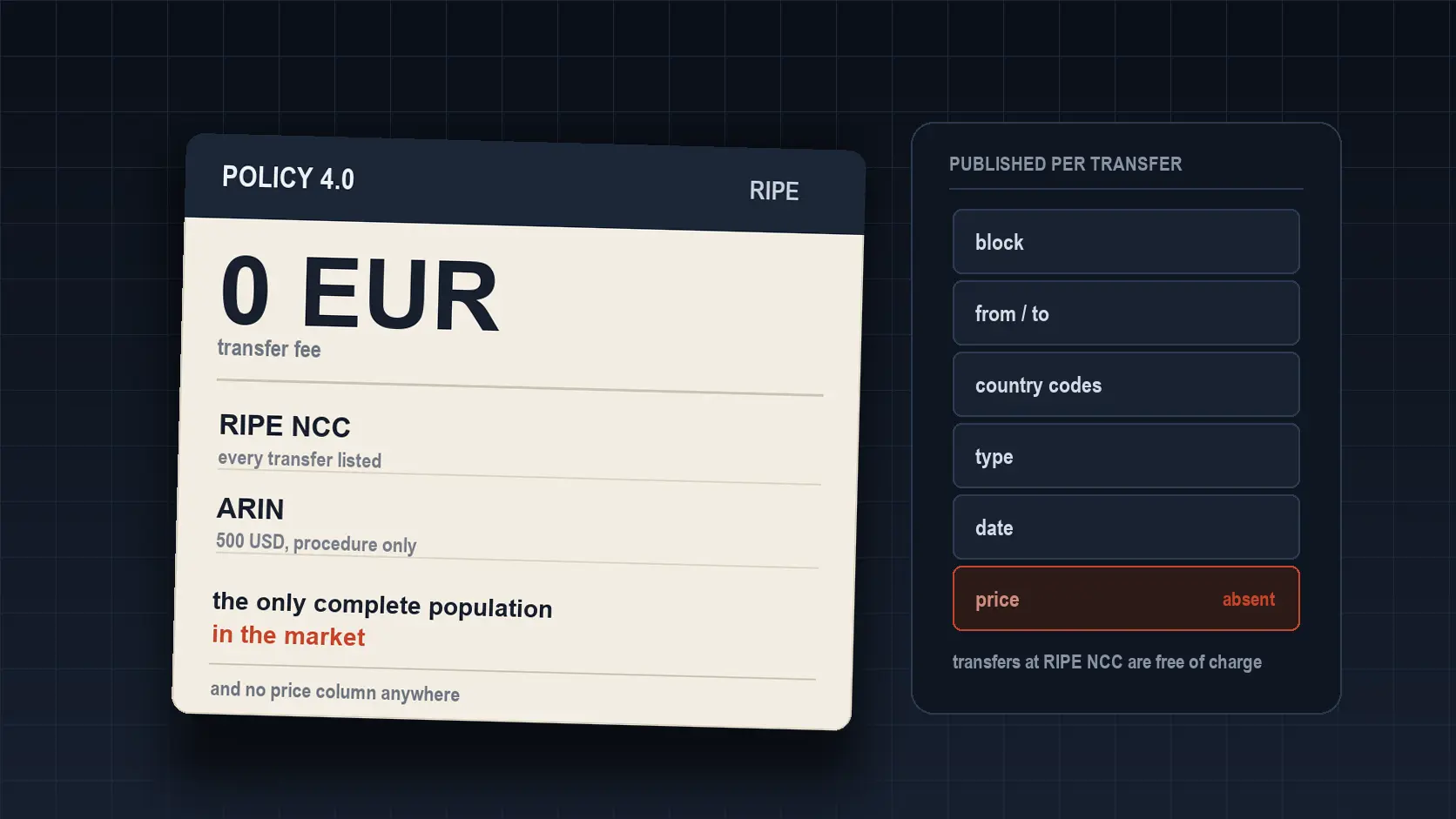
- Each entry carries the original block, the transferred blocks, the transferring and receiving party names, both country codes as recorded at processing time under ISO 3166, the transfer type — policy transfer or business-structure change such as a merger or acquisition — and the date. The registry also states that all resource transfers are free of charge.
A compliance obligation that happens to be a market dataset
Nobody designed the IPv4 trade tape as a product. It exists because a policy paragraph requires publication, and the registry that must publish it also happens to process every transaction. That accident produces a record no commercial data vendor can assemble: the full population, not a sample, updated by staff, with a JSON download for the PA and PI lists.
For anyone modelling the secondary market, the practical consequence is that the denominator is public. You can count transfers rather than estimate them, and you can count them by resource type, by direction and by month, without asking a broker.
The country codes are the part nobody uses
The most valuable columns are the two-letter ones. Each entry records the country where the transferring organisation was legally registered at the time the transfer was processed, and the same for the recipient, with ISO 3166 named as the reference. That makes it possible to describe where address space is moving between countries rather than asserting it.
The tape therefore answers a question the market argues about constantly and rarely measures: is European space leaving Europe, and if so to where? The registry publishes the raw material and sells nothing.
Two transfer types, one honest distinction
The transfer type column distinguishes transfers under the resource transfer policies from transfers due to changes in an organisation's business structure, such as a merger or acquisition. That is the only published split between trade and consolidation, and it matters: a merger transfer is an asset following a company, while a policy transfer is a market transaction. Mixing them makes the market look busier than it is.
What the tape does not carry
There is no price. The register records quantity, parties, direction, type and date, and never consideration. So the industry's best public dataset is silent on the single number every participant argues about, and the price of a /22 must still be inferred from private conversations, hearsay and the occasional disclosure.
That gap is structural rather than lazy. A registry sets policy, not value, and the transfer policies govern holdership. The market therefore runs on a tape that measures everything except the thing it is a market for.
The comparison that is uncomfortable
RIPE NCC states that all resource transfers are free of charge. ARIN charges a $500 non-refundable processing fee for a source transfer request before evaluation in its 2027 schedule, plus a recipient processing fee after approval, and its transfer page publishes rules, requirements, fees and a facilitator programme — but no per-transfer list and no JSON feed.
So the registry that takes no money for a transfer publishes every transfer, and the registry that takes money for one publishes the procedure. That is not an argument about which is better. It is an argument about what a fee buys.
Sources
Member Briefing
Read the full trend briefing
Members read the full briefing with the source notes behind every finding.
Strategic Circle
A daily briefing in your language, built from changes we have verified.
Join for USD 20/monthCancel anytime.
Members also get the full research library, a daily briefing on the networks they follow and the private forum.