Summary
- Policy proposal 2026-01, in its concluding phase with a last call ending 10 December 2026, aims to remove the needs assessment for the first AS number requested by holders of an address prefix allocated or assigned directly by RIPE NCC.
- The 2027 charging scheme takes the opposite approach to every other ASN: the first assignment on an account is inside the €1,894 annual fee, and each additional ASN costs €50 a year. The registry is making identity free to enter and rented to repeat.
Two doors, one price list
| Object | 2026 | 2027 |
|---|---|---|
| LIR account, annual | €1,800 | €1,894 |
| First ASN on the account | included | included |
| Each additional ASN | €50 | €50 |
| Independent resource assignment | €75 | €75 |
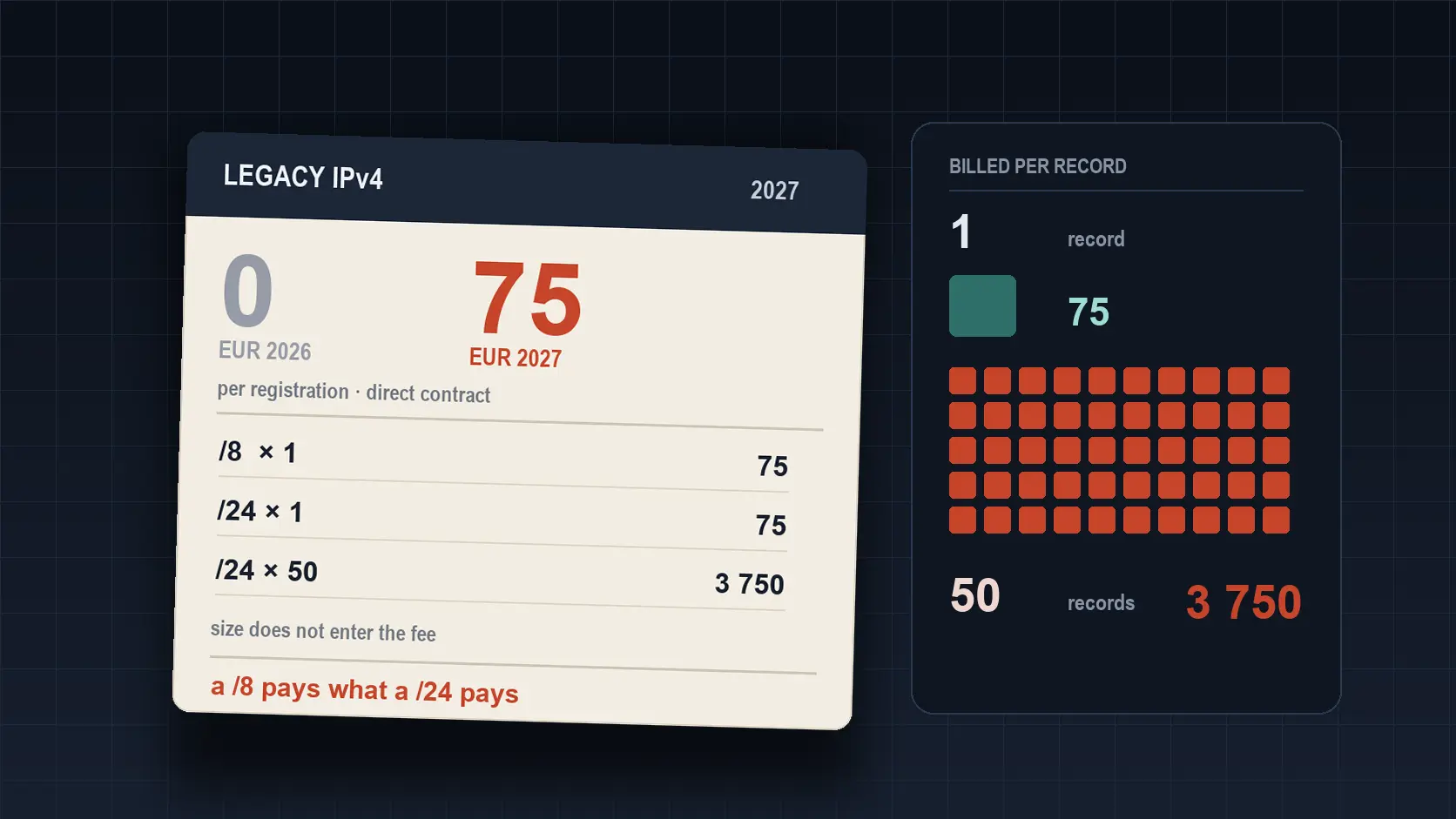
| Legacy IPv4, direct contract | €0 | €75 |
| Sign-up, new account | €1,000 | €1,000 |
The table is the published RIPE-867 comparison. The proposal above it touches no number in that table. What it changes is the evidence a first ASN has to bring.
What the proposal actually removes
The needs assessment for a first AS number exists because an ASN is a routing claim: two networks with the same policy do not need two numbers, and the registry has historically asked a holder to show multihoming or a distinct routing policy before handing one out. Proposal 2026-01 keeps that structure and drops the question for one case — the first ASN of somebody who already holds a prefix from RIPE NCC directly. The prefix is the evidence; a holder with registered space has already demonstrated operational existence.
RIPE NCC's November update records the state precisely: the proposal advanced to the concluding phase, and the last call for new objections allows comments on the Address Policy Working Group mailing list before 10 December 2026. A concluding phase is not adoption. Comments can still reopen a clause, the chairs can still send it back, and implementation needs its own step. Anyone pricing this year's decisions should treat 10 December as a deadline for input, not a launch date.
Why the second ASN is now the expensive object
Read the two documents together and the cost curve inside routing identity appears. Entering costs €1,894 a year and, from the proposal, no justification beyond the prefix. Adding one more identity costs €50 a year and still requires a need. Per object, the second ASN is therefore the most expensive thing the region issues: it is 2.6 percent of the account fee but it carries the only surviving test.
That shape favours consolidation. A group with five ASNs on one account pays €1,894 plus four times €50, which is €2,094, and finds it cheaper to keep every policy inside one number and one set of sessions than to pay for separations it has to justify anyway. The other route to a fresh unjustified ASN is a second LIR account at €1,894 plus a €1,000 sign-up — and the board restricted the acquisition of additional accounts on 29 September 2026, so that door is not free either.
The bill for identity after ten years of cheap numbers
ASNs have been effectively free in the RIPE region for most of their history. Networks accumulated them the way organisations accumulate domains: one per site, one per acquisition, one for the experimental peering session that nobody dares to turn off. From January, each of those historical decisions becomes a recurring line on a bill that a finance department can read, and the only defence is a return, a transfer, or a consolidation that requires a policy argument.
That is a form of housekeeping the registry has wanted for years, achieved through billing rather than policy. It also settles an old argument about whether an ASN is an asset: an asset produces income, while a number that costs €50 a year to hold and cannot be sold produces expense. The rents will push holders to release numbers, which is the cleanest supply increase the ASN book has ever had.
What would change the reading
The proposal might fail at last call. The wording of eligibility might narrow to allocations only, or to prefixes of a minimum size, in which case the free first ASN reaches fewer holders. RIPE NCC might publish a count of accounts holding more than one ASN, which would turn the €50 sentence from an inference into a measured forecast. Any of those three would move the arithmetic and none of them is in the public files today.
Sources
Member Briefing
Read the full trend briefing
Members read the full briefing with the source notes behind every finding.
Strategic Circle
A daily briefing in your language, built from changes we have verified.
Join for USD 20/monthCancel anytime.
Members also get the full research library, a daily briefing on the networks they follow and the private forum.