Summary
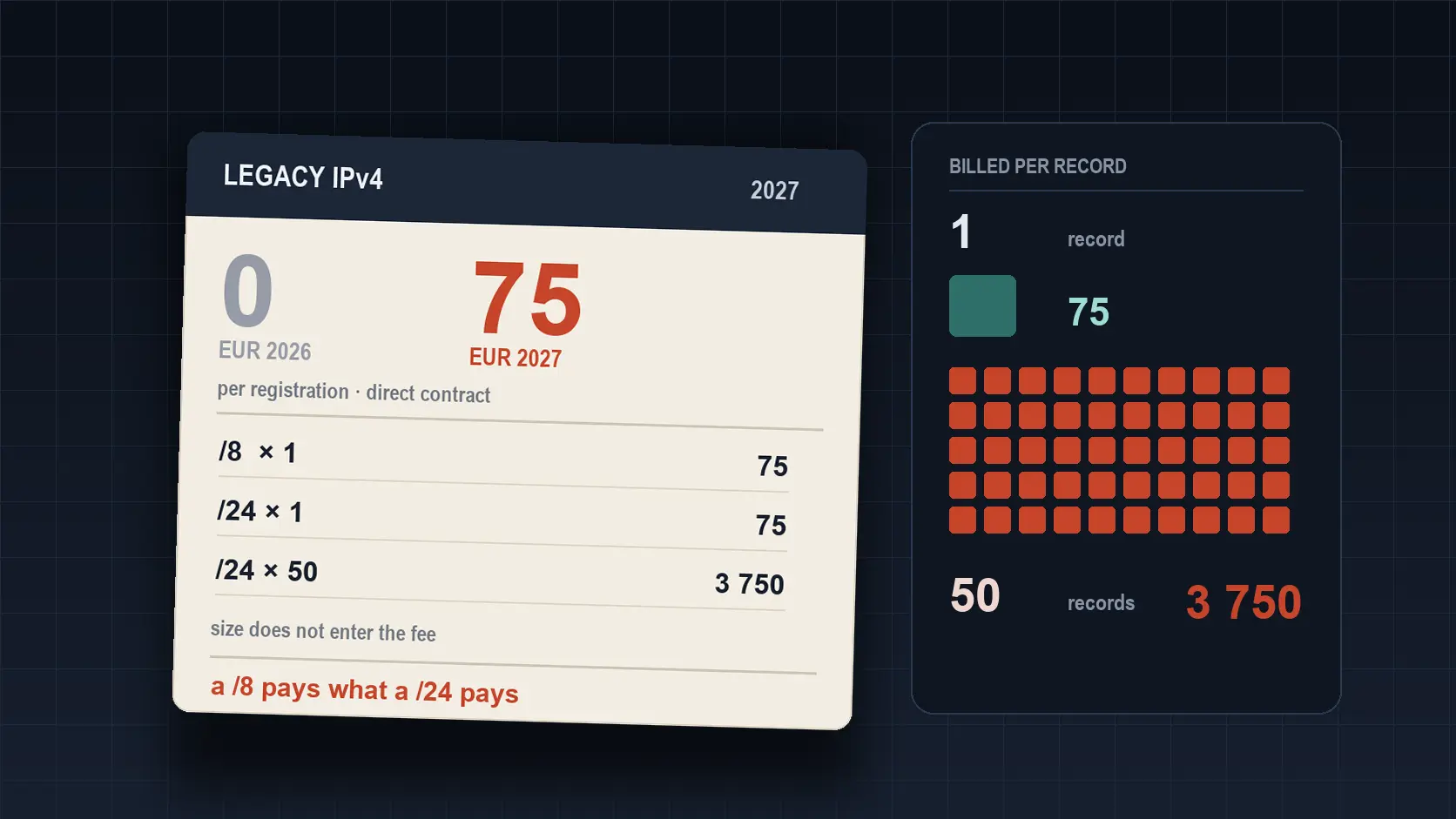
- RIPE-867 extends the EUR 75 legacy IPv4 registration fee to resources held under a direct contractual relationship with RIPE NCC, which paid EUR 0 for those registrations in 2026. Registrations through a sponsoring LIR already cost EUR 75.
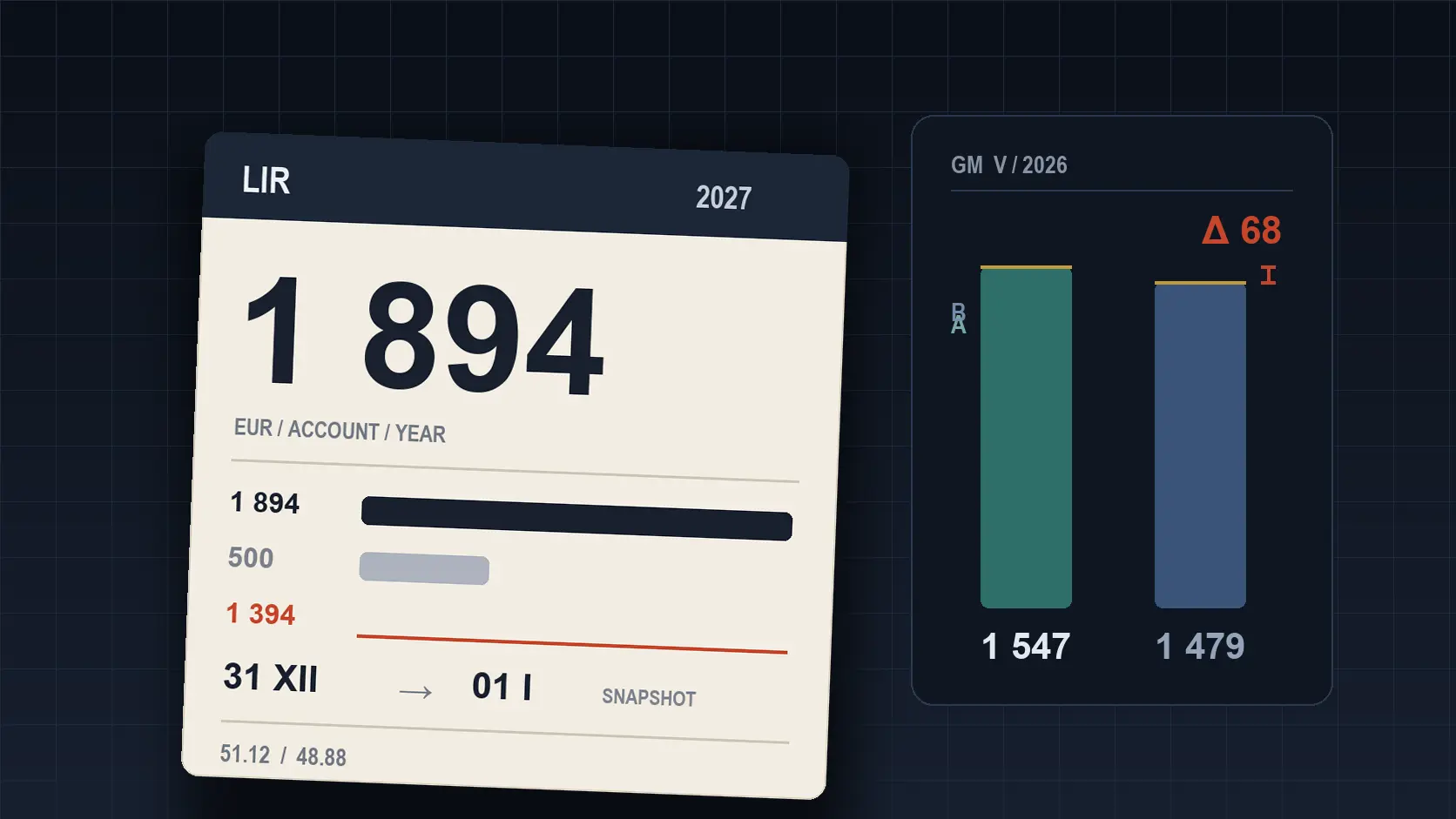
- The fee is per registration, not per address block, and it sits on top of the annual fee, which for a legacy holder with a direct agreement is identical to the LIR-level EUR 1,894. A holder's bill therefore follows the number of records it keeps, not the size of its space.
The first bill Europe's legacy space has ever had
Direct-contract legacy holders had an unusual position in the 2026 scheme: they were billed like a member on the annual contribution, and their registered legacy IPv4 cost nothing. From 1 January 2027 the second half of that disappears. Each legacy IPv4 registration based on a direct contract costs EUR 75.
The comparison table in the scheme states the change with no commentary. EUR 0 per Legacy IPv4 resource registration based on direct contract with the RIPE NCC in 2026; EUR 75 in 2027. The annual contribution moves from EUR 1,800 to EUR 1,894 in the same table, and the sign-up fee stays at EUR 1,000. Legacy holders concluding a separate direct agreement pay no sign-up fee, and a legacy holder that joins as a member without requesting new resources also escapes it — until it requests additional registered resources, at which point the sign-up fee applies.
The unit is the record
Read the unit carefully, because it decides the amount. The fee is per registration of a legacy IPv4 resource, and the document prices registrations, not prefixes. Two holders with identical space can therefore be billed different amounts depending on how that space is recorded: one registration of one block costs EUR 75, and fifty registrations cost EUR 3,750. The size of the block does not enter the calculation.
For an address market that has spent a decade arguing about the price of a /24, this is a pricing basis nobody in it uses. Blocks are valued by size and scarcity; the registry's new legacy line is valued by paperwork. Two neighbours on the same street can pay the same annual contribution and different legacy fees, and the difference is record hygiene rather than holdings.
The incentive arrives before the invoice
The consequence is a reason to tidy up. A holder with forty legacy registrations covering the same footprint as a holder with four has ten times the fee, and consolidation of registration objects becomes a cash decision in a way it never was at EUR 0. Whether RIPE NCC will accept the merges a holder wants, and on what evidence, is the operational question the fee creates and the scheme does not answer.
There is a second-order effect worth naming. Any legacy holder that has kept registrations split across entities, contact handles and years now has a document that prices the mess. Every year the fee is charged, the cost of not having merged earlier is visible on an invoice, which is a more effective registry tool than any data-quality campaign.
What the change is not
It is not a charge on IPv4 size, and it does not touch the annual contribution arithmetic that the membership voted on in May 2026. It is also not a licence to lose title: a legacy registration is the record of a right, and the fee is for keeping the record, not for the address inside it. A holder that lets registrations lapse to save EUR 75 per record is trading a database entry against a claim, and the registry has never promised that the claim survives the entry.
Sources
Member Briefing
Read the full trend briefing
Members read the full briefing with the source notes behind every finding.
Strategic Circle
A daily briefing in your language, built from changes we have verified.
Join for USD 20/monthCancel anytime.
Members also get the full research library, a daily briefing on the networks they follow and the private forum.