Summary
- Each registry's delegation file opens with three summary lines counting its IPv4, ASN and IPv6 records. On 26 November 2026 they total 271,676 IPv4 records, 117,831 ASN records and 387,070 IPv6 records, so IPv6 holds 42.5% more objects than IPv4 and 3.3 times the ASN book.
- IPv6 is the largest of the three books in every registry, and the ASN book is the smallest in every registry. RIPE NCC's 2027 scheme now puts a recurring price on the margin of the small books — €50 per additional ASN, €75 per legacy IPv4 registration — while the account fee, not the object count, carries IPv6.
Five books, published as headers
Every RIR publishes a delegation file in a fixed text format. The header carries a version line and then three summary rows, one per resource type, each counting the records that follow. The counts below are those headers, reproduced; in all five files the three summaries add up exactly to the total on the version line.
| Registry | IPv4 records | ASN records | IPv6 records | File total |
|---|---|---|---|---|
| RIPE NCC | 101,347 | 48,687 | 111,396 | 261,430 |
| ARIN | 81,440 | 33,267 | 90,897 | 205,604 |
| APNIC | 61,898 | 14,893 | 114,904 | 191,695 |
| LACNIC | 20,848 | 16,634 | 60,356 | 97,838 |
| AFRINIC | 6,143 | 4,350 | 9,517 | 20,010 |
A record is an object, not an address. A /8 allocation and a /24 assignment both occupy one row, which is why this census measures the registry's paperwork rather than the size of the internet. It is still the most honest map of what the registry system actually maintains, sells, audits and now bills.
IPv6 became the volume business
In all five registries the IPv6 book is larger than the IPv4 book. Across the five, IPv6 records outnumber IPv4 records by 115,394, and the IPv4 book — the one with a waiting list, a transfer market and a second-hand price — is the middle-sized book everywhere.
The reason is arithmetic rather than enthusiasm. IPv4 was handed out in bigger, fewer blocks during an era of abundance; IPv6 has been handed out in /32 and /29 allocations to far more holders, and a single operator can appear many times. Object counts therefore measure how finely a registry sliced its space, not how much of it runs traffic.
APNIC is the extreme case. It holds the largest IPv6 book of the five, 114,904 records, and only 14,893 ASN records: 7.7 IPv6 objects for every routing identity in the file. LACNIC sits at the other end, with 20,848 IPv4 records against 16,634 ASNs, which is 1.3 IPv4 objects per network identity. The Asia-Pacific book says few networks, many blocks. The Latin American book says many networks, few blocks each.
That difference matters for anyone pricing a transfer. Depth in a market comes from the size distribution of the objects for sale, not from the number of records a registry keeps. Twenty thousand small IPv4 records in LACNIC describe a market of small sellers; sixty thousand IPv4 records inside APNIC's much larger space describe fewer, bigger holders and lumpier deals.
The ASN book is the gate, and it is now metered
Every network needs one ASN. Nothing else in the system is that universal, and nothing else is that small: 117,831 records across five registries, less than a third of the IPv6 book and 43% of the IPv4 book.
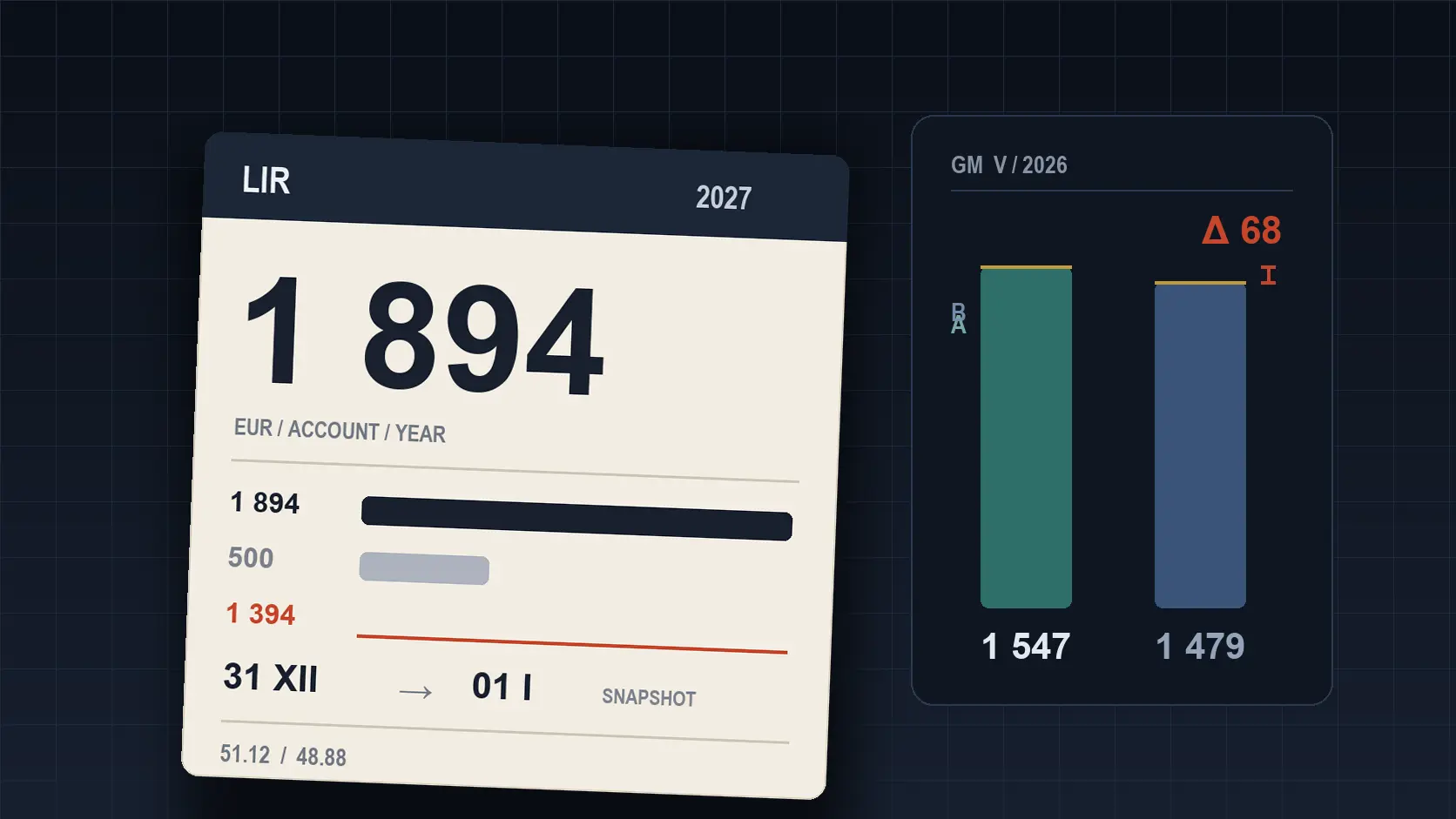
RIPE NCC's published 2027 charging scheme treats that asymmetry as a revenue design. The annual contribution is €1,894 per LIR account and includes the first ASN assignment on that account; every additional ASN costs €50 a year. Legacy IPv4 registrations held under a direct contract stop being free and pay €75 each. The sign-up fee for a new account stays at €1,000. Nothing in the schedule prices an IPv6 allocation as an object: it travels with the account.
So the smallest books are where a marginal euro is collected, and the biggest book is where volume accumulates for free. Read the five header lines together and the exposure is visible: 387,070 IPv6 objects sit outside per-object charging today. If any registry ever extended per-object pricing to IPv6, the invoice base would be three times the ASN book and 1.4 times the IPv4 book, before a single byte moved.
What the census cannot say
These are published record counts. They include historical and legacy rows, they identify no holder, RIPE NCC and AFRINIC publish format version 2 while ARIN, APNIC and LACNIC publish 2.3, and none of the numbers says whether a prefix is announced, routed, used or forgotten. A registry with many IPv6 records has sliced its space finely; whether a single customer uses it is not in the file.
Sources
Member Briefing
Read the full trend briefing
Members read the full briefing with the source notes behind every finding.
Strategic Circle
A daily briefing in your language, built from changes we have verified.
Join for USD 20/monthCancel anytime.
Members also get the full research library, a daily briefing on the networks they follow and the private forum.