Summary
- In May 2026 RIPE NCC members chose between one flat annual fee per LIR account of EUR 1,894 and a 21-category model whose base fee was EUR 500 and whose largest holder paid over EUR 30,000. The Executive Board recommended the category model and said almost 75% of LIR accounts would pay less under it.
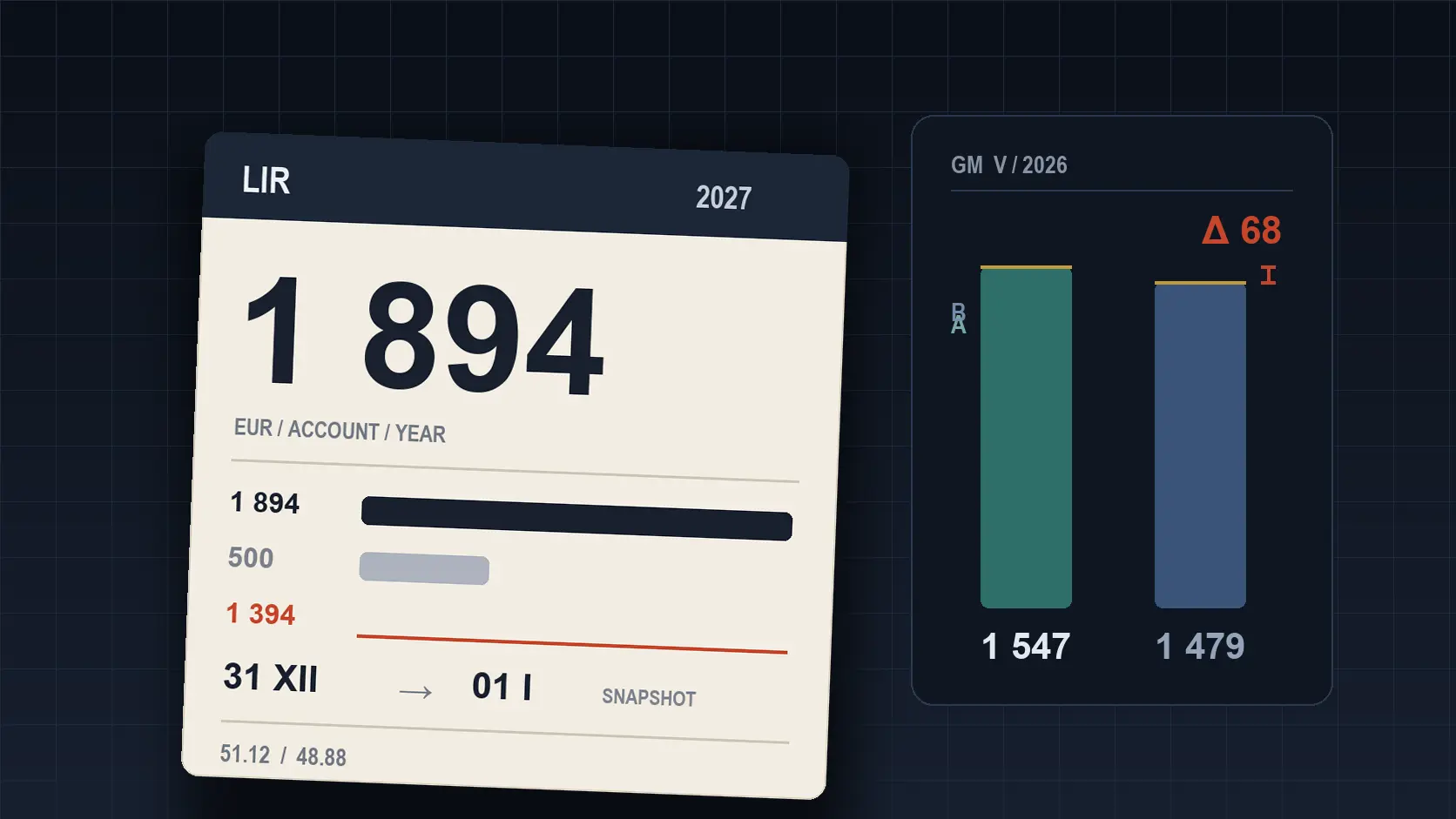
- The flat model won 1,547 to 1,479, a margin of 68 votes, with 23 abstentions. From January 2027 a base-category LIR account pays EUR 1,394 a year more than the rejected model would have charged it, and the largest IPv4 holder pays over EUR 28,000 a year less.
The bill is set on 31 December, not in January
The Charging Scheme 2027, published as RIPE-867 on 11 September 2026, keeps the "one LIR account, one fee" model. The annual contribution rises from EUR 1,800 to EUR 1,894 per LIR account, a 5.2% increase. The sign-up fee stays at EUR 1,000. Fees per account are determined from data gathered on 31 December 2026, and invoices go out in January 2027.
Everything else in the document is a price list for things that are not the account. The first ASN assignment registered to an LIR account is now inside the annual fee; each additional ASN costs EUR 50. An independent assignment — PI space, anycast, IXP — costs EUR 75. Legacy IPv4 held through a sponsoring LIR still costs EUR 75 per registration. Legacy IPv4 held under a direct contractual relationship with the RIPE NCC cost EUR 0 in 2026 and costs EUR 75 from 2027. A legacy holder that signs a separate direct agreement pays the LIR-level fee itself, EUR 1,894, without the EUR 1,000 sign-up charge.
Two models, one unit
The charging scheme options announced for the May 2026 General Meeting set the choice out without decoration. Both models were built to the same EUR 42.5 million income budget, using 3.3% Dutch inflation on the 2026 budget, a flat staff headcount, 3% personnel cost growth, a 1.5% overall cost-reduction commitment, and an assumption of 20,000 active LIR accounts. The sign-up fee and every separate charge were identical in both. Only the annual fee differed.
Model A charged the same amount to everyone: EUR 1,894. Model B sorted accounts into 21 categories by the IPv4 and IPv6 PA resources they hold, included a /29 of IPv6 PA in the base, and set a base fee of EUR 500 for accounts with no PA IPv4 or a /29 or less of IPv6 PA. The largest resource holder would pay over EUR 30,000. RIPE NCC described that top figure as a threefold increase over the category model it had published during consultation, and said almost 75% of LIR accounts would pay less than they do now.
The Board recommended Model B. It described Model A as continuing "the principle of equality among members" and Model B as a change of direction in which three-quarters of accounts pay less and holders of more PA resources pay more.
The register voted for the unit that does not measure the resource
On 22 May 2026 the result was read into the General Meeting. Model A: 1,547 votes, 51.12%. Model B: 1,479 votes, 48.88%. Abstentions: 23. Model A was approved.
The scale of the poll makes the margin thinner than the percentage suggests. 3,421 members registered to vote and 3,049 cast ballots across three resolutions and a Board election; the charging-scheme decision turned on 68 ballots out of 3,026 that chose a model at all, with 23 abstaining. The Board's recommendation moved fewer votes than one large member's proxy block.
Here is what the two models cost, taken straight from the published numbers. A base-category account pays EUR 1,894 instead of EUR 500: EUR 1,394 a year. The largest holder pays EUR 1,894 instead of something above EUR 30,000: over EUR 28,106 a year. The 2027 invoice of a small LIR and the 2027 invoice of the operator with the biggest IPv4 registry holding differ by nothing at all. That is the point of the flat fee, and the membership voted for it by 51%.
The part nobody had to vote on
Both models carried the same EUR 94 increase, so the increase was never the question. The question was incidence. The vote decided who absorbs the growth: 20,000 assumed accounts at EUR 1,894 gives EUR 37.88 million of the EUR 42.5 million target, leaving EUR 4.62 million to be collected from sign-up fees, extra ASNs, independent assignments and the new legacy IPv4 charge. Under the flat model, a member that acquires more IPv4 pays the same annual fee as before; under the category model it would have moved up the ladder and paid for the space.
The published record gives the aggregate, not a per-fee-band tally. A breakdown by category would show whether the accounts facing EUR 1,394 more actually voted to pay it, or whether the result came from holders whose bill the category model would have raised. That single table is the missing fact; with it, the "three-quarters of members rejected their own discount" reading becomes testable instead of arithmetic on a total.
One quiet detail rides along with the ASN change: the bundling of the first ASN is a real reduction for a small operator, since a network that needs an ASN and little else now pays EUR 50 less for the second one and nothing extra for the first. It is also the only part of the scheme that charges for scarcity with any precision at all. The space itself, held inside an account, is still free at the margin.
Sources
Member Briefing
Read the full trend briefing
Members read the full briefing with the source notes behind every finding.
Strategic Circle
A daily briefing in your language, built from changes we have verified.
Join for USD 20/monthCancel anytime.
Members also get the full research library, a daily briefing on the networks they follow and the private forum.