Summary
- RIPE NCC's November 2026 member update puts ROA coverage at 78 percent of IPv4 space and 46 percent of IPv6 space, and counts 15,859 LIRs with IPv6 against 20,704 LIR accounts, which leaves 4,845 accounts without any IPv6, or 23.4 percent.
- Signing has cost nothing since 2011: the registry hosts the certificate authority for anyone who does not want to run one, and legacy holders can request certificates too. The 2027 fee schedule meters accounts, additional ASNs and legacy IPv4 registrations, and contains no charge for an IPv6 allocation or for a ROA.
Two fractions and one subtraction
| Measure | Value |
|---|---|
| LIR accounts | 20,704 |
| LIRs holding IPv6 | 15,859 |
| LIR accounts without IPv6 | 4,845 |
| Share of accounts without IPv6 | 23.4 percent |
| IPv4 space covered by ROAs | 78 percent |
| IPv6 space covered by ROAs | 46 percent |
The subtraction is arithmetic on two published counts, not a survey: an account without a separate IPv6 allocation may still reach IPv6 through transit, through provider-assigned space, or through a prefix obtained by transfer. The ROA figures are shares of address space, not shares of holders, so a single large IPv6 allocation without signatures can drag the regional number down without any small network behaving badly.
Even with those limits, the direction is hard to argue with. Whatever an operator's IPv4 prefix is worth on the transfer market, the ROA on it protects revenue. Whatever an IPv6 block is worth, it was free, and the signature on it protects somebody else's routing table.
Free since 2011, hosted for the asking
The RIPE NCC opened its Resource Certification system at the beginning of 2011. A holder requests a certificate listing the resources it has, and the certificate is verifiable proof of the registration; the practical use is BGP origin validation, where a route is checked against the signed authorisation instead of against an email address in a database.
The service deliberately removes the usual excuses. Operators choose between running their own certificate authority and letting the RIPE NCC host the CA. Sponsoring LIRs and End Users can request certificates for provider-independent assignments, and legacy holders can request certificates for legacy End User resources. Nobody in the region is excluded by status, by size or by the age of the registration. All five registries run such a system, so this is not a regional curiosity.
The invoice meters everything except validation
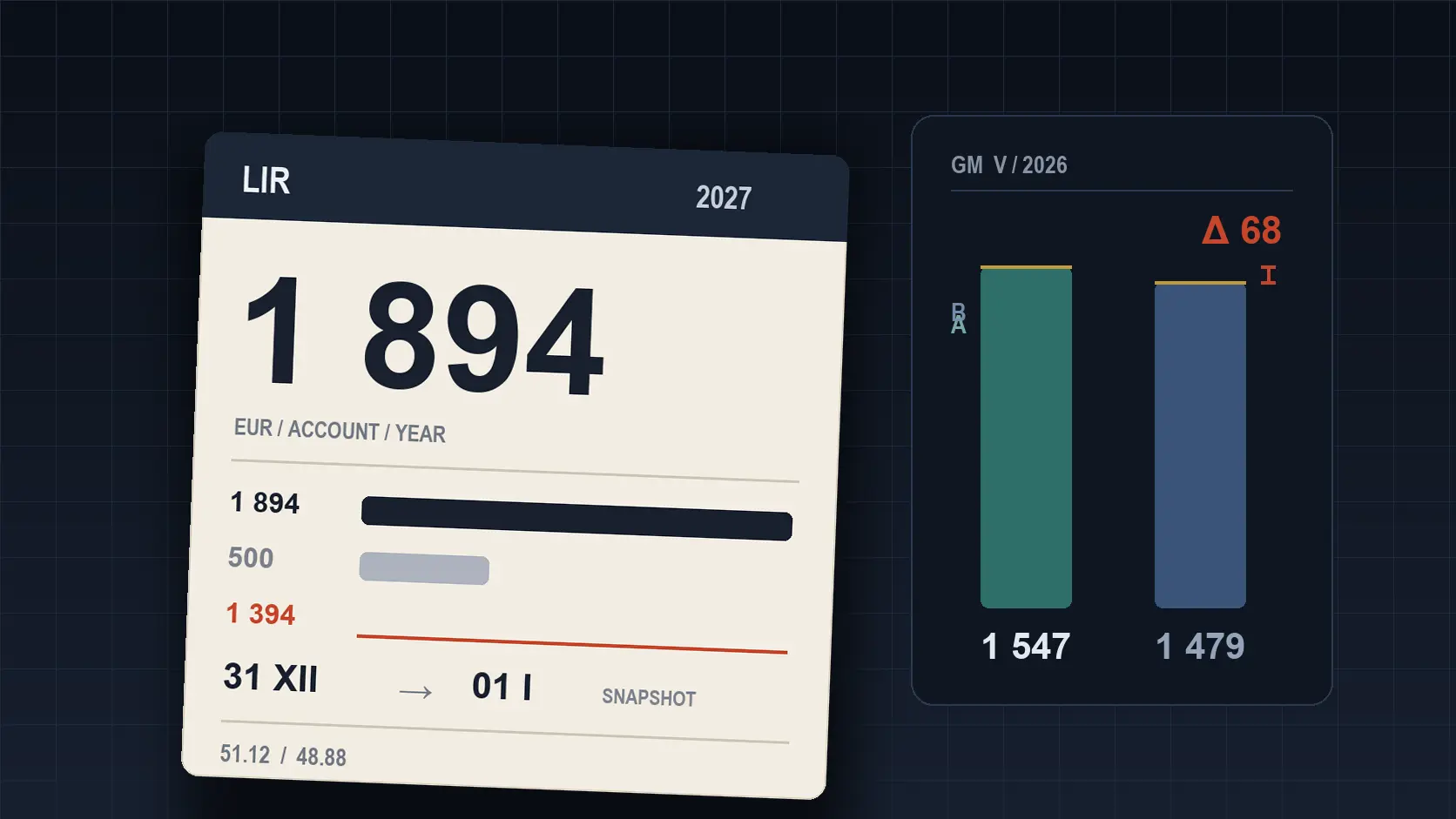
The 2027 charging scheme prices the account at €1,894, includes the first ASN assignment, charges €50 for each additional ASN, €75 for an independent resource assignment, and €75 for each legacy IPv4 registration held under a direct contract — a line that was €0 in 2026. The sign-up fee for a new account stays at €1,000.
Read the list against the coverage table and the incentive is plain. The registry charges for the objects that required paperwork and charges nothing for the act that makes a prefix trustworthy. An IPv6 allocation rides inside the account fee, and a ROA does not appear in the schedule at all. Nothing in the invoice pushes 46 percent upward; something in the market pushes 78 percent there instead.
What an unsigned half of IPv6 does to a buyer
Origin validation is only useful when the receiving side performs it. A transit provider or an internet exchange that drops invalid announcements protects the prefixes it validates, and those prefixes are overwhelmingly IPv4. The route a customer cares about in 2027 — a website, a voice service, a cloud endpoint — increasingly runs over IPv6, and a substantial share of the authorisations behind that space does not exist.
That changes the shape of due diligence. A prefix with a clean ROA record travels as a low-risk object; a prefix without one travels as an object whose reachability depends on the filters it encounters. The second is not unsellable. It is priced by the buyer's assumption about how much validation the other side performs, which is a polite way of saying that the discount is set by other people's habits.
What this snapshot cannot say
The update gives one date and no series, so nobody can see whether 46 percent is rising or falling. It has no breakdown by holder size, country or year of allocation, so the gap could sit in a handful of very large allocations. Coverage measures whether an authorisation exists, not whether any network acts on it, and it says nothing about traffic or deployment quality. The 245 assisted registry checks completed in October measure checks, not failures, so they do not tell you how much space leaves the registry each month.
Sources
Member Briefing
Read the full trend briefing
Members read the full briefing with the source notes behind every finding.
Strategic Circle
A daily briefing in your language, built from changes we have verified.
Join for USD 20/monthCancel anytime.
Members also get the full research library, a daily briefing on the networks they follow and the private forum.